On September 29, 1946 (eighty years ago today, a coincidence I noticed only after choosing this subject), the BBC launched a radio service called the Third Programme. The man most responsible for it, Director General William Haley, had a specific idea about the audience he was after. Not everyone. Not most people. People who did not need to be protected from their own intelligence.
The Third Programme broadcast symphonies. Philosophy lectures. Poetry readings. A production of Sophocles performed in the original Greek. It made no apologies for these choices and offered no simplified alternatives for those who found them difficult. Its audience was small and, by most accounts, fiercely devoted. The other ninety-seven percent of BBC listeners changed the station to dance music, which was entirely reasonable.
What strikes me about this, eighty years later, is how precisely Haley had identified something that is true about a subset of every population at every moment in history: the people who are willing to sit with a complicated idea for a long time, not because they have nothing better to do, but because they have finally reached the point in their lives where they can do exactly what they want, and this is what they want.
That subset has always existed. For most of history, it had nowhere to go.
The podcast is not a new technology. It is an old technology with a distribution problem solved.
Haley’s Third Programme audience could only listen when the program aired. They had to plan around a schedule. What the podcast solved, seven decades later, was the tyranny of the channel and the clock. You listen when you walk. When you drive. When you stand in the kitchen for forty minutes turning chicken thighs and can’t watch anything and won’t read because your hands are occupied and the light is wrong anyway. The podcast fills exactly those hours, and if you have reached the point in your life where you have accumulated a significant number of such hours (the morning walk, the afternoon errand run, the Tuesday kitchen hour), the question of what you’re actually listening to has become worth thinking about seriously.
I have been listening to podcasts for about twelve years. I am not comprehensive in my knowledge of them; no one is, because there are too many. What I know is what I keep returning to, what I’ve recommended to people who then reported back that they were glad I did, and what I’ve tried and abandoned because the format or the ambition wasn’t honest enough to justify the time. The eight programs below have all passed those tests repeatedly.
In Our Time, BBC Radio 4. Melvyn Bragg conducted this program from 1998 until 2025, when Misha Glenny took over (Radio World): forty-five minutes, three scholars, one topic. Quantum mechanics. The Peloponnesian War. The philosophy of time. The Brontës. Rumi. The history of the seed. Bragg was not the most learned person in the room on any given episode, and he knew it, and this is precisely what made his run work. He asked questions the way a genuinely curious nonexpert does: the follow-up the scholar expected, and then the one after that which they didn’t. Glenny has inherited both the format and the quality. The archive runs to over a thousand episodes now. I have been listening for four years and have not run out of places to go.
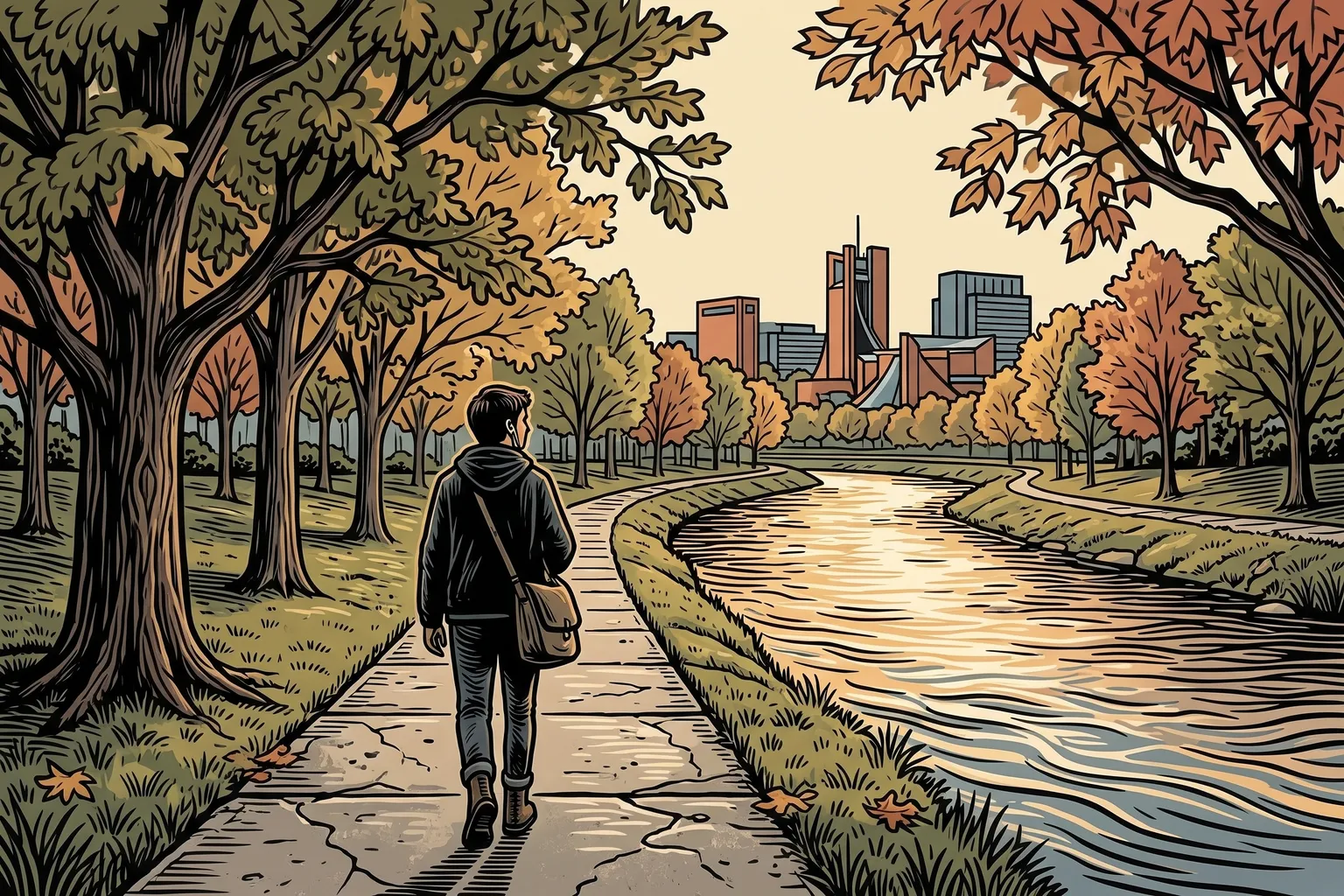
Hardcore History, Dan Carlin. Let me be precise about what this program is. It’s not academic history. Carlin is a former broadcast journalist who reads everything he can find about a subject and then talks about it for six hours at a time, sometimes considerably more. The episodes covering the First World War ran to roughly twenty-three hours in total. I know this because I listened to every minute of them on the Flatrock River trail behind our house, about twenty minutes per morning walk, over the course of an autumn. What Carlin does that most professional historians don’t is refuse to let the past become abstract. He keeps asking: what would it have felt like to be this person making this decision with only the information they had? He’s not always right. He’s never boring. In the pedagogy of history, that distinction matters less than you’d think.
Radiolab, WNYC. This is science journalism done the way science journalism should actually be done: with the uncertainty left in, the methods explained, the ways a study could be wrong acknowledged alongside the ways it might be correct. I spent years writing about the gap between what a study actually demonstrates and what a headline claims it demonstrates, and Radiolab is one of the few programs in any medium that consistently closes that gap rather than widening it. Not every episode succeeds at the same level. The best ones are models of how to explain a genuinely difficult idea to someone who isn’t a specialist, and models of intellectual honesty about what we don’t yet know.
Fresh Air, NPR. Terry Gross has been doing this since 1975. Fifty years of one woman refusing to ask soft questions. The archive is enormous, and the back catalog is, in my view, underappreciated: conversations with writers and musicians and scientists conducted at the peak of their powers, carefully edited, running a full hour (Audible). I go into the archive deliberately. A 2001 interview with a novelist I’ve just started reading. A 1993 conversation with a scientist whose recent obituary sent me looking. The archive rewards the kind of targeted listening that most news programming doesn’t allow for.
99% Invisible, Roman Mars. The premise is that the designed world is full of intentional decisions almost nobody ever told you about. I wrote a book specifically about this subject (how the built environment shapes human behavior across generations), and I still find things in this program I wish I’d known before the manuscript was finished. Mars and his team have a gift for making the invisible visible: the decision history embedded in a fire hydrant, a street grid, a hospital floor plan, a highway interchange. If you’ve ever suspected that the cities and towns you live in didn’t happen by accident and want to understand the actual decisions that shaped them, this is the most pleasurable education I know of.
Hidden Brain, Shankar Vedantam. Behavioral and social science presented to people who didn’t study it. This sounds like a limited audience. It isn’t. Vedantam is particularly careful about the thing that behavioral research is most frequently careless about: he explains the limitations and the generalizability problems alongside the finding. He resists the temptation to oversell the result, which is a discipline that most science communicators would benefit from acquiring. I have one consistent quibble: the final segment of most episodes, where a tidy takeaway is offered, is almost always weaker than the forty-five minutes that preceded it. Skip the last few minutes. You’ll be fine.
Cautionary Tales, Tim Harford. A program about catastrophic failures told as narrative history, with an explicit pedagogical premise: that you learn more from what went wrong than from what went right. The subjects range across aviation disasters, banking collapses, public health failures, and institutional breakdowns of every kind. I agree with that premise, which is perhaps why I’ve listened to every episode. Harford is an economist by training who writes about decision-making for a general audience, and he has thought very carefully about how to make complex reasoning legible to people who didn’t spend their careers inside an economics department.
Revisionist History, Malcolm Gladwell. I want to be honest about my complicated relationship with this program. Gladwell is one of the most gifted natural explainers of complex ideas working in audio, and I have also spent a considerable part of my career writing about the tendency of science journalism to overstate what a single surprising study can actually demonstrate. His best work, on forgotten historical injustices and the things institutional incentives make us collectively overlook, is genuinely excellent. His weakest work is a case study in exactly the problem I’ve spent twenty years describing. I listen to all of it anyway because I believe you should engage seriously with the thing you’re suspicious of rather than avoid it. This has occasionally required me to revise my suspicions. That’s the point.
A brief word on the practical side, since this was requested and since I remember what it was like not to know this: every podcast listed here is available through an app on your phone. The most common apps are Spotify, Apple Podcasts (built into every iPhone and available on Android), and an independent app called Pocket Casts, which is free, with an optional annual subscription that is worth it for the organizational tools (Pocket Casts). On a smart speaker, you say the program’s name followed by the word “podcast” and it will usually find the right thing. Episodes download automatically when you’re connected to Wi-Fi, so you won’t need a cellular signal on the walk. Earbuds in your pocket. Phone playing. Eyes forward. That’s the complete setup.
The reason long-form audio has earned my sustained attention is the same reason long books have: a host willing to spend forty-five minutes on a single idea has made a commitment to that idea that you get to evaluate in real time. You watch them think it through. You follow the evidence they cite. You notice where they qualify the claim and where they don’t. The eight-minute summary, the two-minute explainer: these are all versions of the headline, and I have spent too many years writing about the gap between the headline and the underlying work to find them satisfying anymore.
Haley understood in 1946 what the rest of the media industry took another seven decades to rediscover: the serious audience is real, it’s patient, it doesn’t need simplification, and it doesn’t need to be protected from its own intelligence. It just needs somewhere to go.
These are eight good places.
If you’re building a reading list to pair with the listening, I put together the books I’d actually recommend earlier this year.