When I was a kid in Muncie, the men on our street worked with their bodies, and summer heat was part of the job description in a way nobody discussed because it wasn’t a discussion. It was a condition. My father laced up his steel-toed boots every morning and drove to the Delco-Remy plant in Anderson, where the line ran regardless of July, regardless of what the thermometer said outside. There were fans. There was not, in those years, much else. He came home with his shirt wrung out and ate whatever my mother had made and went to bed and did it again in the morning. He didn’t complain about this. It was the arrangement.
I’ve been thinking about that arrangement this week.
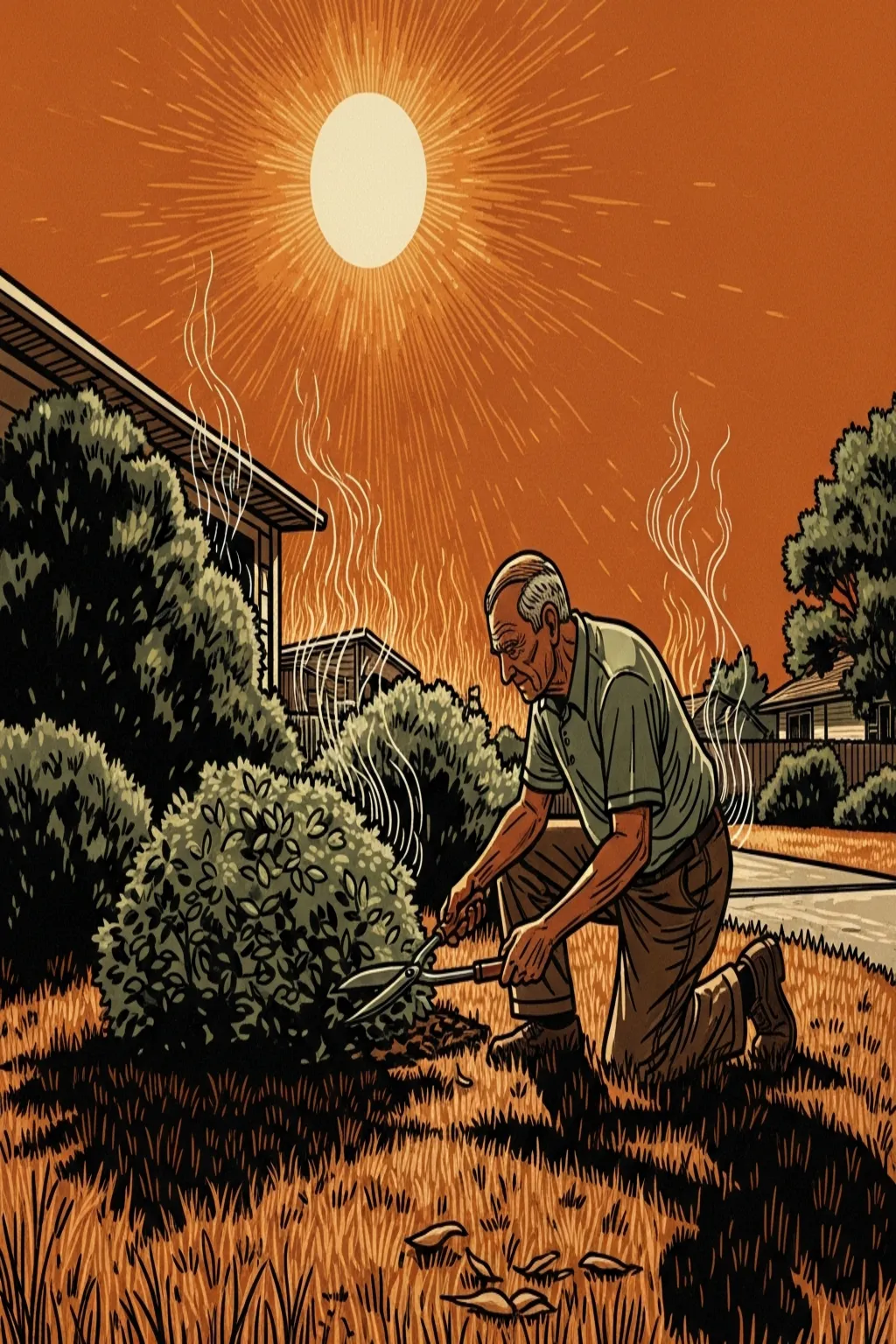
His name hasn’t been released. He was sixty-eight years old, one year older than I am. He lived in Bethel Township, Pennsylvania, in Berks County, eastern part of the state. On July 2, with temperatures above 100 degrees Fahrenheit, he went outside to trim the bushes in front of his house. The Berks County coroner later confirmed his death as heat-related.
He was doing yard work. In his own yard. On a morning when the heat index was well past the threshold that the National Weather Service considers dangerous for healthy adults.
He was sixty-eight years old and he went out to do the work that needed doing and the heat killed him.
On the Fourth, more than 185 million Americans were under heat alerts. Boston, New York, Philadelphia, Washington. New York City exceeded 100 degrees on July 2 for the first time since 2012. Atlantic City hit 106. A quarter million New Jersey residents lost power when storms knocked out the grid during the peak of the heat, meaning they lost their air conditioning on the days their lives depended on it.
In New Jersey alone, at least twenty-five deaths are suspected to be heat-related this week. The victims ranged from their thirties to their eighties. Most were found in homes without air conditioning. Some were found outside. A few in parked cars.
Heat deaths in this country have nearly doubled since 1999. About 1,069 recorded then. Last year the number was 2,394.
Here is the thing I keep coming back to. Extreme heat has never received a federal major disaster declaration. Not once, in the history of the program.
Under the Stafford Act, the law that governs how FEMA responds to catastrophes, the president can issue a major disaster declaration for hurricanes, floods, wildfires, tornadoes, earthquakes. For the heat that kills more Americans each year than hurricanes do in most years, there’s no equivalent authority. FEMA can’t deploy its full emergency toolkit. The federal government doesn’t have a word, legally speaking, for what killed the man in Bethel Township.
This isn’t a gap caused by ignorance. People know heat kills. There’s legislation in Congress to add extreme heat to the Stafford Act. Democrats have pushed it. It hasn’t moved.
I want to be honest about the complication here, because there is one.
The politics of climate attach themselves to everything in the heat conversation, and when they attach, the conversation often stops being about the deaths and starts being about the larger argument, which nobody agrees on and which the deaths can’t wait for. I have views on climate. But I’ve covered enough policy to know that conflating a specific, solvable problem with the full weight of an unsettled political argument is one of the reliable ways nothing gets done.
The specific problem is this: we know who dies in extreme heat. Outdoor workers. People in older housing without central air. People living alone in their seventies and eighties. People who can’t afford to run an air conditioner when the July electricity bill arrives. We know the geography. We know the demographics. And we know that the federal disaster architecture, the one we reach for after a hurricane or a tornado, doesn’t reach for them.
I wrote last week about five million people who lost ACA marketplace coverage not through a vote but through a subsidy expiration nobody acted to prevent. The heat problem is older and runs on the same logic. Something lethal and preventable continues, year after year, because the political cost of fixing it hasn’t yet exceeded the political cost of leaving it alone.
On the night of the Fourth, the fireworks eventually went off over the National Mall, delayed by storms, 85,000 shells in thirty colors. The Navy staged the largest maritime gathering in American history in New York Harbor. Sixty ships from thirty countries. Tens of thousands of people looking up at the ships and the sky and the lights.
Both things were true. People were watching fireworks from the National Mall. People were dying in apartments without air conditioning in the communities just to the north and west of those ships.
I’m not saying the fireworks shouldn’t have happened. I’m saying the distance between them isn’t an accident. It’s what happens when a thing that kills 2,400 Americans a year isn’t named a disaster.
Earlier this summer I wrote about FISA Section 702 lapsing while the House was on recess. Nobody went dark. The certifications held. But a statute expired because nobody stayed to renew it, and the reason behind that was a failure of institutional will rather than a failure of knowledge. The heat deaths run on a longer clock, but the mechanism is similar. Not a decision to let people die. A steady accumulation of smaller decisions not to act on a thing that is clearly, measurably happening.
Karen came in from the garden Saturday afternoon. It was pushing ninety in Cincinnati, hot but manageable, and she had the look she gets when she’s been reading something she’s still chewing on.
She asked me about New Jersey. I told her what I knew. She stood at the sink for a moment.
“Who has to say it’s a disaster?” she asked.
The president, I told her. A major disaster declaration comes from the president.
She nodded once and went back outside.
I don’t have a clean conclusion for this. I’ve been doing this long enough to know when I don’t have one and to say so rather than manufacture something that sounds right.
The man in Bethel Township went outside to trim his bushes. He didn’t have a vote in whether this summer’s heat would be classified as a disaster. He had a yard that needed tending and a country that has not yet decided, after forty years of watching this number climb, that the people who die in that heat are dying from something that needs a federal name.
That decision gets remade every summer. The deaths go into the records. The summer ends. The number grows. Congress has other things on its calendar and the calendar turns.
We light the fireworks. The heat finds the people it’s always found. Those two facts appear in different sections of the paper, and we go to sleep in the air conditioning, if we have it, and in the morning we get up and do the work that needs doing.
The man in Pennsylvania did.