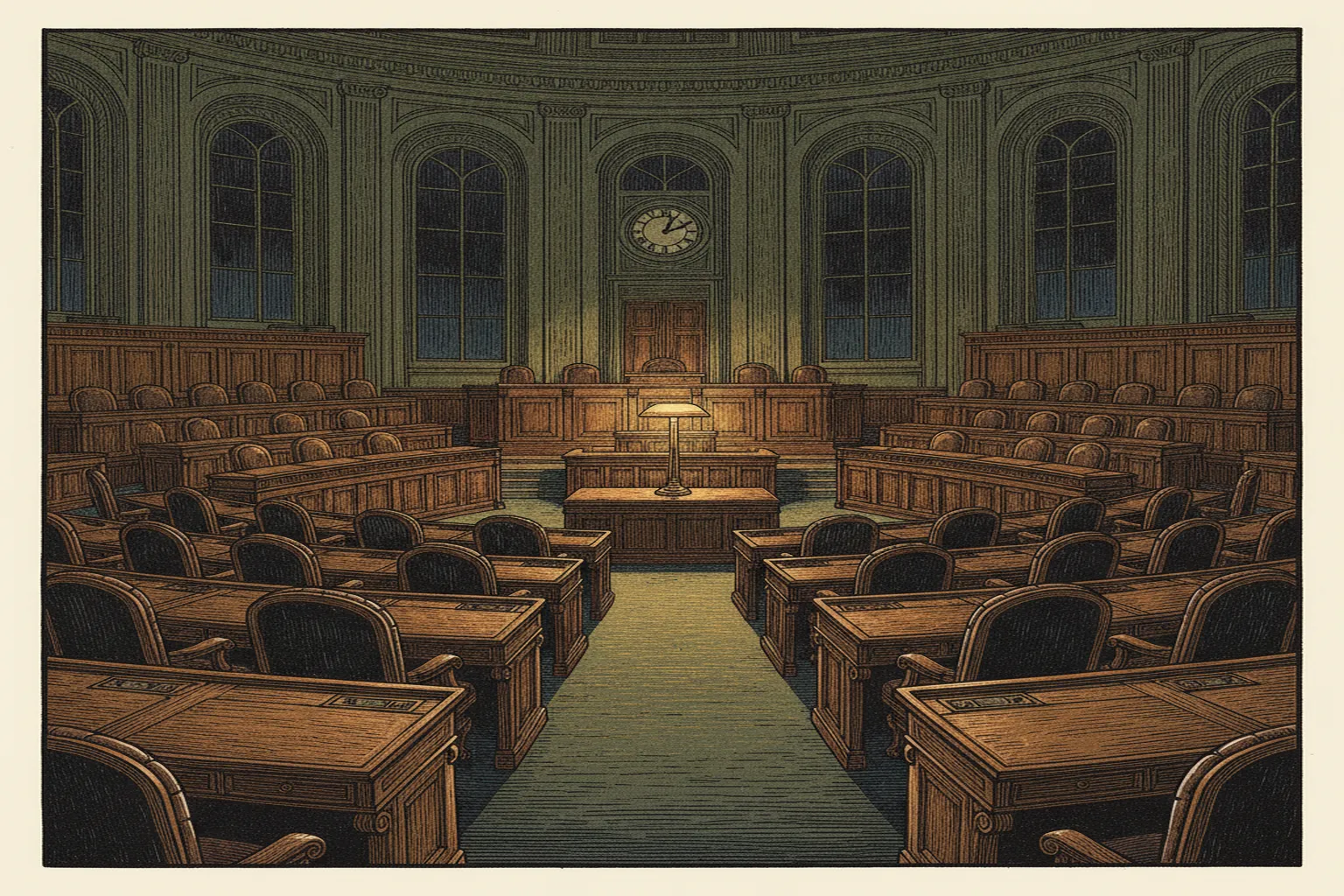
At midnight on Friday, June 12, a surveillance law lapsed.
Not with a vote. Not with a floor speech. Not with a press conference in the marble hallways of any building you’ve seen in a news photograph. The House had gone home for its scheduled recess. A short-term extension had failed to pass. And Section 702 of the Foreign Intelligence Surveillance Act, the legal authority that allows American intelligence agencies to collect the electronic communications of hundreds of thousands of foreigners located outside the United States, quietly expired while most of official Washington was somewhere else.
Nobody went dark. The intelligence community was quick to clarify. The Foreign Intelligence Surveillance Court had renewed its collection certifications in March, and those certifications run until early 2027. The phone companies and internet companies are still legally required to turn over what the intelligence community requests. About sixty percent of what appears in the president’s daily intelligence briefing comes from 702 collection, and that didn’t change when the clock hit midnight.
There was a comparable gap in late 2017, nineteen days when the authority technically lapsed and nothing measurably broke. The intelligence community said, effectively: nothing to see here. They weren’t wrong, technically.
So why am I still thinking about it?
This was a considerable week for American foreign policy. Pakistan’s prime minister announced Friday that Iran and the United States had reached agreement on the final text of what’s being called the Islamabad Declaration, bringing what appears to be a formal close to a conflict that has been reshaping the Middle East since last year. I wrote about the first announcement of that deal in late May, when the terms were still being disputed and Iran was contradicting the White House on the nuclear provisions. Now there’s a final text, and a signing ceremony scheduled for Switzerland next week.
That’s the story this weekend. That’s what everyone is writing about.
But I keep coming back to what happened at midnight, the same night the Iran news was moving.
Democrats in Congress refused to extend Section 702. Not because they’ve developed a sudden commitment to civil liberties, which would at least be a principle you could argue with. Not because a principled reform coalition finally forced the question after years of advocacy. They refused because President Trump had nominated a political loyalist, Bill Pulte, to serve as acting director of national intelligence. And they were afraid, with some historical justification, of what a loyalist in that position might do with 702’s collection authority. Use it against political opponents. Route intelligence toward partisan ends. Do what intelligence authorities have, in this country’s history, occasionally been used to do.
So Democrats did the only thing available to them. They let the statute expire. A short-term extension failed in the House. Nobody called anyone back from recess.
I’ve been watching Congress since I was a twenty-two-year-old reporter in Indianapolis. I’ve watched FISA go through its original passage, through its expansion after September 2001, through the Snowden disclosures, through years of arguments about minimization procedures and incidental collection and what exactly the government is allowed to know. None of it was simple. It wasn’t supposed to be simple. Democratic oversight of intelligence is hard by design, because the alternative is worse.
But I’ve never watched what happened last Friday night.
Democrats didn’t fight to reform 702. They didn’t hold hearings, propose amendments, or try to attach conditions that might constrain a politically directed intelligence operation. They stepped back. Let the clock run. And the clock ran out at midnight while the House was gone, because nobody stayed.
I want to be fair about this. Forty years of trying to be fair has taught me it’s different from trying to be balanced, and the difference matters.
Democrats aren’t wrong about the risk. A politically directed intelligence apparatus is a real historical phenomenon. The Church Committee spent years in the 1970s documenting what happens when collection drifts from its stated purpose toward something else. The concern isn’t paranoid. It’s memory.
And the condition Democrats were responding to didn’t materialize out of nowhere. Congress tried seven times to invoke the War Powers Resolution over the Iran conflict, starting in March. It failed every time. The constitutional architecture that was supposed to require Congress to authorize a war has been available to use for decades, and the institution has consistently failed to use it, failed on a 50-49 vote in May. The people now refusing to extend 702 authority are the same people who watched that. It’s possible that teaches you something about what the other side will do when the tools are in their hands.
What I can’t put down is the question underneath all of that. If the two parties have arrived at a place where they can’t agree to maintain the basic tools of intelligence gathering, not reform them, not improve them, just renew them, what is the shared project now?
This isn’t the debt ceiling, where at least you can describe the specific dispute. It isn’t even a government shutdown, where the fight is about money. It’s a surveillance authority that both parties have supported, in various configurations, for decades, lapsed because one party made a personnel appointment and the other party decided it couldn’t hand that person a renewed statutory key. Rather than negotiate, rather than condition the renewal, rather than do the unglamorous work of finding enough common ground to keep the lights on, the clock ran out. The House went home.
The system technically continues. The certifications are valid. The data is moving. The intelligence community is right that nothing changed at midnight.
But a statute lapsed. Both parties have historically supported this authority as necessary. It lapsed anyway, not because they disagree about whether foreign surveillance is useful, but because one party put a specific person in a specific position and the other party decided it couldn’t tolerate the risk that he might direct the renewed authority against them.
That’s a different kind of failure than a shutdown. It’s quieter. It doesn’t look like a crisis because the system technically continues. But I’ve been watching systems fail for forty years, and they rarely announce themselves loudly. You see the place where trust ran out, and you see what stopped being maintained, and you work backward from there.
I walked my usual route through Oakley on Friday morning, before the midnight deadline. The trees are full now, the way Cincinnati gets in June when the heat hasn’t arrived yet and the canopy is still green and new. I was thinking about how you don’t usually see a system going wrong in real time. You see the place where it went wrong, after the fact, and work backward.
At dinner that night I told Karen what had happened. She listened, the way she does, and when I finished she asked: “Did anyone try to call them back?”
I told her the extension failed and the House was already on recess.
She nodded and picked up her book.
There wasn’t anything else to say. That was the whole thing.