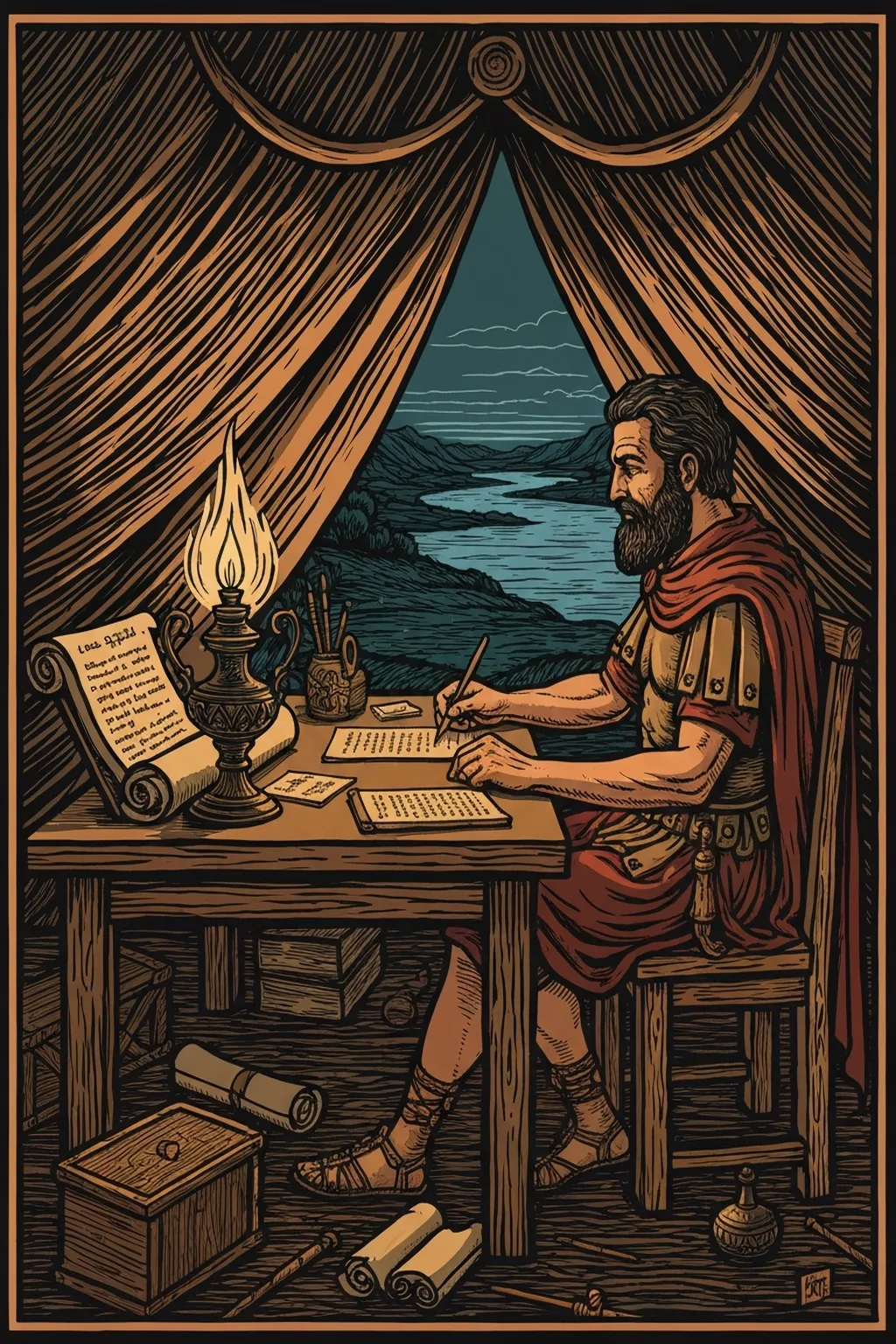
There is a sentence attributed to Marcus Aurelius that has been shared millions of times. “You have power over your mind, not outside events. Realize this, and you will find strength.” You will find it on coffee mugs and gym walls, on the motivational accounts of people who have never read the Meditations and on the LinkedIn profiles of people who claim they have. It carries the weight of ancient authority. It sounds, frankly, like something a Roman emperor would say.
The problem is that Marcus Aurelius did not write it.
Not in those words. Not in any words that translate to those words. The sentence appears in no reliable edition of the Meditations, and no scholar has been able to trace the phrasing to a specific passage. It exists as a thing the internet decided he said, formatted attractively and repeated until it acquired the gravity of fact. That is not, strictly speaking, the same as coming from a second-century emperor’s private journal.
This piece is not, mostly, about the fake quote. It is about the question the fake quote raises: of all the things Marcus Aurelius actually wrote, who decided which ones we repeat?
The Meditations is a strange book. It was written in Greek, which already surprises people who assume a Roman emperor would think in Latin. Marcus did use Latin for official purposes, for the correspondence and administration of an empire that stretched from Britain to Mesopotamia. But for private thought, for the notebook he kept on military campaigns along the Danube in the 160s and 170s AD, he used Greek, the language of philosophy and of the Stoic texts he had been reading since his tutor Rusticus handed him a copy of Epictetus when he was a young man.
He never named the notebook. The title “Meditations” is a later English convention. In Greek the work is often called “Τα εις εαυτόν,” which translates roughly as “To Himself,” and which tells you everything you need to know about the intended audience. Marcus was not writing for posterity. He was not writing for publication. He was writing reminders to himself, the kind you put on index cards above a desk when you’re prone to forgetting your own stated values under pressure. The difference being that the desk in question belonged to the emperor of Rome, who was conducting wars on two fronts while trying not to become the kind of person emperors tended to become.
He was thirty-nine when he became emperor. He had wanted to be a scholar. He spent the next nineteen years dealing with plagues, wars, political crises, and ungrateful subordinates, while writing to himself at night about why he shouldn’t be angry about any of it. The Meditations contains repeated notes to self that suggest he struggled with irritability, with vanity, with the temptation to enjoy power more than his philosophy permitted. He writes about the difficulty of waking up in the morning and wanting to stay in bed. He writes about people around him who flatter him and how hard it is not to like it.
He was, in other words, not a man who had achieved peace. He was a man who was working on it, and leaving himself homework.
The first printed edition of the Meditations appeared in 1559. A German classical scholar named Wilhelm Holtzmann, who published under the Latinized name Xylander, worked from a manuscript that has since been lost. He arranged the twelve books into their current order. He gave the text a structure that Marcus almost certainly did not impose, because Marcus was not writing a book. He was writing a journal that other people later organized, printed, translated, anthologized, and then, seventeen hundred years after Marcus died on the Danube frontier, turned into Instagram captions.
Every step of that chain involved someone making a selection. Xylander chose which passages to include when he worked with a manuscript he alone could read. Translators made choices: the same Greek phrase, rendered by different hands, can produce sentences with very different emotional registers. Some scholars translate the Meditations as a document of philosophical severity. Gregory Hays, whose Modern Library edition from 2002 is largely responsible for the current English revival of the text, renders it with a directness that makes Marcus feel more modern, more plainspoken, more quotable. That translation choice matters. The quotable Marcus is, partly, Hays’s Marcus.
None of this is a criticism. Translation is interpretation. Every edition of any ancient text reflects the priorities of the people who brought it forward. The point is that the quote you encountered on a motivational poster passed through at least six or seven human decision points before it arrived in that form, and none of those decision points were Marcus Aurelius.
The modern Stoicism revival is largely the work of a small number of writers and podcasters who found in Marcus Aurelius a philosophy that fit a particular American moment. Ryan Holiday published “The Obstacle Is the Way” in 2014, built around a line from Book Five of the Meditations. Tim Ferriss has recommended the Meditations to audiences of millions. Coaches, athletes, and startup founders cite Marcus Aurelius with the confidence of people who have read the book, which some of them have.
What gets cited is not random. It is a specific subset of passages, selected for a specific purpose. The passages that made it into the tech-and-performance canon are the ones about obstacles, about discipline, about controlling your response to adversity. They fit a worldview in which the individual can optimize his way through any difficulty by maintaining the right mental posture. This is a legitimate reading of some parts of the Meditations. It is not the whole book.
The whole book includes Marcus writing about how meaningless fame turns out to be. How the people who spent their lives pursuing it are, with rare exceptions, already forgotten. He lists the powerful men of previous centuries, the ones whose names were once spoken with awe across the empire, and notes that they have dissolved into time the same way he will. He writes about his obligations to the people around him in a way that reads as genuinely communal rather than individual: the Stoic sage he describes is not someone who has maximized his personal resilience but someone who has learned to act for the good of the whole. That version of Marcus has appeared on considerably fewer motivational posters than the one about obstacles.
None of this makes the popular passages wrong. “The best revenge is to be unlike him who performed the injury,” from Book Six, is genuinely in the text, and it is, as practical wisdom, quite good. The famous passage from Book Two, in which Marcus tells himself to wake up expecting that the people he meets that day will be meddling, ungrateful, arrogant, dishonest, and jealous, is genuinely there too. But it doesn’t read the way the motivational version implies. He writes it not as complaint but as discipline: knowing people will be difficult means you can stop being surprised and resentful when they are. He continues by noting that those people are acting from ignorance, that he himself has sometimes acted from the same ignorance, and that the appropriate response is something closer to patience than triumph. That’s a more interesting idea than the inspirational version, but it requires the surrounding paragraph to make sense of it.
The surrounding paragraph doesn’t fit on a coffee mug.
I think about this problem whenever I’m evaluating a list of books worth reading: the selection is the argument. When a curator chooses which passages to repeat and which to let go, they are not providing access to a text. They are providing access to their interpretation of the text, shaped by what they needed it to say. Mortimer Adler did this with the Western canon. Harold Bloom did it more combatively. Ryan Holiday did it with the explicit goal of making ancient philosophy useful to modern people under modern pressures. All of them made choices that felt, by the time they reached you, like natural facts about what the text contains.
This is the pattern behind most of what we call common sense: someone made a selection, the selection traveled, and at some point it stopped looking like a selection and started looking like the thing itself. The age sixty-five was not discovered; a budget committee decided it. The great books of Western civilization were not unearthed; Mortimer Adler identified them. The essential Marcus Aurelius quotes were not self-evident; a sequence of scholars, translators, anthologists, and, eventually, podcast hosts decided which ones to surface. The machinery is real. Most people never see it.
What Marcus Aurelius actually wrote is twelve books of private notes from a man trying, with incomplete success, to live by his stated principles while running an empire he did not particularly want. He was working through something. The notes have the texture of private argument, of a person who knows what he believes and cannot quite get himself to act accordingly all the time. That is more interesting than a quotation board and, I suspect, more useful. The gap between what Marcus says he values and what he admits he struggles with is where the book lives. The curated version, the one that arrived via six centuries of editorial selection and two years of podcast recommendation, tends to close that gap.
The fake quote is fake. The real quotes are more complicated than the popular version. And yet.
I’ve read the Meditations three times, and I find it difficult to argue that the people who found it through a self-help recommendation and came away with something useful about handling adversity are wrong to have found it useful. Marcus was not writing about productivity. He was writing about how to be a decent person under extraordinary pressure, and some of what he worked out is genuinely portable across seventeen centuries. The selection distorts him. The distortion is also, in places, reasonably close to what he was getting at. Both things are true simultaneously, and that is a more uncomfortable conclusion than “the popular version is a fraud.”
The Meditations survived because someone, working from a manuscript that no longer exists, decided it was worth printing. Someone else decided to translate it. Someone else decided that a line from Book Five was the key to modern resilience. The book you encounter has been shaped by every one of those decisions, and it has survived all of them.
Marcus would probably recognize what happened. He wrote extensively about how quickly everything is forgotten, including the people doing the remembering. He was not building an enduring reputation. He was trying to get through the next day without becoming a worse version of himself than he’d been the day before. The quote-industrial complex has kept him famous for nearly two thousand years. It has also turned a complicated, doubt-prone man into a caption.
He would likely regard both outcomes as beneath his attention. That is, possibly, the most Stoic response available to him.
Warren Holt writes about ideas and culture for The Sunday Evening Review. He is the author of two books, including “The First Answer Is Usually Wrong.”