Somewhere around 1968, in the aftermath of one of the first large waves of early retirement from American manufacturing, a vocational psychologist followed forty-seven men for two years. The company she worked for had expanded its early retirement program; men with thirty years of service could leave at fifty-eight with a full pension. Her job was to understand what happened next.
She tracked health metrics, depression screenings, marriage quality, what they said they were doing with their days. At the end of two years she had an answer, and it was the same answer that has kept appearing in the research on retirement ever since.
The men who were doing well were the men who were still making something.
I want to be honest about what a small study from fifty years ago can’t prove by itself. What it can do is point. It points toward a question the research on hobbies for older men has been circling for decades without quite landing on cleanly: the challenge isn’t finding something to do. It’s finding somewhere for a specific form of intelligence to go.
I’ve written before about the cultural mandate around retirement hobbies and how the prescription to stay active arrived in American life as an artifact of midcentury gerontology rather than a careful study of what people actually need. The short version: activity theory won not because it was better supported by evidence but because it was more useful to the industries forming around retirement. If retirees needed hobbies, someone would sell them hobbies. And someone did.
What the theory never distinguished, and what the selling has never cared to, is that not all activity serves the same function. The function that matters most for men specifically is one the framework was never designed to capture.
Here is the structure, stated as plainly as I can manage.
For most of the twentieth century, male identity was organized primarily around occupation. This isn’t a complaint about that arrangement or a defense of it. It’s a description of a social fact that shaped a generation. Ask a man in 1970 who he was and he’d tell you what he did. The occupation was the identity. When the occupation ended, the identity had no other frame to support it.
Women’s lives in the same era tended to be organized around a more distributed set of roles: work and marriage and children and community, often simultaneously. The end of formal employment was a shift in one relationship among several. For many men, it was the end of the primary relationship. The one that defined the shape of every day, provided the social network, supplied the reason to be somewhere at a specific time and do something that mattered.
Researchers who tracked this through the 1970s and 1980s kept finding the same pattern: the men who struggled most after retirement weren’t the ones who’d hated their jobs. They were the ones whose jobs had most completely been their identities. The carpenter who was a carpenter suffered more than the carpenter who happened to build things for a living. The foreman who’d been a foreman for twenty-five years was in worse shape than the foreman who’d also been a husband and a neighbor and a fly fisherman and a man who read history for fun. The more total the identification, the more total the loss.
This is changing for younger cohorts, slowly. Men who are sixty-five today were formed in a different cultural arrangement than men who are eighty. The problem is softening at the edges. It hasn’t disappeared.
The part that gets left out of most conversations about hobbies for older men, I think, is the specific intelligence of hands-on work.
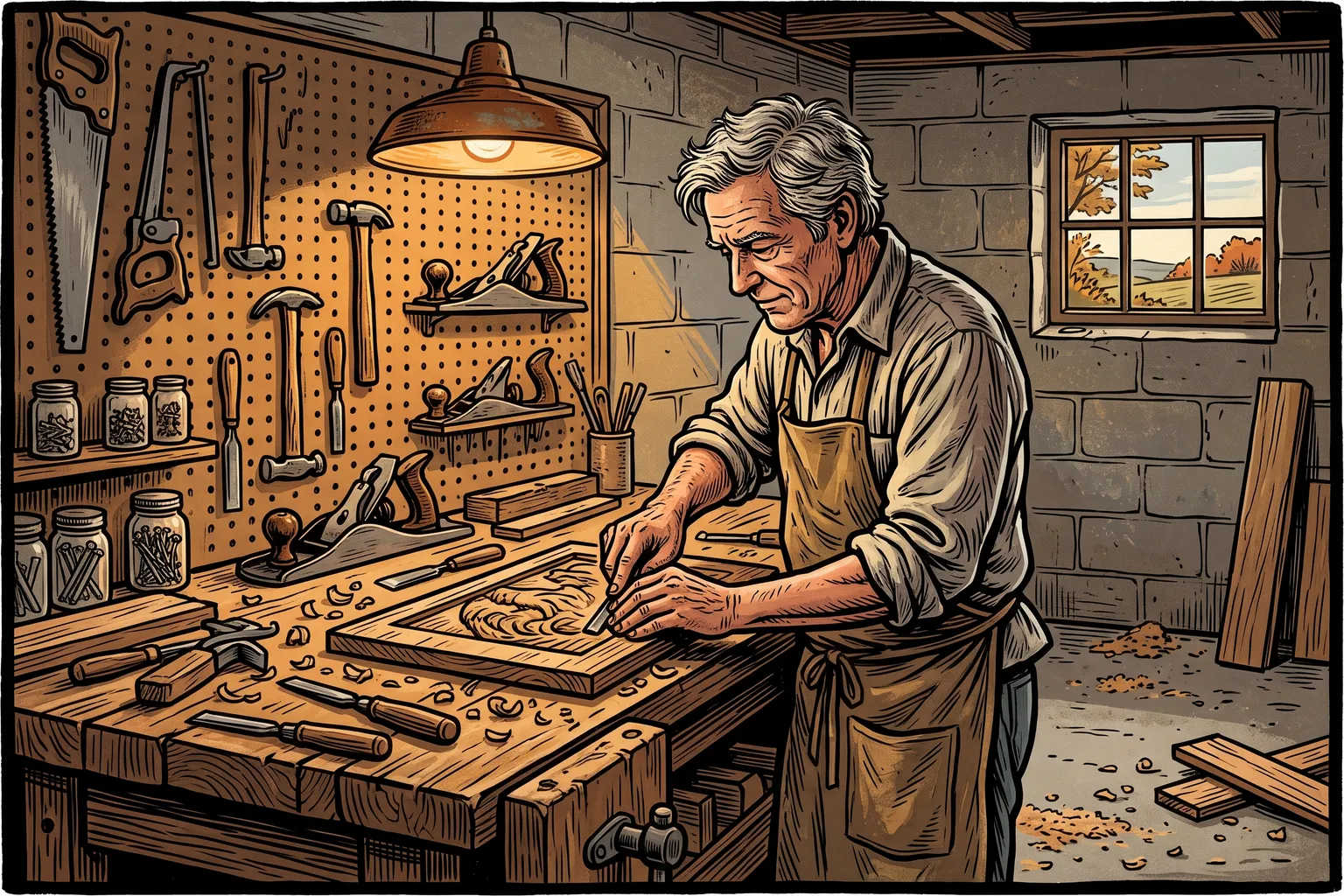
When a man spends thirty years doing something physical (building, machining, planting, repairing, welding, fitting stone), something accumulates beyond skill. It’s a form of knowledge encoded in spatial reasoning, pattern recognition, and muscle memory for which common English has no good word. The carpenter who can look at a corner and know it’s out of square before he picks up a tool is using something different from a carpenter who checks with a level. Something slower and deeper, compressed from thousands of hours of getting it wrong and then right and then reflexively right.
I’ve written at length about the cognitive science behind this: the work that researchers like Paul Baltes spent decades trying to make legible, that the expert’s intuition isn’t magic but stored pattern recognition, a form of intelligence the standard cognitive tests were never built to measure and that actually improves over decades of practice.
When retirement ends the practice, it doesn’t dissolve the intelligence. It just removes the domain where that intelligence could express itself. The machinist who stops machining still has the neural architecture for precision work, the hand-eye calibration, the diagnostic sense for when something is a fraction off. He has nowhere to apply it. The question of what to do in retirement is, at its most useful, a question about where that stored capacity can go next.
This is the specific gap that good hobbies for older men tend to close. Not activity for its own sake. Activity that gives stored intelligence somewhere to land.
The man restoring a 1954 Ford pickup in a Minnesota garage is making something. So is the man growing tomatoes in a raised bed, imperfectly, with the groundhogs taking their share, but the whole business of watching something respond to your care is its own form of deep engagement. Gary Kowalski wrote about learning fly fishing at sixty-three and what he kept returning to wasn’t the scenery or the exercise. It was the reading of water: a form of problem-solving with immediate and honest feedback. The river tells you whether you got it right.
What these share isn’t a category. They’re not all outdoor activities or craft activities or physical activities. What they share is a structure: a domain with its own standards, a way to get better, a form of intelligence the activity rewards. There’s a right way to do them and you can tell the difference. The diagnostic sense, the pleasure of getting it right, the encoding of accumulated knowledge into new material: these are the actual mechanisms. The specific hobby is just the container.
The prescriptive approach to hobbies for older men (try pickleball, try watercolor, here are fifteen options) gets this structure backwards. It starts with the activity and hopes the man will find meaning inside it. The version that works starts with the intelligence: what did thirty years of this work actually require of you? Where did your specific knowing live? Then it asks what new domain rewards that same kind of knowing.
The men who search for hobbies for older men in a low-grade panic six months into retirement usually aren’t lacking imagination. They’re lacking permission. Permission to take a new domain seriously enough to get genuinely good at it, to spend real money on the tools, to tell the people around them: this is where I do work now, and I need time to do it.
The forty-seven men that vocational psychologist followed didn’t have a manual. What the ones who came through did was locate a domain. They set up the workshop or the table or the corner of the garden that said: this is where I make things. Then they treated it the way the work had always been treated. Not as a retirement hobby. As work.
The research since 1968 is messier than one observation can capture. Social connection matters enormously, and most good activities for older men turn out to be social whether they look like it or not: the woodworking club at the community center, the fishing guide who becomes something close to a friend, the neighbor who also has groundhog problems and wants to compare notes. But underneath the connection is something more specific. The experience of competence. Of being good at something. Of having a reliable form of intelligence that the world responds to honestly.
That intelligence is already there. It’s been accumulating for decades. It doesn’t need a list. It needs a domain.
Warren Holt writes about ideas and culture for The Sunday Evening Review. His books include “The First Answer Is Usually Wrong” and “Neighborhood.”