There is a woman named Margaret in Terre Haute, Indiana, who is eighty-seven years old and was a math teacher for forty-one years and who, about two years ago, said something to me that I have not been able to shake.
I was sitting in the common room of the assisted living center where my mother spent her last years. I had driven up from Virginia to see some of my mother’s friends, the ones who were still there, because I was working on an idea for a new publication and I wanted to ask them what they read. What they wished they read. What no one was giving them.
Margaret went first. She folded her hands on the table and looked at me the way, I imagine, she once looked at students who had not done the reading.
“Everything I read treats me like I’m dying,” she said. “I’m not dying. I’m reading.”
I wrote that down. I still have the notebook.
I have been in this business for thirty-five years. I started writing obituaries at a small daily in Indiana because it paid $6.50 an hour and my car needed a transmission. I learned something there that took me years to articulate: the people who came in to tell me about their dead were not there to recite facts. They were there because they needed someone to understand what had been lost. Facts were just the skeleton. I was trying to find the life inside the bones.
That is what I have been trying to do ever since.
I have edited magazines. I have managed writers who were better than me and I have tried to protect them from the business pressures that would have made them worse. I have sat in meetings where someone referred to readers over sixty as “the pre-death demographic.” I did not laugh. I went back to my desk and wrote a note that said: They are people. I stuck it on my monitor. It has followed me to every desk I’ve sat at since.
What I have watched happen, over three decades, is a narrowing. American media decided at some point that the audience worth chasing was young, urban, and online. Everything else got smaller. Got condescending. Got soft.
The publications that serve older readers mostly treat them as a problem to be managed. Here is how to talk to your doctor. Here is how to protect your assets. Here is what to do when your knees go. All of it useful. None of it sufficient. None of it written for someone who spent forty years thinking hard about the world and wants, still, to think hard about the world.
Betty was in that room in Terre Haute too. She is seventy-nine and she said: “Write something worth my time. I don’t have as much of it as you do.”
The Sunday Evening Review is my answer to Betty.
It is a magazine for people who’ve been alive long enough to know things. People who have earned their opinions through experience rather than ideology. People who can read a piece about estate planning and also a piece about grief and also a piece about what the best pasta you ever ate tasted like and why you still think about it. People who do not need to be protected from complexity or irony or the occasional uncomfortable fact.
I am sixty-one years old. I am not the target audience because I’m old. I’m the target audience because I’m curious. Because I have read more than I have done and I am trying to fix that ratio before it’s too late. Because my wife, Susan, is the most interesting person I know and she has three friends who are more interesting than I am, and none of them feel represented in anything they read, and that has always struck me as a catastrophic waste.
We will cover health because bodies matter. We will cover money because it does too. We will cover travel, food, faith, grief, marriage, grandchildren, second careers, bad knees, good books, and the occasional subject that defies categorization but is too good to leave alone. We will not cover any of these things as though you are a problem to be managed. We will cover them as though you are a person who is paying attention.
We will be fair to people across the political spectrum and to all things in the world that deserve fair treatment. We will not be neutral about stupidity or cruelty. There is a difference.
I spend more time on this column than on anything else I write for this publication. That is intentional. The editor’s letter is where I show you who I am and what I believe and why you should keep reading. I plan to keep earning that.
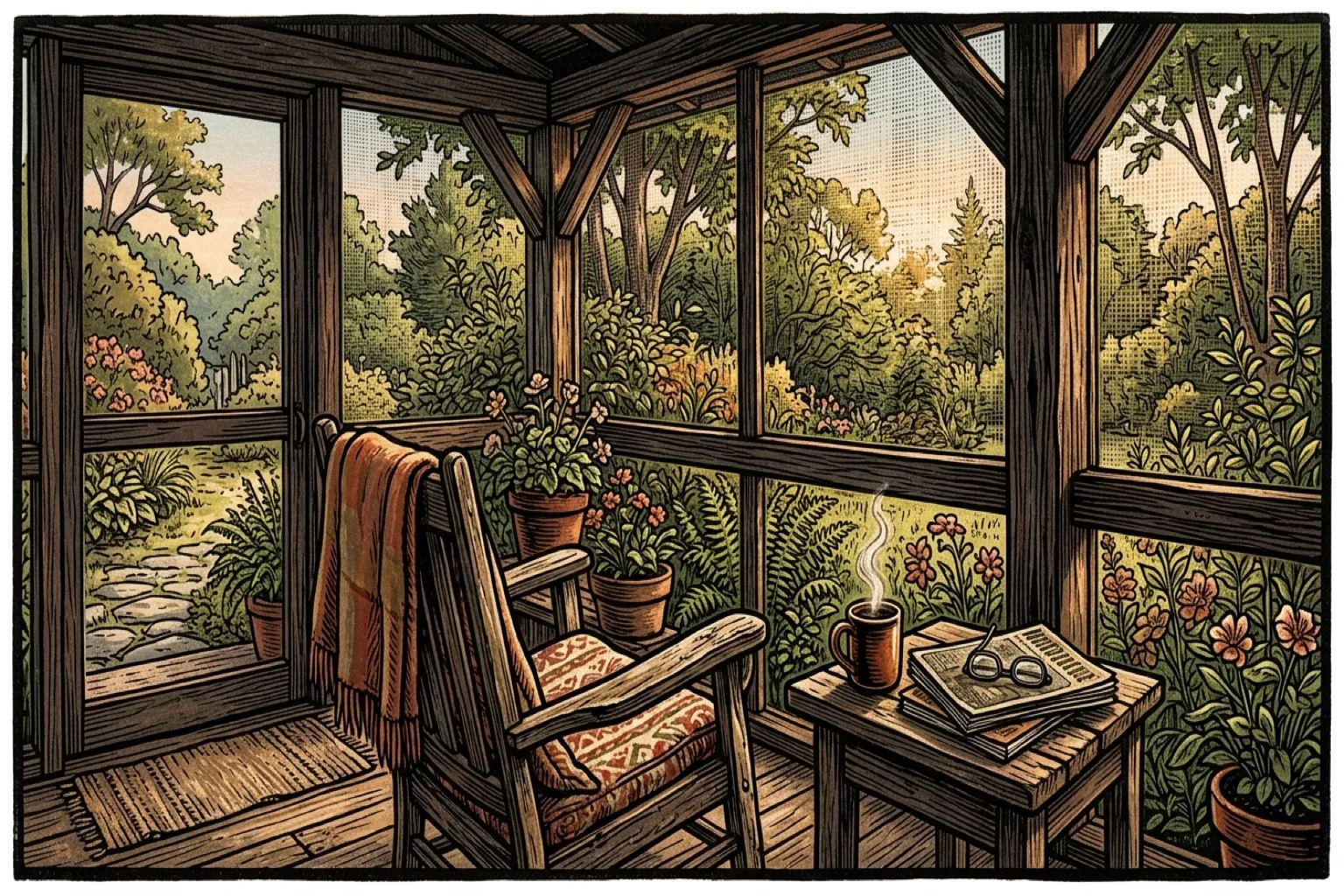
The name comes from Sunday evenings, which have always been the best hours of my week. The work of Saturday is done. The rush of Monday has not yet arrived. Sunday evenings are when I am most fully myself: on the back porch, coffee cooling, a book or a magazine open in my lap, the ceiling fan turning overhead, thinking about everything I did not pay enough attention to during the week.
That is what this magazine is for. Paying attention. To the world. To the years. To each other.
Margaret told me she was not dying. She was reading.
Let’s give her something worth reading.
Dale Parsons Editor-in-Chief Charlottesville, Virginia