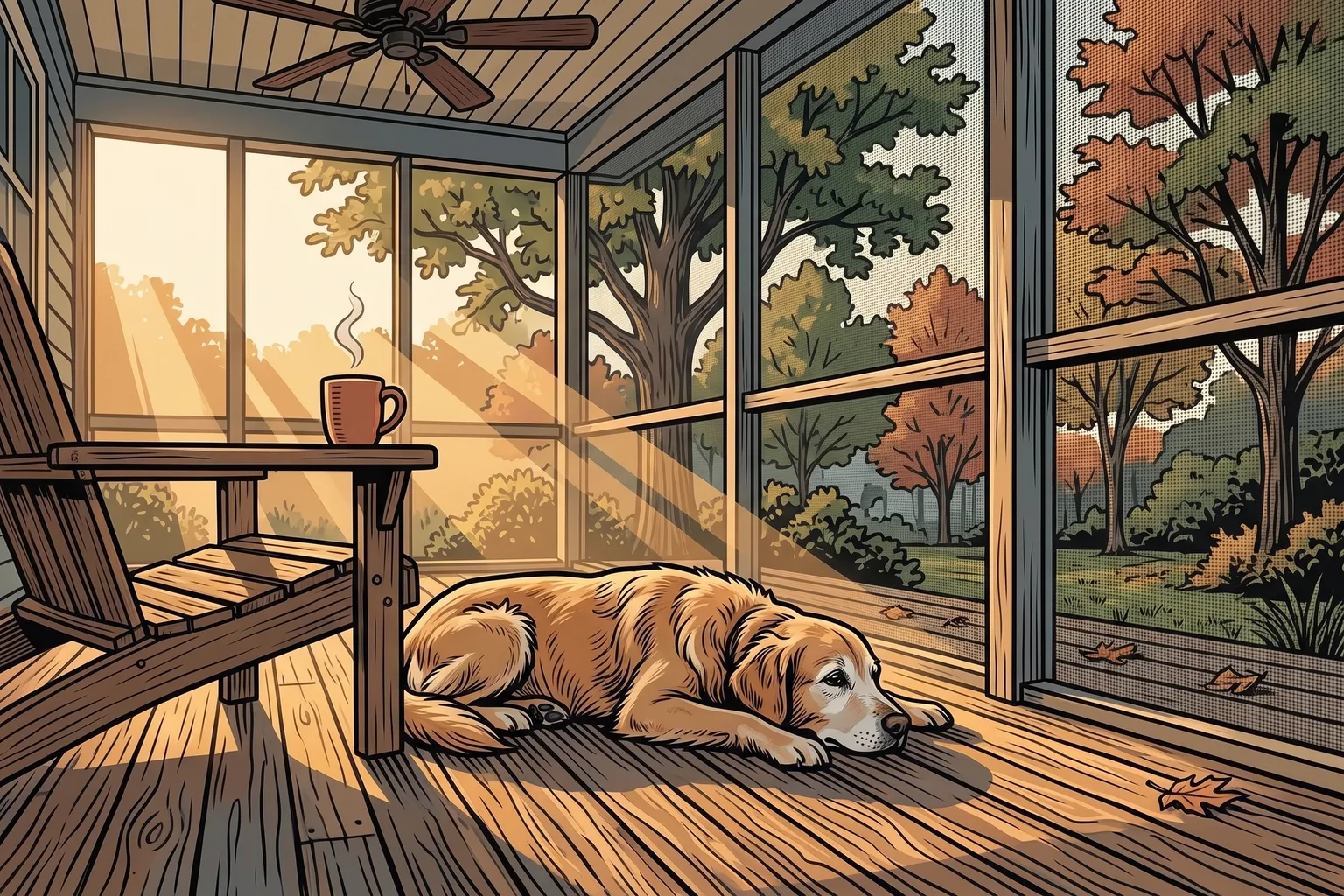
The morning I noticed was a Tuesday in early September. I was out on the porch a little after seven, coffee in hand, and Hank had followed me without my asking, which he’s started doing this year. He doesn’t want to go outside, not really, especially not at that hour. He just doesn’t want me to be out there alone. He settled onto his side in the patch of light coming through the screen, and I looked at his face and thought: I don’t remember when his muzzle got that gray.
It had to have been gradual. These things are. But the summer light in Charlottesville is a particular kind of bright, the direct overhead kind that flattens everything, and I’d been sitting with him every morning for three months without noticing the gray had spread. The September light is lower, longer, more angled. It comes through the screen at a slant and lands on things the way a careful reader marks a passage, with attention and purpose.
I mentioned it to Susan that evening. About Hank’s face. She looked at me with the expression she reserves for statements that require a response because to not respond would be unkind. “Dale,” she said. “He’s been gray since April.”
She was right. She’s almost always right about things I’ve missed.
But here’s what I keep thinking about. Not that I missed it, exactly. That I couldn’t see it until the light changed.
September does this. It has a different quality than the other months, not sad, though people sometimes mistake it for sad, but clarifying. The air thins a little. The angle of the sun drops a few degrees. Things that were there all along become visible in a different way. The turning leaves are the obvious version of this. But I mean something quieter: the way you can suddenly see the garden for what it actually is rather than what you’ve been hoping it would become. The way an old dog looks himself again after the summer haze lifts.
I’ve been thinking about this for the Review as September comes in. We’re six months old now, and there’s something about the fall light that invites a looking-at. Not a verdict. Just a seeing. The summer was full and loud and we published more than I expected and some of it was very good and some of it taught me things about what we’re still figuring out. Now the light changes and I can see the shape of what we’ve built more clearly than I could in June.
What I see is that the people who come to us aren’t looking for noise. They’ve had enough noise. They come for the particular satisfaction of reading something true, told well, about the things they already know but haven’t found the right words for yet. Ruth Ann says something about a marriage and it lands because it names something real. Glenn explains a financial rule and it lands because he treats the reader like they can handle it. Carol writes about sleep and you think: that’s right, that’s it exactly.
That’s what good writing does at its best. Not news. Recognition.
There’s a reason I started this publication for people who’ve been alive long enough to know things. Not because they’re done learning, though they know more than anyone gives them credit for. But because they’ve spent decades collecting experiences that no one has organized for them. The right sentence does that. It holds the experience up in a certain light and says: yes, this is real, this is yours, you weren’t imagining it.
September does that too. It holds the summer up in a different light and lets you see what happened.
Hank is still sleeping in the September light on the porch when I come downstairs now. His gray muzzle pressed to the floorboards. He is old and slow and apparently has been gray since April without my permission.
I’m glad the light changed.
Dale Parsons
Editor-in-Chief
Charlottesville, Virginia