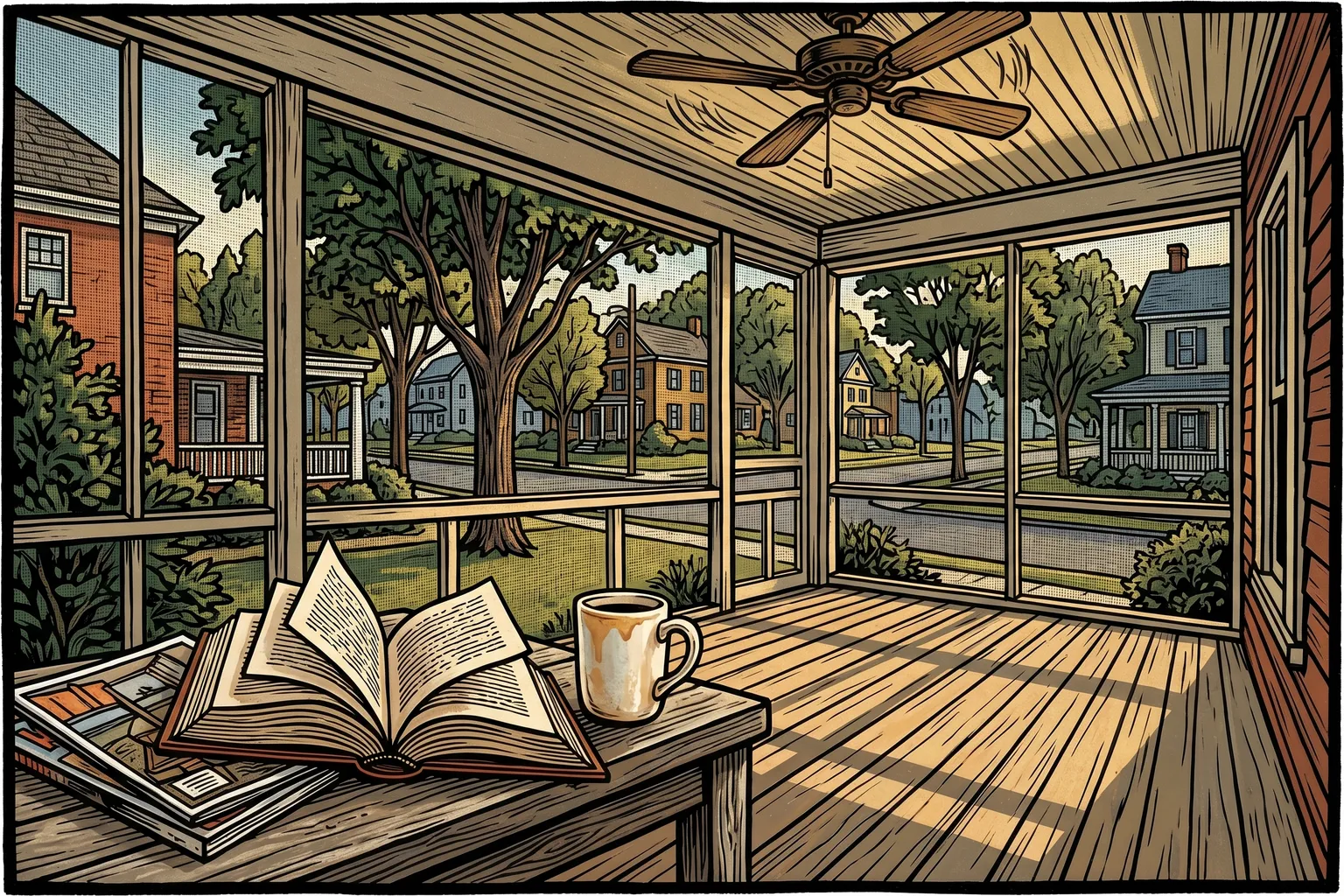
The stack on the porch never gets smaller. I know this about myself. I add to it faster than I read, which means most of what’s out there isn’t current. It’s a record of what I meant to get to.
Tuesday morning I finally reached the bottom. Not because I’d worked through everything (I’d been pulling from the middle, the way you do) but because the stack tipped over in the night and I had to restack it. At the bottom was a slim book I’d carried through two moves: a collection of editor’s letters from an American magazine that ran for thirty years through the middle of the last century. I’d read it first at an old job and underlined things I’ve mostly forgotten. It had been on the porch stack since April.
I opened it at random. Third of the way in. A letter dated late spring, 1961.
The editor was writing about something one of his writers had just finished. A profile of a retired schoolteacher in rural Pennsylvania who collected pressed wildflowers. The piece took three months. The editor wrote three paragraphs about what made it work, and I sat with those three paragraphs for longer than the coffee lasted.
He wasn’t describing technique. He was describing what attention looks like when a writer stops performing it and actually does it. The difference between going somewhere and being present somewhere. One you can teach. The other you can only recognize when it shows up.
Sixty-five years.
That letter was dated June 1961. I’m reading it in June 2026. We’re eighty-six days old. And what that editor said about pressed wildflowers is exactly what I told one of my writers last month about a different piece, in a different form, across whatever distance there is between 1961 and now.
There’s a version of this that’s reassuring. Look, the things that matter stay the same. There’s a version that’s demanding. The second one is the honest one.
That editor wasn’t trying to be timeless. He was trying to be precise. Specific enough to be true. And the specificity is what held. Not the observation about attention, which anyone could make. The wildflowers. The schoolteacher in rural Pennsylvania. The particular.
I’ve been thinking about that word this week. Warren wrote about jazz albums last week in a way I thought had it. Not a survey of the form but a point of view, organized around what he actually hears when he puts on a record and lets it work. He comes back to a few albums the way you come back to things you trust. He trusts his ear, and that trust is audible. Whether it holds sixty-five years isn’t his problem. His problem was to be honest about what he heard.
That’s all any of us can do. Be specific about the particular. The wildflower, not the garden. The album, not the genre.
The fan wobbled. The light came through the screen slow and sideways the way it does in June.
Susan came out just before seven and asked what I was reading. I told her about the editor and the schoolteacher and the wildflowers. She said, “Why do you need to read about magazines when you run one?”
She wasn’t wrong, exactly. But she also knows that’s not what I was reading about.
Dale Parsons
Editor-in-Chief
Charlottesville, Virginia