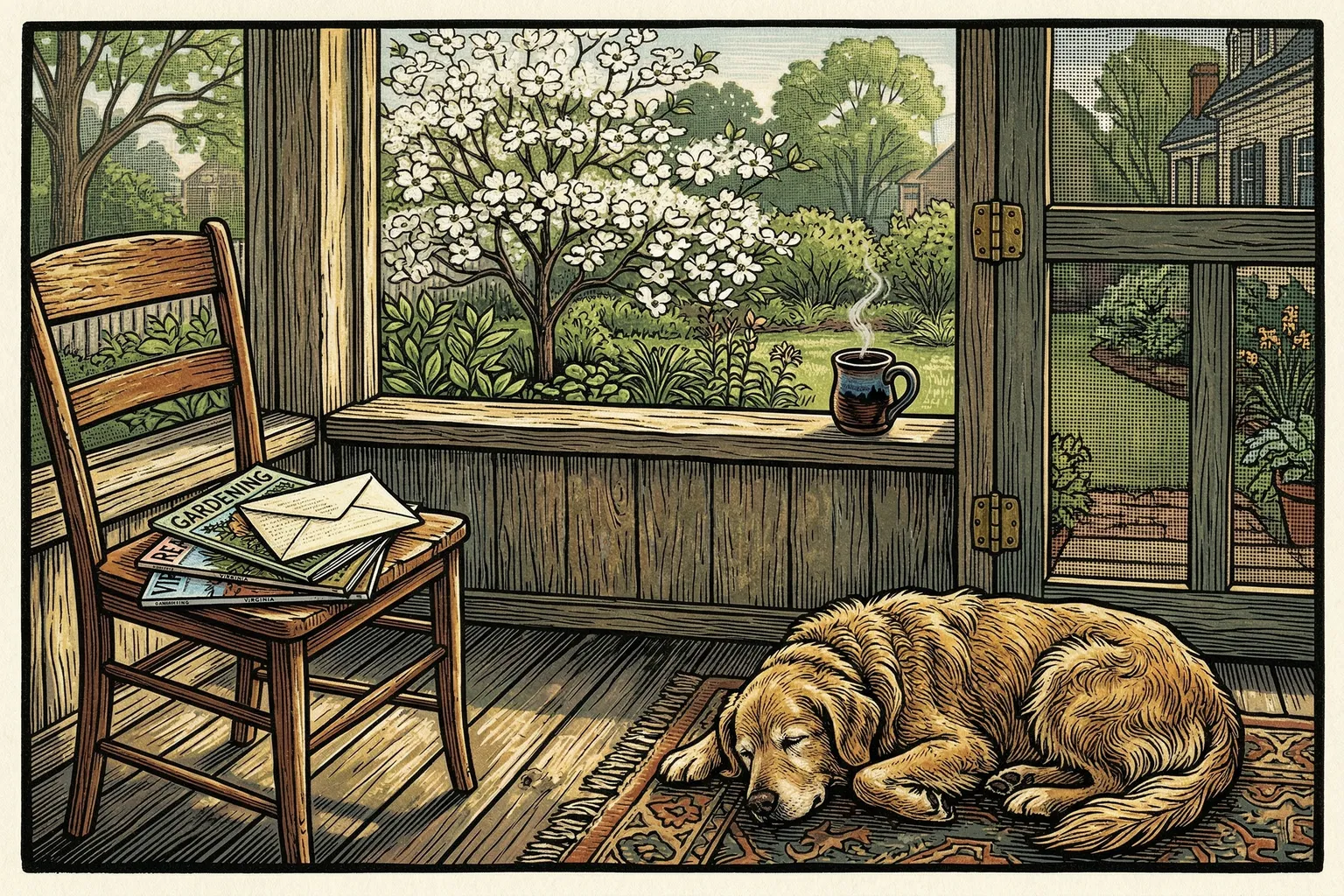
Hank does not care about the Sunday Evening Review. I want to be clear about this. He is twelve years old, mostly deaf, and his primary concern each morning is whether I will share the corner of my toast. I will. I always do. Susan says I am training him to expect it. I remind her that he is twelve and has already been trained, by me, to expect it, and that I see no reason to introduce austerity measures at this stage of his life or mine.
I mention Hank because he was lying on the porch floorboards last Tuesday morning when I read the first letter from a reader that stopped me.
It was from a woman in Michigan. I won’t use her name because she didn’t give me permission, but I will tell you what she said. She said she had read our piece on downsizing and had called her daughter afterward. Not to discuss logistics. To tell her a story about a Christmas ornament. She said the article reminded her that the objects in her house were not the point. The stories were the point. And she had been keeping the objects and forgetting to tell the stories.
I sat with that for a long time. Hank snored. The coffee got cold. The dogwood in the backyard, which has been threatening to bloom for a week, had finally committed.
This is what I did not expect.
I expected, when we started this publication two weeks ago, to worry about the writing. I have been worrying about writing for thirty-five years. It is what I know how to do. Are the sentences clean? Is the voice right? Does the piece earn its length? These are the questions I ask every day, the questions that keep me at my desk past the point where Susan calls from the kitchen to ask if I plan to eat dinner or just read about it.
What I did not expect was the reading.
I don’t mean the numbers, though those matter and I pay attention to them. I mean the act. People reading. People writing back. A retired teacher in Ohio who told me our faith column made her sit in her car in the church parking lot for twenty minutes, just thinking. A man in Tucson who said he sent our piece on estate planning to his brother, and that it was the first time they’d discussed their parents’ affairs without arguing. A woman in North Carolina who simply wrote: “I felt seen.”
I have been an editor for a long time. I have published thousands of pieces. But there is something different about building a publication from nothing and then watching strangers find it and recognize themselves in it. It is not pride, exactly. It is closer to relief. You build a porch and you hope someone will sit on it, and then someone does, and they stay.
Spring is arriving in Charlottesville the way it always does, slowly and then all at once. The dogwood is white. The redbuds along the road to Crozet have turned that particular purple that lasts about ten days and then disappears for another year. Susan has started her tomato seedlings on the kitchen windowsill, which means we will spend the next two months negotiating counter space.
I mention spring because this is what the Sunday Evening Review is supposed to feel like. Not the grand declaration. The quiet noticing. The season that arrives while you’re busy with something else, and then one morning you look up and the whole yard has changed.
We are two weeks old. We don’t have everything figured out. We don’t have to. What we have is a porch and some good company, and the dogwood is blooming, and the coffee is hot, and I am grateful you’re here.
Hank is also grateful, but mostly for the toast.
Dale Parsons Editor-in-Chief Charlottesville, Virginia