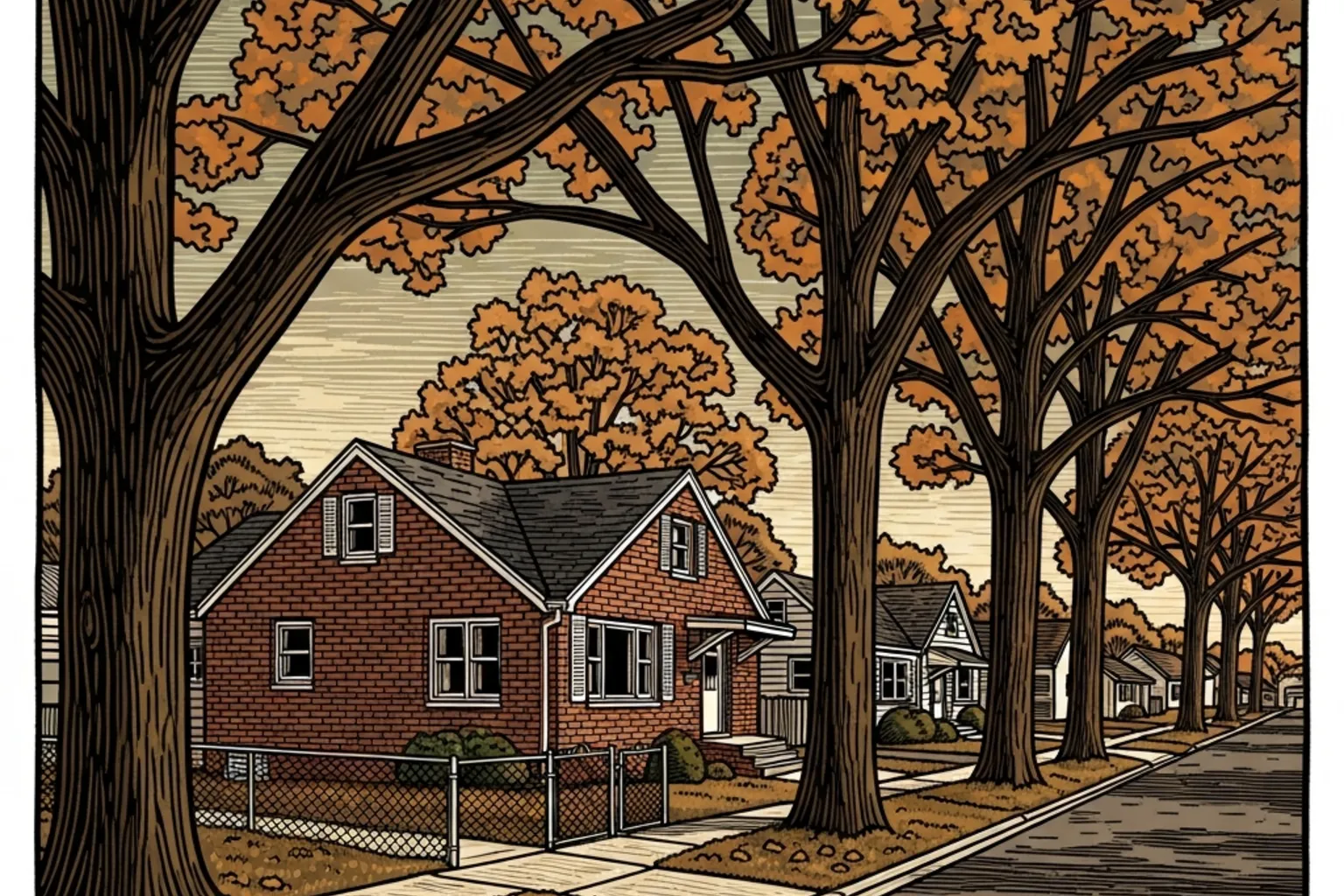
The house my parents bought in Muncie in 1968 cost $18,400. My father had been on the Delco-Remy line in Anderson for eleven years by then. My mother was working the front desk at Ball Memorial Hospital. They saved until they had a down payment, applied for a mortgage, and got one without much drama. Three bedrooms, one bathroom, a yard with a chain-link fence, on a street of houses where everyone was doing more or less the same thing for more or less the same reasons.
I’ve been thinking about that house all week because of what the United States Senate did Wednesday.
The ROAD to Housing Act cleared cloture 84 to 8, advancing toward a final vote a bill that would prohibit large institutional investors from purchasing additional single-family homes. Not from selling the ones they already own. Not from developing new construction. From using institutional capital to buy more of the existing residential stock where working families have historically lived, and if they were fortunate, owned.
Eighty-four to eight. In this Senate. The one that produces margins closer to 51-49 on most things that matter, often with a few defections and a lot of parliamentary maneuvering. Senators who can’t agree on surveillance law reauthorization agreed on this by a margin that breaks any filibuster by nearly twenty-five votes.
That number deserves some attention before we get to whether the bill will actually work, which is a harder question and worth asking separately.
The accumulation of single-family homes by institutional investors accelerated during the pandemic and its aftermath in ways that surprised even economists who study housing markets professionally. When borrowing costs sat near historic lows and asset prices were climbing everywhere, corporations with access to institutional capital could outbid families with cash offers, close in days rather than weeks, and convert the properties to rental stock at above-market rents or resell them at a premium when prices rose further. A family saving for a down payment competes badly against a corporation that doesn’t need financing and doesn’t have contingencies. That’s not a moral argument. It’s arithmetic.
The effect varied by place. In some markets the corporate footprint stayed small enough that most buyers never encountered it directly. In others, particularly across the Sun Belt and parts of the industrial Midwest, companies owned a meaningful share of homes on specific streets, which changed the neighborhood’s character even when the numbers didn’t register in regional data in ways a spreadsheet could capture.
What it changed, everywhere it landed, was the nature of the competition at the entry level. The starting point of the American middle class, since roughly the end of the Second World War, has been the first house. The down payment scraped together over years. The mortgage you can just barely qualify for. The yard. Getting there required competing with other families doing the same thing. Now, in the markets where the institutional buyers concentrated, it also required competing with entities that don’t need to sell if prices soften and don’t need the yard for anything.
Here is the complication the bill doesn’t fully address, and which its own supporters largely acknowledge.
The supply is short for reasons that have nothing to do with institutional investors.
Zoning laws in most American cities restrict the kinds of housing that can be built near where people want to live. Construction costs rose sharply over the past four years and haven’t come all the way back down. The shortage of affordable entry-level homes predates the institutional buying wave by at least a decade. Corporate purchases worsened a problem they didn’t create, and they worsened it at the margin where the problem was already worst.
Banning future institutional purchases won’t return the homes already bought to owner-occupied status. It won’t build a single new unit. It won’t change what a city allows to be constructed at what density, and that decision, made neighborhood by neighborhood over decades, is why there isn’t enough housing in the places where people need it.
I’ve covered enough congressional debates to recognize when a policy response is addressing one piece of a larger problem. This bill is that. That’s different from saying it shouldn’t exist. It’s saying the larger problem remains, and Congress isn’t voting on the larger problem.
But I’ve been sitting with that vote count since Wednesday.
I wrote in April about the gap between what the market says and what Americans feel. Record stock high and record-low consumer sentiment in the same week, two economies sharing one name. One of the things I didn’t get to in that column was the underlying question: when does the economy people actually live in force a response from the institutions that tend to track the other economy?
The answer, at least sometimes, is when enough people stop absorbing it quietly.
Something about housing crossed a visibility line. Not a crisis line exactly. The cost of housing has been rising for decades, and so has the difficulty of buying a first home, and so has the percentage of Americans renting rather than owning. What appears to have changed is that the cause became specific enough to legislate against. Institutional investors are a visible actor. They’re a target you can name in a sentence a constituent can understand. When senators go home on weekends, the people who stop them in grocery stores and at the county fair have apparently been describing what they’re seeing. And 84 of them heard it clearly enough to vote.
That matters to me because I’ve been watching Congress come up with reasons not to act for most of my career. I watched last week as Section 702 lapsed while the House was home on recess. Both parties had supported that surveillance authority for decades. It expired anyway because no one called anyone back. The explanation there was that trust between the parties had degraded past the point where even a shared interest could hold a procedural vote together.
The housing vote says something different. It says the pressure from below, from the people who can’t buy houses in the towns where they grew up, can still move a room. That 84 senators looked at the same problem and named the same cause and agreed that a law should address it is not a small thing, even if the law turns out to be an incomplete solution to an incomplete diagnosis.
Whether it passes the House, whether it gets signed, whether implementation follows the vote with any fidelity: those are legitimate questions, and I don’t know the answers. What I know is that a margin like 84-8 isn’t theater. It’s pressure that built somewhere until it found an exit.
The house on that street in Muncie sold in 2019, after my mother moved to assisted living. The buyer was a family, a young couple who wanted the yard for their kids. I don’t know the final price. I know it was considerably more than $18,400.
I walked my usual route through Oakley on Friday morning thinking about that chain-link fence. Karen was working in the garden when I got back. I told her what the Senate had done, and a little about what I’d been thinking.
She said, “About time,” and went back to her tomatoes.
She has a way of landing at the center of a thing without spending extra words on it. Forty-one years, and I still can’t do it quite as well as she can.