Patricia has been watching me read Colson Whitehead for thirty years. Not all at once, not as a project, but book by book as they arrived, each one doing something different from the last. Last week she asked me what I was going to say about him, having spent the spring writing about Wright and Baldwin and Hurston. I told her I wasn’t sure yet. She said: “You’re sure. You’re just stalling because he matters too much.” She reads three mysteries a week and doesn’t miss much.
She’s right, which is why I want to be careful here.
I’ve been tracing a lineage through this spring, not because a tradition needs its own defender but because these writers belong together the way the Mississippi Delta and Chicago blues and New York jazz belong together: same root system, different flowers, all of it music. Richard Wright named what it costs when a country arranges its power to ensure that some people never stop being afraid. James Baldwin wrote from exile and from love about the interior damage of being seen as a problem. Zora Neale Hurston insisted on the full life, joy and sorrow and everything between, as what Black literature owned and no one else could give us.
Colson Whitehead is where that current runs in our time.
He’s fifty-six years old and has published nine novels. He’s the only writer I know to have won the Pulitzer Prize twice, for The Underground Railroad in 2017 and The Nickel Boys in 2020. He writes zombie novels and crime novels and allegories and coming-of-age stories. He’s impossible to put in a category. Every few years he does something you couldn’t have predicted from what came before.
And yet I recognize him every time.
Sag Harbor (2009)
This is where I’d hand you the first book: not his most famous and not the prize-winner, but the one that makes you understand what all the others are built from.
Benji Cooper is fifteen years old in the summer of 1985. His family is Black and professional, part of a community that has summered in Sag Harbor, on the eastern end of Long Island, for decades. The novel is about a summer in this particular world: Black teenagers having the ordinary experiences of being fifteen in America, navigating friendships and first embarrassments and the specific awkwardness of not quite knowing who you are yet.
Hurston would have recognized this book immediately. The project is the same: Black people living full lives that contain everything life contains, not organized around the white gaze, not reduced to the thing done to them. Whitehead grew up summering in Sag Harbor and he writes this world from the inside. He knows what the inside of this summer sounds like.
It’s funny in the way real experience is funny, the comedy of specific remembered humiliations rather than the comedy of sketches. I’ve given this book to half a dozen people who said they weren’t sure about Whitehead, and every one of them came back wanting more. Begin here.
The Intuitionist (1999)
His debut told you, immediately, that something unusual had arrived.
The novel is set in an unnamed American city in an unspecified midcentury period. Lila Mae Watson is the first Black female inspector in the Department of Elevator Inspectors, and when an elevator she has certified crashes in a luxury building, she finds herself at the center of a mystery that is also an allegory about race and progress. Two schools of elevator inspection exist in this world: the Empiricists, who examine physical mechanisms, and the Intuitionists, who read the elevator by something closer to feel. The conflict between them is the conflict between what America says it values and what it actually does.
Whitehead builds this allegory with such a light hand that you can read the novel as a pure mystery and not miss a thing, or you can read it as one of the most precise meditations on the idea of racial progress in contemporary fiction. Both readings work. That’s the skill. Wright would have understood the anger underneath this book. Baldwin would have recognized the insight about how systems maintain themselves while appearing to change.
John Henry Days (2001)
His most ambitious novel and the one most people haven’t read, which is a genuine loss.
A freelance journalist named J. lives on press junkets, eating free food and filing copy, part of a culture of promotional journalism that Whitehead treats with sharp-eyed comedy. He’s been sent to cover the dedication of a John Henry postage stamp in Talcott, West Virginia, the town that claims to be where the legendary steel-driving man died in his contest with a steam drill. Whitehead braids J.’s story with others across time: a stamp collector, people who have passed through Talcott over the decades, fragments of the legend itself.
The novel is about myth-making, about what happens when a real person becomes a symbol, about the cultural machinery that turns Black labor into American legend and what gets left out in the translation. It’s demanding and it gives back more than it asks for. Come here after the others.
Apex Hides the Hurt (2006)
The protagonist is a nomenclature consultant, a man whose job is to give products their names, hired by a small town in dispute about what it should be called. His own name is never given. The novel is about naming as power: who gets to decide what something is called and what that decision means.
It’s short, strange, and funny, and the pleasure doesn’t undercut the seriousness. A town’s name is its identity. Who names it is who owns it. People who start with this book are sometimes surprised it came from the same writer who later wrote The Underground Railroad. I’m not surprised. This is Whitehead working at a smaller scale on the same question he always asks: what does this arrangement mean, and who pays the cost of maintaining it?
Zone One (2011)
Yes, this is a zombie novel. It’s also an elegy for New York City and a meditation on survival and the impossibility of returning to what you were before something terrible happened.
A civilian volunteer who goes by the nickname Mark Spitz is helping to clear Manhattan of the stragglers left behind after most of the dead have been eliminated: slow-moving figures stuck in loops of their former lives, standing forever in their offices or their favorite coffee shops. The novel follows three days of this work while his backstory unfolds in flashbacks.
The dead are a metaphor and they’re not a metaphor. They’re the premise, handled seriously. But they’re also the people who got left behind, the trauma that repeats itself indefinitely. Whitehead’s prose here is more deliberately literary than in some of his other work, sentences that accumulate in the way grief accumulates. I read it twice. The second time I understood it differently.
The Underground Railroad (2016)
You’ve heard of this one. Read it anyway, because hearing about it isn’t the same as sitting with it.
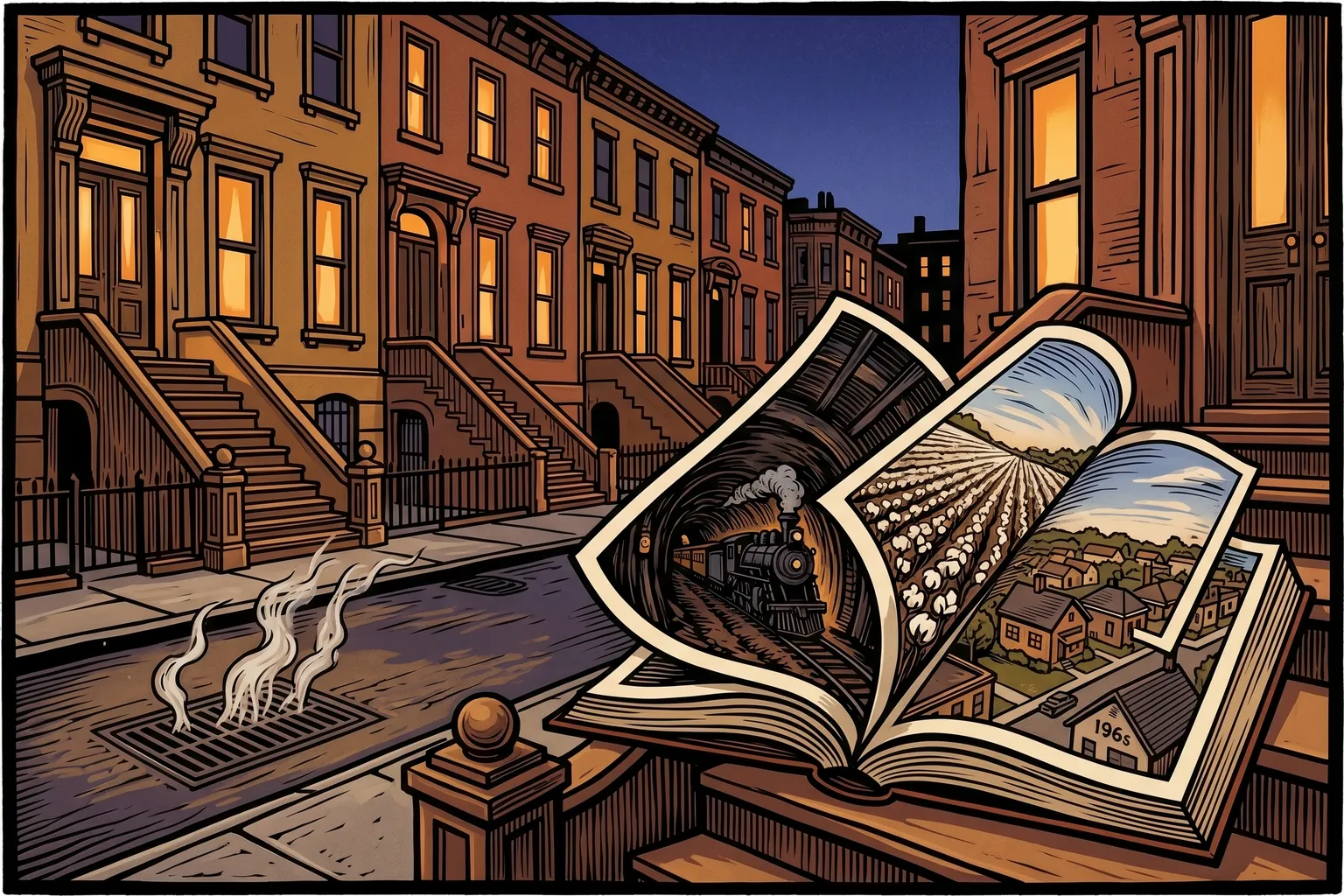
Cora is enslaved on a Georgia plantation. She escapes and takes the Underground Railroad, which in Whitehead’s novel is a literal railroad: tunnels and tracks and conductors and stations running underneath the American South. Each state she passes through is a different version of the country’s racial arrangements, each one proposing a different form of the same oppression.
The novel does what Wright and Baldwin were doing in different registers: it shows the specific, embodied, individual cost of the American racial system as what it does to one woman’s life. Cora is as fully realized as any character in recent American fiction. You know what she wants. You know what she fears. You understand exactly what she has survived.
The ending cost me something. That’s the highest praise I have.
The Nickel Boys (2019)
His second Pulitzer is the smaller, quieter, more devastating of the two.
Based on the real history of a reform school in Florida where students were subjected to years of documented abuse, and where some were killed and buried in unmarked graves, the novel follows Elwood Curtis, a young man sent to the Nickel Academy in the 1960s on the flimsiest of charges. He’s a reader of Martin Luther King, a young man who has taken the moral argument about justice seriously, and the novel traces what happens to that belief when it encounters an institution designed to destroy it.
Turner, another Nickel boy, is the moral counterweight: a pragmatist, a survivor, someone who figured out early how to read the system and get through it. The novel holds both of them without asking you to choose. Baldwin’s lessons show up everywhere here: the interior damage, the cost carried in the body, the long duration of what an institution tells a person about their worth. But what Whitehead does at the end is entirely his own invention, a structural choice that recasts everything you’ve read. I won’t describe it beyond saying it’s one of the few times I’ve put down a novel and sat still before I could get up.
Harlem Shuffle (2021) and Crook Manifesto (2023)
These belong together. One ends and the other picks up, following the same man across different decades.
Ray Carney is a furniture salesman in 1960s Harlem with a complicated relationship to the criminal world he grew up adjacent to. He’s not quite straight and not quite bent, and the novel is about the moral physics of a man trying to build something legitimate in a neighborhood where legitimate and otherwise are always in each other’s company. These are crime novels and they’re love stories, love for a neighborhood, for a marriage, for the specific texture of Harlem life across two books and roughly three decades. Whitehead is having more visible fun here than in much of his earlier work, the genre machinery clicking along while the emotional core stays serious.
The comparison I keep making is to James McBride’s The Heaven & Earth Grocery Store: a world built person by person, a neighborhood as protagonist, the life of a community as the thing the novel is trying to contain. Start with Harlem Shuffle and continue. You won’t want to stop.
The Tradition He Carries
When I write about the southern gothic writers or about the Harlem Renaissance or about any moment in this long American literary conversation, I’m tracing a root system. The roots don’t determine what grows. They make it possible.
Whitehead knows all of this. You can feel it in every book he’s written. And what he’s done with that knowledge is make nine novels that couldn’t exist without the tradition and couldn’t have been written by anyone who came before him, because they’re his, shaped by his particular restlessness, his refusal to write the same book twice. He reinvents himself every time. Most writers find a groove and stay in it. He treats the groove as a place to visit.
That’s what a tradition is for. Not to repeat. To hand forward.
If you want to follow the thread I’ve been pulling through this spring, start with Richard Wright, then move to James Baldwin, then Zora Neale Hurston, then Whitehead. You’ll understand each of them better for having read the others, and you’ll understand the tradition better for seeing how a writer inherits it and makes it new.
Or start with Sag Harbor. Come find me when you’re done. I know what to hand you next.