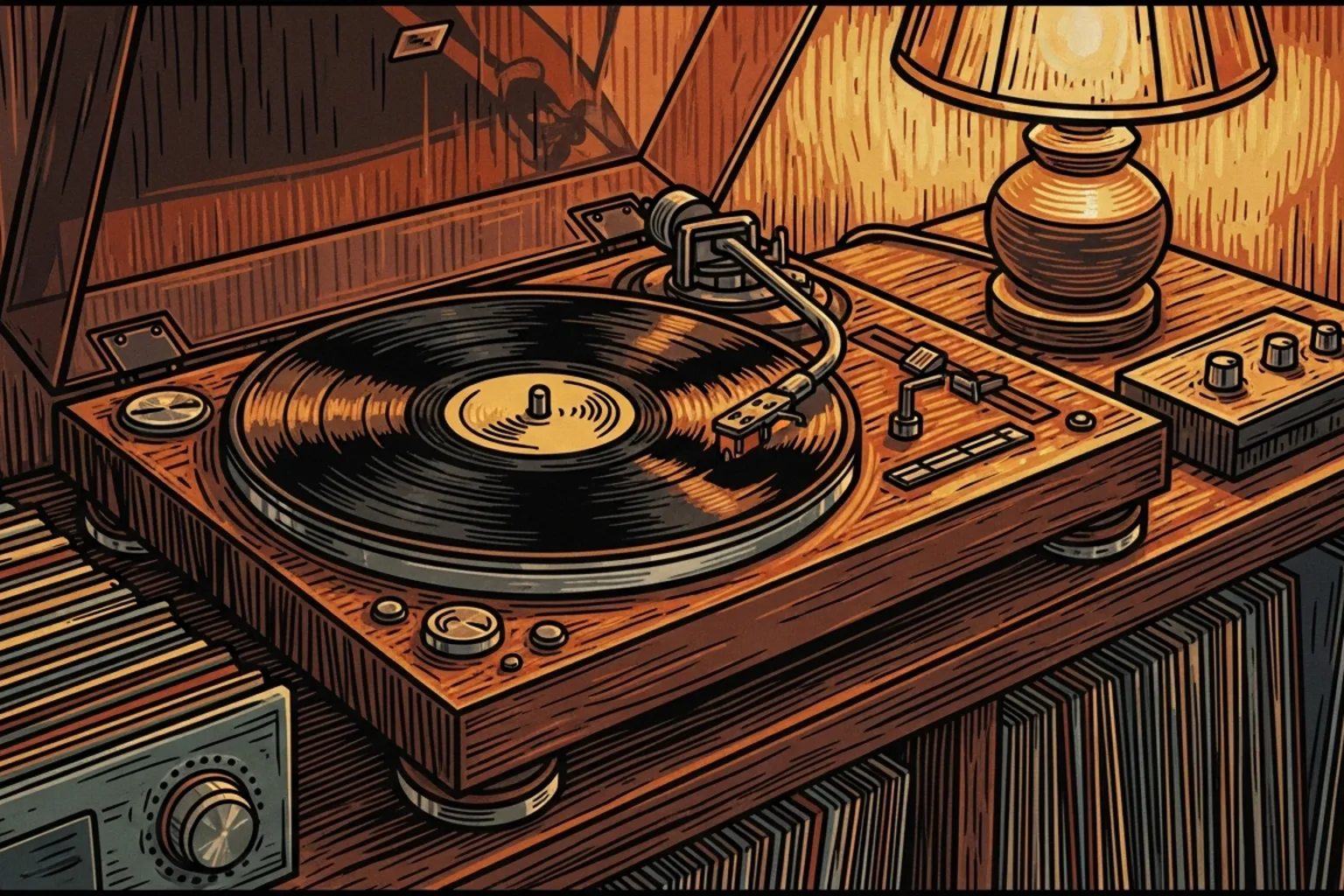
I found the records on a Saturday morning in late July. I wasn’t looking for them. I was looking for a lamp. The basement of the Kingfield house contains, in rough terms, thirty-nine years of accumulated decisions, and I’ve been working through them in the slow way that feels honest rather than the fast way that feels like erasure. The records were in a box behind the water softener, underneath a box of curtains we replaced in 1997.
There were close to a hundred and fifty of them. Jazz, mostly. Some soul. A few things that don’t fit any category cleanly. Miles Davis, Coltrane, Aretha Franklin, Al Green. A copy of “Night Birds” by Shakatak that I have no memory of buying. A Dinah Washington LP with a sticker from a record shop in St. Paul that closed before Marcus was born.
I have a receiver in the living room with a phono input. I know this because it’s labeled. What I don’t have is a turntable. At some point between the early nineties and now, the one I owned in my thirties left the house without my noting its departure, which is how these things go. So there’s a hundred and fifty records sitting in a box in the hallway that I can’t play, and I want to play them.
Here’s the honest place to start: I haven’t bought a turntable yet. What you’re reading is research, not experience. I’ve been studying the current market for several weeks, reading reviews, comparing what reviewers consistently agree on versus where they split, and trying to understand what’s real versus what’s marketing language. When I put a needle to vinyl, I’ll tell you. Right now, I’m telling you what the looking has gotten me.
The looking has gotten me somewhere useful.
What changes
The turntable market has reorganized itself considerably since the early nineties, and not in the direction I expected. The basic mechanics haven’t changed. You still need a needle in a groove, a platter spinning at controlled speed, a cartridge to translate that movement into electrical signal, and an amplifier to bring that signal up to something a speaker can use. The physics are the same physics.
What changed is the infrastructure around those physics. When I owned a turntable in my thirties, I had a receiver with a phono preamp built in as a matter of course. Nearly all receivers did. The phono preamp is a small but essential amplifier that takes the very faint signal from a turntable cartridge and raises it to the level that any other audio source produces. Without it, you hear almost nothing. With it, you’re in business.
Receivers stopped including phono preamps routinely sometime in the nineties, when the design assumption shifted to CD players and eventually to digital sources entirely. A lot of people with receivers bought in the last twenty-five years don’t have a phono input at all. The current generation of turntable manufacturers has largely answered this by building the preamp directly into the table. You plug it into powered speakers or any line-level input and it works. This is the first feature I checked on every table in this roundup.
The cartridge situation has also clarified. The best tables in this price range now come with serviceable cartridges designed to be upgraded over time, and they’re built so the upgrade is a stylus swap rather than a full cartridge alignment requiring a protractor and patience. That matters if you plan to stay interested in the listening, which I do.
What I look for now
I started this search with one requirement that narrowed the field immediately: the table has to connect directly to my powered speakers without additional hardware. I have a pair of active monitors I use for working in the evenings, and I want to run records through them on nights when the film I’ve queued can wait. That means a built-in phono preamp. Three of the seven tables I looked at most seriously don’t have one: the Fluance RT85, the Pro-Ject Debut Carbon EVO, and the Rega Planar 1. All three are fine turntables. None of them will help me without spending another $40 to $150 on an external preamp, which changes the real cost calculation. I kept them in the research because the picture isn’t complete without them.
The second thing I looked for was cartridge upgradeability. I know nothing yet about what my ears want from a turntable. What I know is that they’ve spent forty years developing preferences in film: a certain clarity in the detail, a sense that what you’re hearing is revealing something rather than just playing. That will translate to audio, and when it does I’ll want the option to improve the stylus without buying a new table. The tables with upgrade paths that don’t require realignment are worth the extra attention.
After those two things: build quality, platter material, speed stability, and how it looks on a shelf. The last one shouldn’t matter, but it does. I’m going to be looking at this in my living room every day.
Audio-Technica AT-LP60X
The AT-LP60X is the table I almost stopped at. Around $180, fully automatic, plug-and-play from the first record. You set the needle, press play, and when the record ends the tonearm lifts itself and returns to the rest position. That sounds like a minor convenience until you consider the alternative: a stylus sitting in the silent groove of a finished record while you’ve fallen asleep in the chair, grinding against the label. The AT-LP60X won’t do that.
The built-in phono preamp works. The die-cast aluminum platter stabilizes speed better than the plastic platters on cheaper alternatives. Reviews are consistent on both points.
The consistent criticism is that the cartridge can’t be upgraded. The ATN3600L stylus that ships with it can be replaced when it wears out, but the underlying cartridge body is fixed. You can’t swap in a better stylus later. The table you buy is the table you have. For someone who wants records to play reliably and without complication, and who isn’t interested in an upgrade path, this is a legitimate choice. It’s the easiest turntable to live with at this price.
As an Amazon Associate we earn from qualifying purchases. Sunday Evening Review earns a commission if you buy through a link on this page, at no extra cost to you. We have not been paid to recommend anything here.
Check current price on Amazon →
Audio-Technica AT-LP120XUSB
The LP120XUSB is the runner-up, and I want to be specific about what it offers. Direct drive means the motor sits directly beneath the platter and spins it without an intermediating belt. Belt-drive tables have to replace the belt eventually, and belts stretch slightly with age. Direct drive doesn’t age the same way. The LP120XUSB’s speed stability is, according to reviewers, meaningfully better than any belt-drive table at this price over the long run.
The VM95E cartridge that ships with it is part of a family designed around the stylus swap. If I want to upgrade from an elliptical stylus to a nude elliptical, or from there to a line-contact, I swap the stylus. No realignment. The upgrade runs $50 to $200 depending on how far I want to go. That’s an unusually clean upgrade path for this price.
The USB output lets you transfer records to digital, which I’ve thought about for a few of the more fragile LPs in that box. Reviews flag a real problem though: the USB recording circuit introduces audible digital interference for anyone trying to make clean archival transfers. Worth knowing.
What I’d have to live with: the tonearm is fully manual. When the record ends, the stylus sits in the silent runout groove until I lift it. For late-evening listening, that’s a discipline question. I’m capable of it. But I also fall asleep in my chair more often than I used to, and the stylus doesn’t care about that.
Check current price on Amazon →
Fluance RT81
This is the one I’d buy. Let me say that plainly and then explain it.
At around $250, the RT81 costs the same as the LP120XUSB. The two tables make different choices, and I prefer the RT81’s. The walnut MDF plinth makes it look like a piece of furniture rather than a piece of equipment, which I care about in a way I didn’t expect to. The built-in phono preamp means I plug it in and it works. The Audio-Technica VM95-series cartridge is upgradeable in exactly the way I want: a better stylus swaps in without touching cartridge alignment.
Reviewers who’ve pushed the built-in preamp on revealing systems say it shows its limits. That’s fair. I’m not running this on a revealing system. I’m running it on a pair of studio monitors in a living room in south Minneapolis, and the preamp will be more than adequate for years before I notice what it’s leaving behind.
The consistent minority complaint is occasional ground hum. Reviews note it clearly and note it isn’t universal. The tonearm is fully manual, which means I have the same stylus-in-the-groove situation I mentioned with the LP120XUSB. The RT81 isn’t the table for falling asleep to records. The AT-LP60X is that table. The RT81 is the table for sitting with records and listening to them, which is what I intend to do.
What I like most is the room to grow. The cartridge upgrade path is an honest one. The table will outlast the first stylus by years. At $250, you’re buying a starting point that doesn’t require you to start over.
Check current price on Amazon →
U-Turn Audio Orbit Plus
The Orbit Plus is built in Woburn, Massachusetts, which for some buyers is the beginning and end of the conversation. U-Turn has been assembling turntables in Massachusetts since 2012, and for people who make purchasing decisions around where things are made, this is one of the few legitimate choices in this price range.
What reviewers consistently describe is an open, uncolored presentation that serves acoustic music, jazz, and vocals especially well. The OA3 magnesium tonearm is a genuine step up from the aluminum arms on competing tables at this price. The Ortofon OM5E cartridge is upgradeable. The version with the built-in Pluto 2 phono preamp connects directly to powered speakers and comes in around $450.
Speed changes require moving the drive belt manually from one pulley position to another for 45 RPM. It works. It’s just not as smooth as tables with electronic speed switching. And like every other table here except the AT-LP60X, the tonearm is fully manual.
If American provenance matters, or if the sound character reviewers describe sounds like what you’re after, the Orbit Plus is worth serious consideration. For someone whose records run heavily toward jazz and vocal, I’d take a long look at this one before settling on the LP120XUSB.
Check current price on Amazon →
Fluance RT85
The RT85 costs around $500 and arrives with an Ortofon 2M Blue cartridge factory-mounted. The 2M Blue is an audiophile-grade stylus that sells for $150 to $200 on its own. The acrylic platter eliminates the need for a separate mat and contributes to a quieter noise floor. Reviewers describe a wide, detailed soundstage that genuinely surprises people who came in skeptical about what vinyl can do.
The problem is the preamp. There isn’t one. To connect the RT85 to powered speakers or any line input, you need to spend another $40 to $150 on an external phono stage. That puts the real cost somewhere between $540 and $650. At which point you’re having an honest conversation about the Pro-Ject Debut Carbon EVO.
If you already have a receiver with a functioning phono input, the RT85 is a serious table at a reasonable price and the cartridge alone is worth the premium over the RT81. Starting from scratch without a phono input, do the full math first.
Check current price on Amazon →
Pro-Ject Debut Carbon EVO
The defining feature here is the 8.6-inch carbon fiber tonearm. Lower mass, higher rigidity than the aluminum arms on competing tables at this price. Reviewers consistently say it resolves fine musical detail that heavier arms can’t retrieve. The Sumiko Rainier cartridge ships factory-mounted and factory-aligned, so setup amounts to setting the counterweight. No user alignment required.
Electronic speed switching between 33, 45, and 78 RPM without moving the drive belt is a quality-of-life feature that sounds small until you’ve moved a belt manually for the fifteenth time. The Pro-Ject is the only table in this roundup with that capability.
It’s footfall-sensitive. Vibrations from speakers or foot traffic on the same surface the table sits on will reach the stylus. It needs an isolated shelf away from the speakers and floor traffic. Reviewers note this clearly. The drive belt needs replacing every two to three years.
No built-in phono preamp. Add $50 to $150. Tonearm is fully manual. At around $600 before the preamp, this is a table for someone who knows what they’re doing and intends to stay interested.
Check current price on Amazon →
Rega Planar 1
Rega is a British company that has been building turntables in Southend-on-Sea since the 1970s. The Planar 1 is their entry point, and reviewers describe it the way reviewers describe very few things at any price: as musically alive in a way that goes beyond what the specifications explain. Tonal neutrality and rhythmic timing, specifically. The phrase I keep seeing is that it pulls you into the record rather than drawing your attention to the hardware.
The RB110 tonearm’s ultra-low-friction bearings get repeated mention as audibly superior to competing arms at this price. The Carbon MM cartridge arrives factory-fitted and factory-aligned at the factory in England. It’s ready to play within minutes of unpacking.
The limitations are real and worth knowing. No built-in phono preamp. Speed changes require removing the platter entirely to move the drive belt, because there’s no selector switch. The RCA cables are permanently attached and can’t be replaced or upgraded. The cartridge upgrade path is narrower than the Ortofon 2M or Audio-Technica VM95 families. There’s a lifetime warranty against manufacturing defects, which Rega honors.
If I had a phono preamp already and wasn’t interested in managing a cartridge upgrade schedule, the Planar 1 is where I’d be looking seriously.
Check current price on Amazon →
Where the looking has gotten me
A hundred and fifty records and no way to play them is a specific kind of frustration. The research did what research is supposed to do: it turned a vague problem into a specific decision.
The RT81 is the decision. Built-in preamp, so I connect it and it works. Upgradeable cartridge in a family that costs $50 to $150 to improve without touching alignment. A walnut plinth that won’t look out of place between the DVDs and the Blu-rays on the shelf. A starting point, not a conclusion.
I’m aware the Rega Planar 1 is the more musically interesting table, and that the Pro-Ject’s carbon fiber arm retrieves detail the RT81’s aluminum arm won’t. Those are tables for someone who already knows what they want from vinyl, and I don’t know that yet. They also require a preamp I don’t have, and together they cost $350 more before the preamp. That’s a conversation for two years from now, after I’ve been listening and know what my ears are asking for.
The Dinah Washington LP is on top of the box. I’m starting there.