People ask me what southern gothic means, usually because they’ve heard the term applied to a book they just finished and want to know whether the label fits. I’ve been having this conversation for thirty years. My short answer is: you know it by what it does to you. My longer answer is what follows.
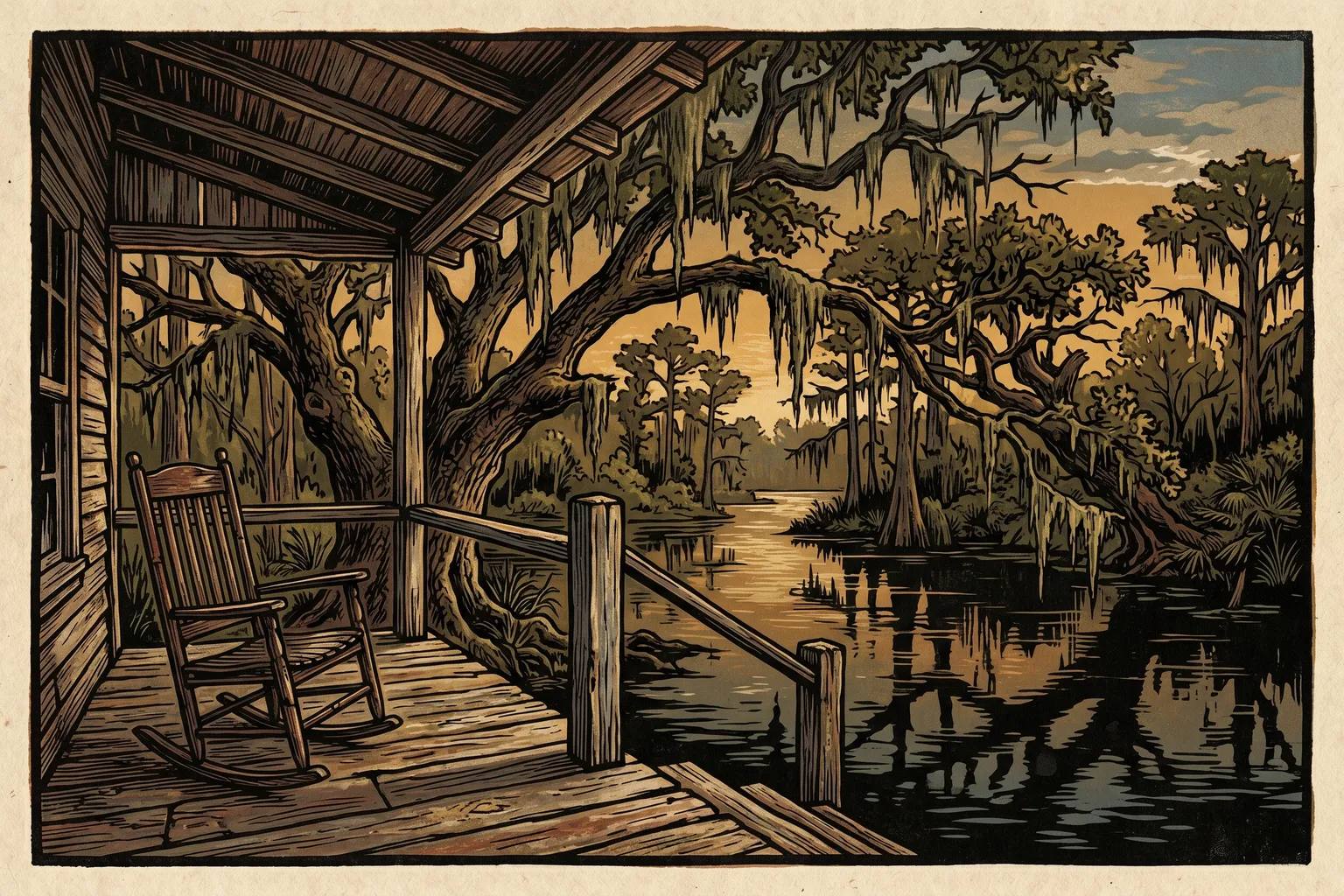
My working definition, built from fifty years of reading rather than any scholarly consensus: southern gothic is the fiction that comes out of a place where the past doesn’t know it’s supposed to stay in the past. Where the houses remember. Where beauty and horror can occupy the same sentence without either one canceling the other out. The South serves as pressure in these novels, not backdrop. The land itself is implicated.
I grew up in Greensboro, North Carolina. My father pastored a Baptist church for thirty-six years. My mother taught sixth grade and read to all five of her children every night. I know something about living inside a place that carries the weight of its own history at all times, where Sunday morning can feel like both grace and reckoning depending on where you’re standing when the light comes in. When I first came to this literature as a young man, I didn’t arrive as a visitor. I arrived as someone who already understood the temperature.
The names most often attached to this tradition are Faulkner and Flannery O’Connor, and they belong here. But something I want to say before we get to them: southern gothic isn’t a whites-only enterprise, and treating it that way misrepresents what the tradition actually is and where some of its most essential work gets done. Some of the most necessary fiction in this tradition was written by Black writers who knew the South from a different angle and whose work carries a weight that the canonical names, for all their genius, weren’t positioned to carry in the same way. If you’ve spent time with James Baldwin’s essays about the American South or Richard Wright’s fiction set in Mississippi and Chicago, you already know the outline of this inheritance. The gothic tradition didn’t pass around those writers. It ran through them.
Toni Morrison, Beloved (1987)
If you’ve been meaning to read Beloved and haven’t yet, let this be the week. A formerly enslaved woman named Sethe lives in a house outside Cincinnati with the ghost of the infant daughter she killed to prevent her return to slavery. The ghost becomes embodied. The house is full of her. The community keeps its distance, and its silence is its own kind of judgment.
I can give you that plot summary and still not prepare you for what the book does to you. Morrison understood that the weight of what the South had done didn’t stop at the Ohio River. The ghost isn’t supernatural in the way horror fiction uses the supernatural. She is what happens when history isn’t allowed to end, when the dead aren’t given the peace they were owed. Sethe carries the past in her body, in the house, in the silence of neighbors who know what she did and can’t forgive her and also can’t entirely condemn her.
Beloved is as deeply gothic as anything Faulkner wrote. Its moral understanding is more complete, because Morrison was working from inside the specific horror that Faulkner was circling from the outside. I’ve given this novel to more than forty people over twenty-two years behind a counter and a decade hosting book discussions at the Durham County Library. Some of them had to set it down for a while and come back. That’s not a warning. It’s the book asking you to take it seriously, which it earns the right to ask.
As an Amazon Associate we earn from qualifying purchases. Sunday Evening Review earns a commission if you buy through a link on this page, at no extra cost to you. We have not been paid to recommend anything here.
Check current price on Amazon →
William Faulkner, As I Lay Dying (1930)
Don’t start with The Sound and the Fury. Start here.
The Bundren family is transporting the body of the family matriarch, Addie, across Mississippi to bury her where she asked. Each chapter is narrated by a different character. One of Addie’s own chapters comes after she’s already dead. The novel is at times blackly comic in ways that surprise readers who approach Faulkner expecting only solemnity: the Bundrens are in over their heads, the journey goes catastrophically wrong, and their determination keeps going anyway. The devotion and the catastrophe are tangled together and neither cancels the other out.
Faulkner’s sentences ask something of you. He doesn’t smooth things out for the reader, because the South he’s writing about isn’t smoothed out, and he considers the difficulty of the reading to be part of the point. Once you’ve read As I Lay Dying, The Sound and the Fury (1929) opens up. The Benjy section isn’t accessible on a first read, but something clicks partway through the Quentin section and you’ll want to go back to the beginning. Read that order: As I Lay Dying first, then The Sound and the Fury. It matters.
Check current price on Amazon →
Flannery O’Connor, A Good Man Is Hard to Find and Other Stories (1955)
O’Connor was a Catholic writer in the Protestant South, and that peculiar double-outsider position gave her a perspective on both traditions that neither could have on its own. Her characters are hypocrites and self-deceivers and people who hold excellent opinions of themselves right up until something violent intrudes. The violence in O’Connor isn’t punishment exactly. It’s an intrusion of reality into carefully maintained unreality, which she understood to be a form of grace arriving in the only way her characters could receive it.
The title story of this collection ends with a mass shooting in the woods. I tell you that not as a spoiler but as a preparation. The suspense isn’t the point; the moral weight is. Read “A Good Man Is Hard to Find,” then “Good Country People,” then “Everything That Rises Must Converge.” If you want everything she wrote in this form, The Complete Stories, published in 1971 after her death, is the book to have. It won the National Book Award that year. It deserved it.
Check current price on Amazon →
Randall Kenan, A Visitation of Spirits (1989)
This is the one I push hardest, because it’s the least known of what I’m describing and it deserves a much wider audience than the one it has.
Kenan grew up in a small rural community in eastern North Carolina. His first novel is set in a place very like it: Tims Creek, a Black community with deep Baptist roots and generations of history pressing on everyone inside it. Horace Cross is sixteen, devoutly religious, and gay, and the novel moves between 1984 and 1985, between the present moment and the layered past of his family and his community, in a structure that has something of Faulkner’s architecture without being imitative. The supernatural is fully present: Horace performs a ritual, an actual conjuring, attempting to transform himself into something other than what he is. The community he comes from is beautiful and suffocating in the same breath.
That’s the essential condition of southern gothic. The tradition requires you to love the place and to understand what it cost the people who had to live inside it.
I read this novel for the first time in the early nineties, after closing the shop one night when Patricia had the car and I’d walked down. I sat in the dark of the bookshop after finishing and thought for a long time about what it means to come from somewhere that can’t love you back the way you need to be loved. I’ve thought about that question many times since. I still don’t have a cleaner answer than what Kenan put on the page.
Check current price on Amazon →
Jesmyn Ward, Sing, Unburied, Sing (2017)
Ward is from DeLisle, Mississippi. She’s written three novels set in the same fictional county in that state, each one adding another layer to the place until it feels as real and specific as somewhere you’ve lived. Sing, Unburied, Sing is where I’d tell you to start.
Jojo is thirteen. His grandfather is a Black man who survived Parchman Farm, the Mississippi State Penitentiary that functioned as a forced labor camp well into the twentieth century. The family makes a road trip to collect Jojo’s father from that same prison, and the dead travel with them. Literally: the novel’s ghosts are full characters, present and demanding and unable to leave. Ward works in a direct lineage from Morrison, understanding the South as a place where the dead don’t rest because they haven’t been given what they were owed.
She won the National Book Award for this novel in 2017. It was her second time. The first was for Salvage the Bones in 2011. Both were earned. If you’ve read the history these novels are in conversation with and want to see what fiction does with that history that scholarship can’t, Ward is where I’d send you.
Check current price on Amazon →
Carson McCullers, The Heart Is a Lonely Hunter (1940)
McCullers was twenty-three when this novel was published. John Singer is a deaf-mute man living in a Georgia mill town whose silence makes him everyone’s confessor. A teenage girl, a Black doctor, a radical labor organizer, a diner owner: all of them talk to him, unburden themselves in his presence, and never quite know that he isn’t receiving them the way they imagine. The tragedy is a specific and quiet kind, a person becoming a symbol to others in a way that forecloses his being known as a person.
The novel isn’t gothic in the way Faulkner is gothic. There are no ghosts, no rituals, no decaying mansion. But it has the thing that makes southern gothic what it is: a society’s failures pressing down on individual people through ordinary life, through ordinary rooms. The South here is the most unremarkable place imaginable. That’s what makes it disturbing.
Check current price on Amazon →
What these books share, across all the differences in who wrote them and when and from what angle: a conviction that the past isn’t done with the present. That the land holds memory. That beauty and horror don’t cancel each other out but require each other in ways that only fiction can hold without collapsing.
I spent twenty-two years recommending books from behind a counter on Ninth Street in Durham. The pile I’d put in your hands has shifted some over those years. These books haven’t left that pile. If you want a place to start, begin with Sing, Unburied, Sing. Let Ward show you what the tradition can do at its most fully realized, then go backward: Morrison, O’Connor, Faulkner. Come to Kenan after those and you’ll understand exactly what he’s doing.
Come to McCullers whenever you’re ready for the quiet kind of gothic, the ordinary kind, which I’d argue is the hardest kind to write.
The questions these books are asking haven’t been answered. That’s why they stay on the shelf. That’s why the books keep coming.