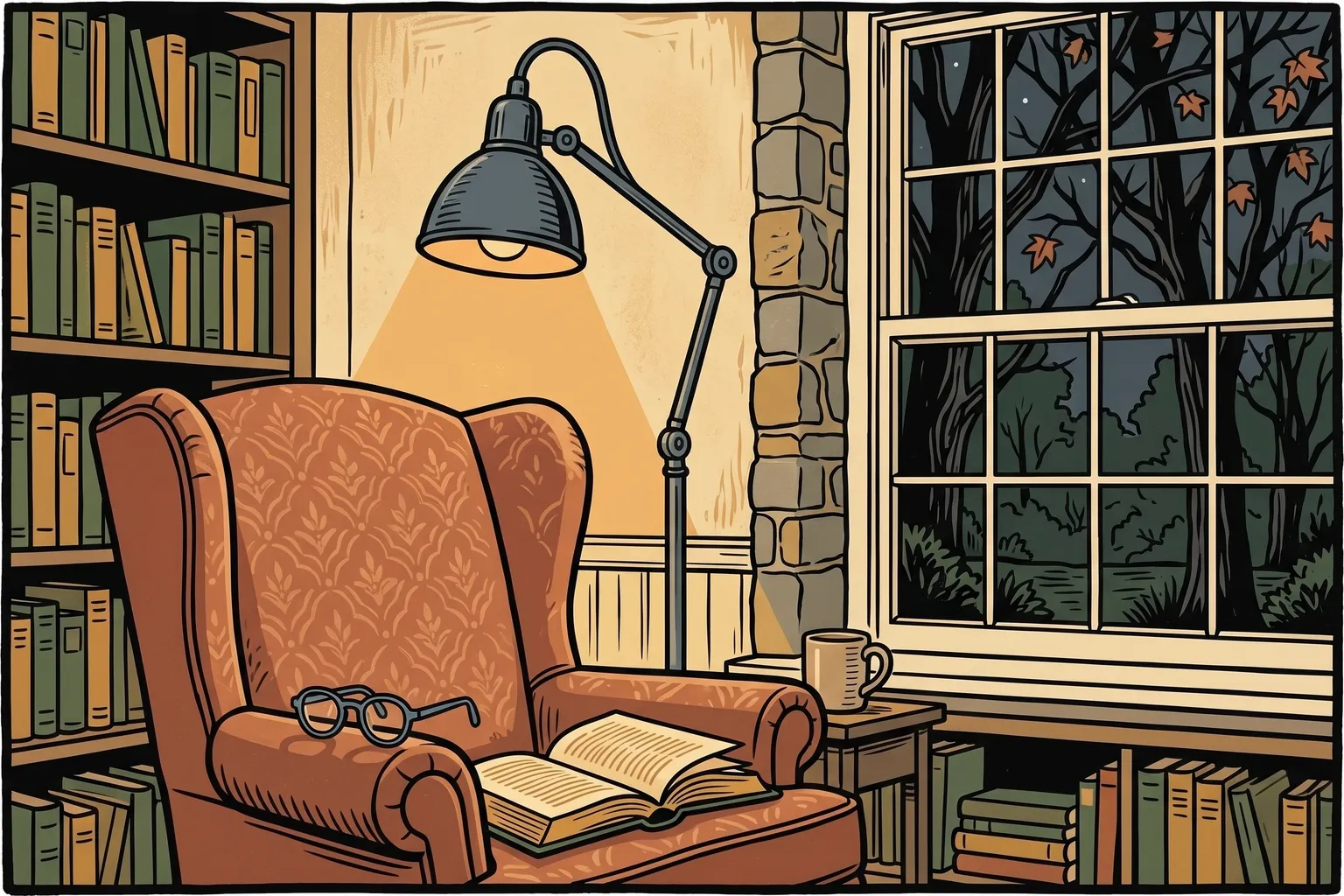
I have a lamp problem.
I’ve had it for years and done nothing about it, which is exactly the kind of thing I would recognize immediately in a letter from a reader as a choice dressed up as inertia. The lamp on my nightstand is a ceramic piece I bought in 1994 because it matched the wallpaper, which has since been repainted twice. It has never, in thirty-two years, been the right lamp for reading. The shade is too wide. The light scatters. At ten-thirty at night, with an Elizabeth Strout novel open and my reading glasses pulled up from the chain around my neck, I’m reading by something I can only describe as ambient optimism. I finish chapters. I miss sentences. I find myself going back three paragraphs not because the prose rewards it but because the light is wrong and I’ve lost the thread.
I mentioned this to Karen last spring. She said, without looking up, “Just get a different lamp.” This is correct. It is also, in the way that all correct obvious things are, considerably easier to say than to do.
What Karen doesn’t understand, or what I’d stopped explaining because she was right and I knew it, is that buying a reading lamp is not quite as simple as buying a reading lamp. There’s brightness, and there’s color temperature, and there’s color rendering index, and there are floor lamps and desk lamps. There are the specific considerations of reading at ten at night versus reading on a Sunday afternoon. And there is the particular stubbornness that settles in after you’ve lived in a house for thirty-six years, which makes it easy to stop noticing things that haven’t worked for years.
This spring I did the research seriously. Not casually. Seriously, which means I spent real time on it, read what the researchers and reviewers actually found, and came to a conclusion I’d stand behind. I haven’t bought any of these lamps. That’s the honest place to start, and I’d rather say it plainly in the first few paragraphs than have you discover it by accident halfway through. What follows is research, not testimony. I’ll tell you when that changes.
Here is what the research found.
What changes
It isn’t the eyes themselves, exactly. Or not only the eyes.
What changes, gradually, is tolerance for the wrong conditions. For years you read by whatever light is in the room and compensate without noticing you’re compensating. You move closer. You tilt the page. You blink more than you used to. None of this registers as a problem. It registers as nothing, until one night you’re rereading the same paragraph for the fourth time and you think: it’s not the book.
Color temperature is the thing most people don’t know to consider. The light from a standard lamp, or a screen, or a certain kind of LED, runs toward the blue end of the spectrum. That blue-heavy light is fine in the morning. It’s designed, essentially, to tell your body the day is starting. At ten o’clock at night, sitting in your reading chair, it tells your brain the day hasn’t ended yet. The research on this is consistent and has been for years: cooler light (measured in Kelvins, with higher numbers meaning cooler, bluer light) suppresses melatonin more than warmer light does. A lamp at 5000K in the morning is a different thing from the same lamp at ten at night. The best reading lamps for evening work let you dial that down to something warmer.
The other change is what you’re asking the lamp to do. I’m reading more now than I was when I was working, longer sessions, harder books, the kind of reading that used to happen in stolen hours and now happens in deliberate ones. The lamp I was tolerating at forty-five isn’t the lamp I’m willing to tolerate at sixty-eight.
What I look for now
The criteria turned out to be shorter than I expected.
Color temperature range comes first. A lamp that runs only at a cool 5000K daylight tone is designed for workshops and offices. I want a warm setting at or near 3000K for late reading, and the ability to go cooler for afternoon work or close needlework.
Brightness with real steps. Not just high and low. Multiple levels of dimming let you match the light to what you’re doing and to the hour, without forcing a compromise in either direction.
Directionality. I don’t need to light the room. I need to light the page. A gooseneck or adjustable arm that lets me aim the light over my shoulder and onto the book is worth considerably more than raw lumen output scattered at the ceiling.
A high CRI. Color rendering index measures how accurately a light source shows colors compared to natural daylight. For reading, it translates to print contrast. A lamp with a CRI above 90 makes type on a white page sharper and more distinct than a lamp with a lower number. It isn’t a dramatic difference. It’s the difference between reading easily and reading with effort.
Stability. A floor lamp that tips if you brush it on the way to the kitchen is a floor lamp I’ll stop trusting. A weighted base earns its cost.
Touch controls are last but they’re not trivial. Finding a switch in a dark room isn’t hard. Finding a switch you can operate accurately when you’re half-asleep and trying to turn off the light without waking yourself up completely is harder. Touch controls solve this in a way that physical switches don’t.
Verilux SmartLight Full Spectrum LED Floor Lamp
This is the one I’d buy. The reason is the 3000K warm setting, which is the feature everything else on this list either offers or doesn’t, and it’s the feature that separates a lamp useful for evening reading from a lamp that will keep you awake longer than you planned.
The SmartLight gives you three color temperatures: 3000K warm, 4000K neutral, and 5000K daylight. It pairs those with five brightness levels. That’s fifteen combinations, which sounds like more than you’ll use until you’re adjusting for the difference between July at ten o’clock, when the light outside has barely left, and January at ten o’clock, when it’s been dark since four in the afternoon. The Optix glare-control lens softens the harsh hotspot that cheaper gooseneck lamps produce. The gooseneck puts the light where reading chairs need it.
With more than 6,000 reviews averaging 4.6 stars, the praise centers on what matters: the adjustable color temperature, the warm evening setting, the light quality for page work. The consistent complaints are worth knowing about. The flexible gooseneck section has cracked or collapsed on some units after months of regular use. The two-piece upright pole doesn’t always seat firmly in the base on every floor, which introduces wobble for some buyers. These are real concerns, reported by a real minority. At around $80, for what this lamp does, the research makes the case clearly enough.
As an Amazon Associate we earn from qualifying purchases. Sunday Evening Review earns a commission if you buy through a link on this page, at no extra cost to you. We have not been paid to recommend anything here.
Check current price on Amazon →
OttLite ClearSun LED Floor Lamp
This was the closest I came to changing my pick. What the ClearSun does better than anything else in this roundup is CRI: 95-plus, among the highest in the category. Reviewers say consistently that black type on white paper appears genuinely crisp under this lamp, not flat, not washed out, but the contrast you remember from reading in good afternoon light. The touch controls are rated highly for ease of use in a dim room, and the adjustable height from roughly 48 to 64 inches suits both chair-side placement and over-the-shoulder use.
Where it falls short, for my purposes, is color temperature. The ClearSun offers three brightness levels but no color temperature modes. You can make it brighter or dimmer. You can’t make it warmer. For an evening reader who wants to shift down to a warm setting before bed, that’s the limitation the SmartLight doesn’t share. Some reviewers also report looseness developing in the flexible neck after extended use.
The runner-up position isn’t a slight. If you read primarily in the afternoon, or in a room with other light sources, and color temperature shift isn’t your concern, the ClearSun’s CRI and touch controls make it the right lamp. At around $85, it’s nearly the same price as the SmartLight.
Check current price on Amazon →
Verilux HappyLight Duo Floor Lamp
This lamp markets itself primarily for light therapy, which reviewers who bought it for reading consistently point out is beside the point. What matters for reading is the output, the control, and the stability, and on all three the HappyLight Duo is the strongest floor lamp in this group.
The brightness goes up to 10,000 lux, substantially higher than anything else here. The 18-pound weighted base is described by reviewers as the most stable gooseneck floor lamp they’ve owned. The 360-degree flexible neck reaches positions that a rigid arm can’t. Three color temperatures and five brightness levels give you full range. The UV-free full-spectrum LED gets consistent credit for even, hotspot-free coverage across a wide reading area.
The trade-off is weight and price. At around $130 and 18 pounds, this lamp is harder to move once you’ve placed it, which reviewers mention most often when rearranging furniture. The light-therapy marketing is irrelevant to what it does for reading, so don’t let it drive the decision in either direction. If you want the most capable floor lamp and are willing to pay for it and give it a permanent home, this is it.
Check current price on Amazon →
Brightech Litespan LED Floor Reading Lamp
The budget option among the floor lamps, at around $55. Reviewers praise the focused gooseneck, which puts light over the page without scattering it around the room, the weighted metal base, which holds without tipping, and the assembly, which is described as straightforward. The 3-year warranty with US-based support is cited often as a deciding factor.
The fixed color temperature, around 5000K with no warm mode, is the defining limitation. For afternoon reading, or for any reading that ends before dark, this isn’t a meaningful problem. For reading in bed at ten o’clock at night, it is. The Brightech is a competent, well-built lamp at an honest price. What it doesn’t do is shift warm for evening reading, and for the extra $25 the SmartLight costs, that shift is the thing worth buying.
Check current price on Amazon →
Lumiy Lightblade 1500S
The most capable desk lamp here, for anyone who reads at a desk or nightstand and wants genuine control over the light. The 1500-lux output at 93 CRI renders very small print in high contrast with minimal color shift, which reviewers who value precision lighting note consistently. Twenty discrete brightness steps and four color temperature modes is more granular than nearly any competitor in the price range, and the pivoting head lets you position the light precisely over a page rather than simply aiming it at the general vicinity.
It’s a desk lamp only, requiring a table or nightstand rather than standing at floor level. The plastic housing draws consistent criticism as feeling less substantial than the price implies, and the glossy finish shows fingerprints badly. Neither concern affects performance. At around $100, for a reader who wants fine-grained control from a desk or bedside position, this is the serious choice.
Check current price on Amazon →
TaoTronics TT-DL02 LED Desk Lamp
The desk lamp for a bedroom or reading table, at around $65. Four color temperature modes, spanning from a warm candlelight tone to a crisp cool white, give useful range across different hours of the day. Touch controls are easy to cycle through in a dark room without hunting for a switch. The memory function returns to your last setting, which is a small feature that proves more useful than it sounds once you’ve used it for a few nights.
The lumen output is modest and falls short for some readers doing very fine print work or reading in a large room. The USB charging port is too low-amperage for fast-charging modern tablets. This is a desk lamp only, so you need a surface. For a nightstand reader who wants a warm evening setting, touch controls, and an easy-to-use timer function, it does what it promises.
Check current price on Amazon →
Where the looking has gotten me
I came into this expecting a clearer field than I found. What the research shows is one strong pick and a set of legitimate alternatives, each serving a different version of the question.
For a reading chair or sofa in the evening, the Verilux SmartLight is the answer. Three color temperatures, five brightness levels, a gooseneck that aims at the page, and around $80. The case for it isn’t complicated.
For a desk or nightstand, the Lumiy Lightblade 1500S is worth the hundred dollars if control matters to you. Twenty brightness steps and four color temperature modes is more than most people will use most nights. Having the range available is a different thing from not having it.
For anyone who wants the most capable floor lamp and doesn’t mind planting it somewhere permanent, the HappyLight Duo at around $130 is that lamp. The 18-pound base isn’t moving without effort, which is also why it doesn’t wobble.
Karen was right that I should have done this sooner. She was more right than she knew. The difference between a lamp that happens to be in the room and a lamp that actually illuminates the page without straining your eyes or keeping you awake past midnight isn’t a small difference. I’ve been tolerating the wrong one for thirty-two years. The SmartLight is where this research has landed.