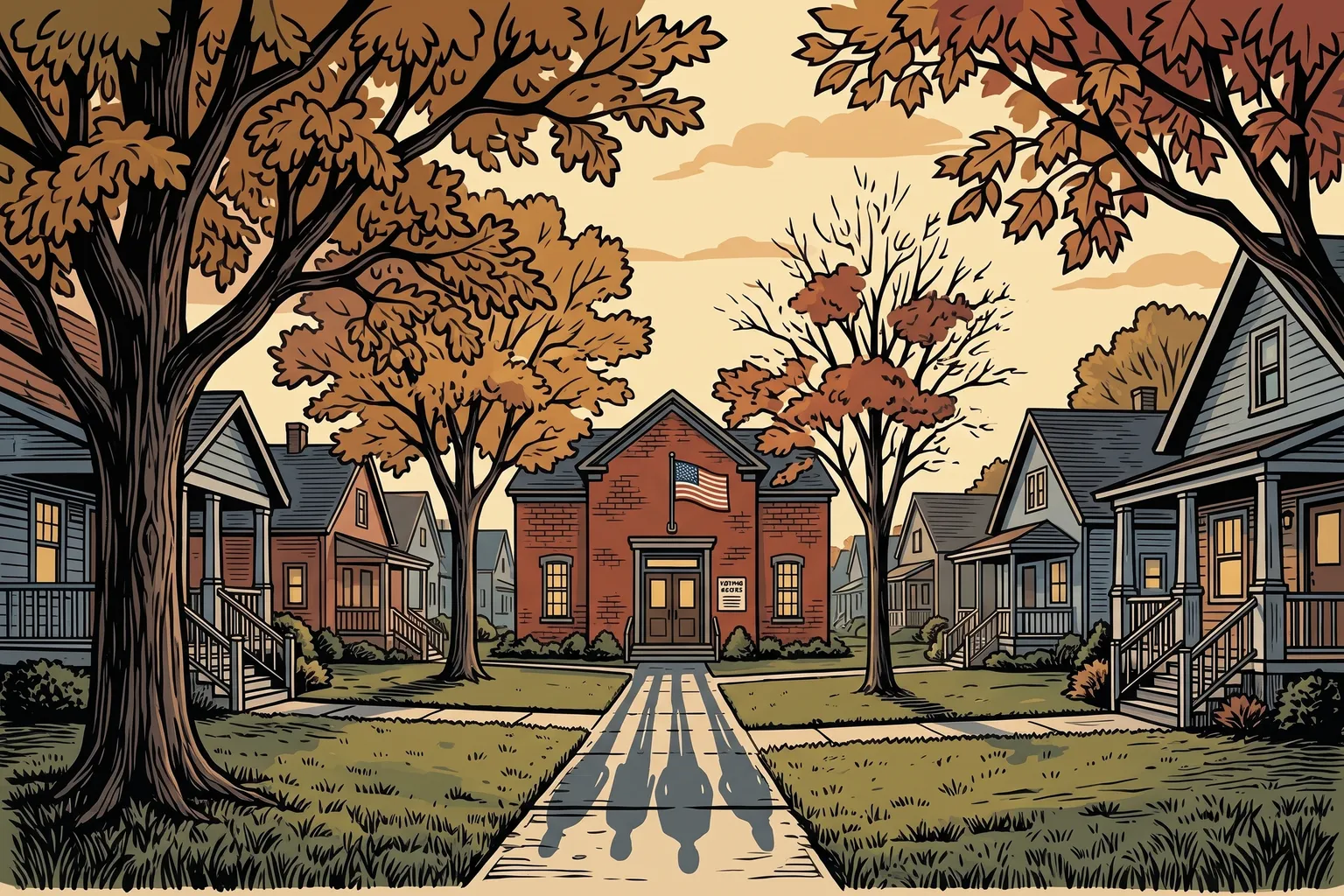
On Wednesday morning I drove past the Hamilton County Board of Elections on my way back from picking up the papers, and there were forty-some people in line outside before the building opened at seven-thirty. A woman in hospital scrubs. A man in work boots holding a thermos. Two women in their sixties who appeared to be together. The line stretched past the parking meters and around the corner.
They were there to vote. Not on Tuesday. On Wednesday. Six days before the only day the country officially calls Election Day.
I sat with that line for a moment before the light changed. The word I kept coming back to wasn’t enthusiasm. It was urgency.
Forty-three million Americans have cast early ballots going into this weekend. That number deserves a little sitting with. It means that by Tuesday evening, when the networks settle into their long night of graphics and projections, somewhere between a third and nearly half of the electorate will have already voted and gone home. The outcome will be shaped, at least in part, by people who made up their minds in October.
We stopped calling it Election Day in any meaningful sense years ago. We just haven’t updated the ceremony.
Early voting was built for access. The argument, and it was a good one, was that Tuesday had been structurally unfair from the beginning. If you worked hourly in a warehouse, or pulled twelve-hour shifts at a hospital, or didn’t own a car and had to get to a polling place across town, the single Tuesday in November was an obstacle that had nothing to do with whether you wanted to vote. Early voting removed that obstacle. That’s worth having.
But something else has happened too, and it took me a while to name it. Early voting has become, for a significant part of the electorate, an anxiety management tool. People are voting early not because they can’t make it on Tuesday but because they don’t want to be the person who watched everything happen without having done their part. They want the box checked. They want the sticker. They want it behind them.
That’s not cynical. It’s very human. But it tells you something about what we’ve made elections into.
The line at the Board of Elections on Wednesday morning wasn’t a partisan thing. You can’t tell, looking at a line, how people intend to vote. The aggregate data suggests Democrats are outpacing Republicans in early voting in several states, which Democrats are citing as momentum and Republicans are noting is consistent with their traditional Election Day strategy. Both interpretations can be true. Most things in elections are less decisive than the people asserting them want them to be.
What you can read from the line is that those forty people didn’t trust the process to wait. Not because they thought their ballot would be lost or suppressed, though some Americans believe things like that, and those beliefs haven’t emerged from nowhere. But because the country has built a rolling two-week election, and once you can vote early, once the option is there, the question becomes why wouldn’t you?
For most of American political history the answer was civic ritual. You went on the day. Your neighbors went on the day. The local fire station hosted the precinct, and someone sold coffee outside, and whether your candidate won or lost, you’d done the thing together. Not everybody, obviously. The history of who could vote, when, and how without harassment is not a simple story. But the ritual meant something, and part of what it meant was that it happened at a fixed time in a fixed place alongside the people you lived near.
That ritual is mostly gone now. It didn’t go at once. It went the way most things go in America: incrementally, through a series of decisions that each made individual sense and whose collective effect nobody fully planned for.
Two days before Tuesday, with 43 million votes already cast, Alaska may turn out to be the state that decides Senate control. That sentence would have seemed implausible ten years ago. The race there is close enough that nobody is confident, which is itself a story about how the country has shifted in ways the old maps don’t capture.
But I keep coming back to the line in Cincinnati. By the time you read this Sunday evening, a few million more people will have voted. The lines outside county courthouses will be gone. The drama will shift to who shows up on Tuesday itself, and then to the slower work of counting in the states that don’t allow early ballots to be processed until that day.
I don’t know what Tuesday will produce. Neither does anyone else, whatever they’re telling you. What I know is that forty people were standing outside a building in the cold on a Wednesday morning, thermos in hand, getting it done. That’s not apathy. But it isn’t quite the old ritual either. It’s something new that we don’t have a clear name for yet, and naming it correctly seems like necessary work for whatever comes next.