A woman I used to case-manage called me last fall. She was seventy-one. She’d fallen in her driveway getting the mail, caught her foot on a crack she’d stepped over a thousand times, went down hard on her left hip. No fracture, which was lucky. But she was shaken in a way that had nothing to do with the bruise. She told me she’d started avoiding the driveway. Then she stopped walking to the mailbox altogether. Her daughter was picking up her mail. Within six weeks of one fall, her world had gotten physically smaller.
I hear versions of this story more than I want to. A fall, then the fear of falling, then the slow retreat from movement that makes the next fall more likely. It is a cycle that geriatricians have a name for: post-fall syndrome. And it is one of the reasons I’ve been paying close attention to the research on yoga for people over sixty. Not yoga as a lifestyle brand. Not yoga as something your neighbor does in expensive pants. Yoga as a clinical intervention for balance, strength, and fall prevention, studied in randomized controlled trials with measurable outcomes.
The evidence is stronger than I expected. I’ll tell you what it says.
The balance problem nobody wants to talk about
Here is a number that matters: one in four adults over sixty-five falls every year. The Centers for Disease Control and Prevention tracks this. Falls are the leading cause of injury death in adults over sixty-five and the most common cause of traumatic brain injuries in that age group. In 2020, the CDC reported approximately 36,000 fall-related deaths among older adults in the United States. That number has been rising.
What most people don’t understand is why falls increase with age, and the answer isn’t just “you get weaker.” It’s more specific than that. Three systems keep you upright: your vision, your vestibular system (the balance organs in your inner ear), and your proprioceptive system (the nerve endings in your feet, ankles, and joints that tell your brain where your body is in space). All three decline with age. Your visual acuity drops. The hair cells in your vestibular system thin. Proprioceptive sensitivity in your lower extremities decreases, sometimes significantly. Add to that the loss of muscle mass (sarcopenia, which begins around age thirty and accelerates after sixty), reduced ankle flexibility, and slower reaction times, and you have a body that is genuinely less equipped to catch itself.
This is not a moral failing. This is physiology. And the question that matters is: what can you do about it?
What the research actually shows
A 2016 meta-analysis published in the journal Age and Ageing reviewed randomized controlled trials of yoga in adults over sixty and found statistically significant improvements in balance, lower-body strength, and flexibility. A separate systematic review published in the International Journal of Behavioral Nutrition and Physical Activity in 2019 found that yoga programs lasting eight weeks or longer produced meaningful improvements in functional mobility and balance confidence in older adults.
The fall-prevention data is particularly interesting. A study published in the Journal of the American Geriatrics Society found that balance-focused exercise programs, including yoga, reduced the rate of falls in older adults by approximately 23 percent. The Otago Exercise Programme, which shares significant overlap with yoga in its emphasis on balance and strength, has been shown to reduce falls by 35 percent in high-risk populations. Yoga isn’t the only path to these outcomes, but it’s a well-studied one.
There’s also the strength component, which surprises people. Yoga is bodyweight resistance training. When you hold warrior II, you are loading your quadriceps, your glutes, and the stabilizer muscles in your ankles and feet. When you hold plank, you are working your core, your shoulders, and your wrists. A 2015 study in the Journals of Gerontology found that a twelve-week yoga program in adults aged sixty to seventy-four produced significant improvements in lower-extremity strength, the kind of strength that keeps you upright when you step on uneven pavement.
I’m not telling you yoga is a miracle. I’m telling you the evidence, from controlled trials and systematic reviews, supports it as a legitimate clinical intervention for balance, strength, and fall risk in adults over sixty. That’s a different conversation than “yoga makes you feel good,” though it does that too.
The stress and sleep piece
There’s a second body of evidence that’s worth your attention. Yoga has been studied for its effects on cortisol, the stress hormone your body produces in response to perceived threat. Chronic cortisol elevation is common in older adults (particularly those managing chronic pain, caregiving responsibilities, or grief) and contributes to poor sleep, elevated blood pressure, and immune suppression. A 2017 systematic review in Psychoneuroendocrinology found that mind-body interventions including yoga produced significant reductions in cortisol levels compared to control groups.
I’ve written about what happens to sleep after sixty. The architecture of sleep changes. Deep sleep decreases. You wake more often. Adding chronic stress to that picture makes everything worse. Yoga won’t rebuild the sleep architecture you had at thirty-five, but the evidence suggests it can improve sleep quality in older adults, primarily by reducing the stress response that keeps people awake at three in the morning staring at the ceiling and cataloguing their health concerns.
This connects to something I care about deeply: the mental health of people over sixty. I’ve watched patients manage anxiety and depression for decades without ever naming it. Yoga won’t replace therapy or medication for clinical depression or anxiety disorder. But as a stress-reduction tool with physical benefits, the evidence is solid enough that I’m comfortable recommending it alongside, not instead of, whatever else your doctor has suggested.
Which yoga, specifically
Not all yoga is the same, and this matters. If you’re over sixty and haven’t done yoga before, you don’t want a heated power flow class. You want something designed for bodies that may have joint replacements, limited range of motion, or blood pressure concerns. Here is what the evidence and clinical practice support:
Chair yoga. This is exactly what it sounds like: yoga poses performed seated in a chair or using a chair for support. A 2017 study in the Journal of the American Geriatrics Society found that a twelve-week chair yoga program improved balance and reduced fall risk in adults over sixty-five. It’s accessible to people who can’t get down to the floor easily or who have significant balance limitations. I’ve recommended it to people who told me they “can’t do yoga.” They can do this.
Gentle or restorative yoga. These classes move slowly, hold poses longer, and use props (blocks, straps, bolsters) to support the body. The emphasis is on flexibility and relaxation rather than strength, though strength benefits do occur. If you have arthritis, chronic pain, or are recovering from surgery, this is where to start.
Hatha yoga. The traditional form. Slower than vinyasa, focused on holding individual poses with attention to alignment. Many of the clinical trials I’ve cited used hatha-style protocols. It builds both strength and balance without the cardiovascular intensity that some older adults need to approach carefully.
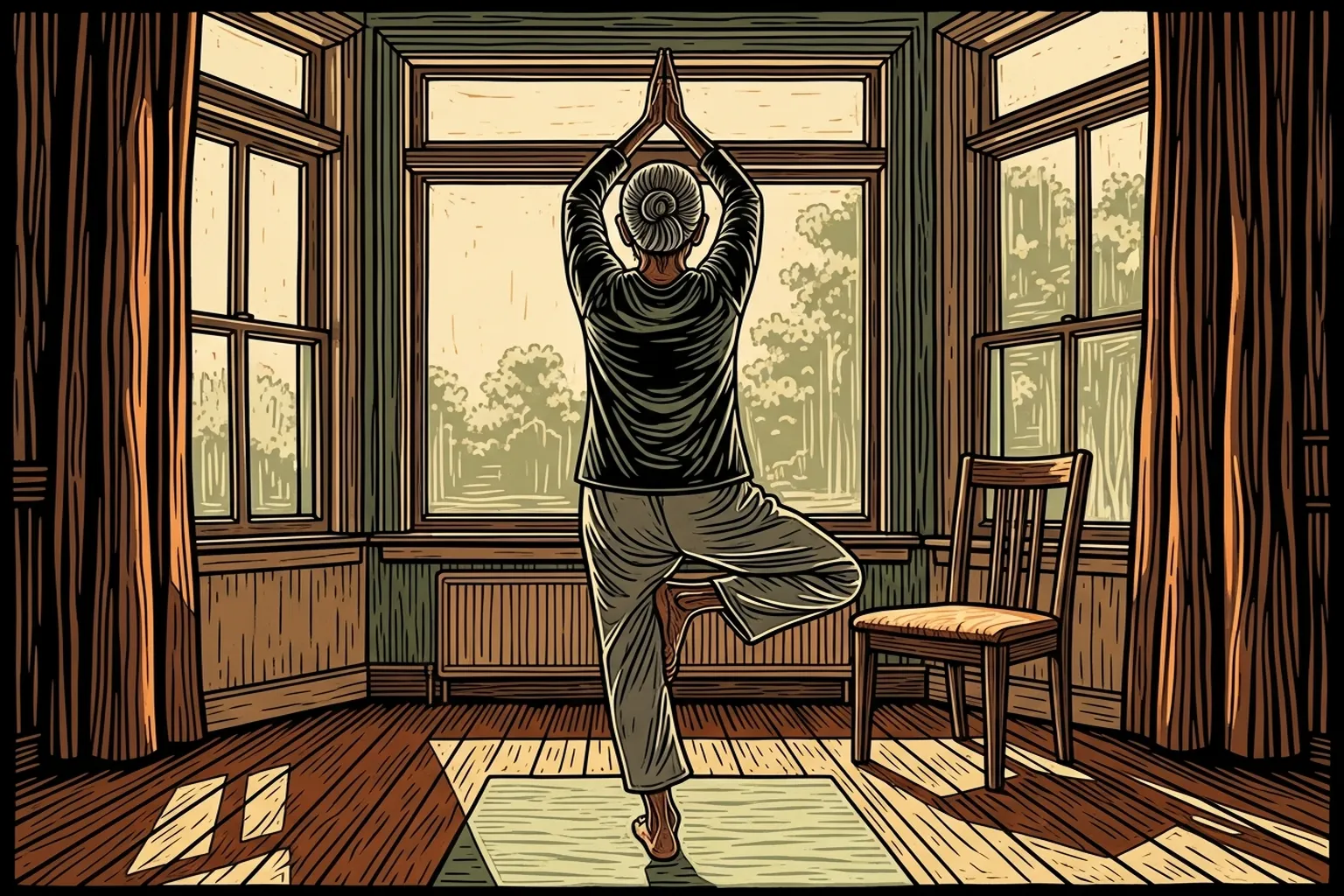
Specific poses worth knowing about. Tree pose (standing on one foot with the other foot resting against your calf or thigh) is one of the most-studied balance poses in the geriatric literature. Warrior I and II build lower-body strength. Cat-cow (alternating between arching and rounding the spine on hands and knees) improves spinal mobility and is gentle enough for most people. Mountain pose, which looks like you’re just standing there, is actually a proprioceptive exercise: you’re learning to feel where your weight falls and how to distribute it evenly. It teaches your body to find center, which is precisely what falls research says older adults are losing.
You don’t have to do all of these. You don’t have to do any of them perfectly. The research consistently shows that imperfect, regular practice produces better outcomes than perfect, sporadic practice.
What I tell people who are skeptical
I get it. Yoga has a branding problem. It has been marketed as a spiritual practice, a flexibility practice, a wellness-lifestyle accessory. It has been photographed almost exclusively on thin, young, flexible bodies in beautiful locations, which tells people over sixty that it isn’t for them. That’s a marketing failure, not a clinical one.
Here is what I tell the skeptics. You don’t have to say “namaste.” You don’t have to buy a mat that costs eighty dollars. You don’t have to be flexible. Flexibility is an outcome of practice, not a prerequisite for it. You also don’t have to believe in anything other than the research, which I’ve just walked you through. The evidence says yoga improves balance, reduces fall risk, builds the kind of strength that keeps you independent, and lowers stress markers. Those are measurable outcomes from controlled studies. You can be as skeptical as you want about the rest of it and still benefit.
I’ve written about the polypharmacy problem, about how people over sixty often end up on medications that interact in ways nobody is watching. I’ve written about dementia prevention and the evidence for aerobic exercise. I keep coming back to the same core argument: the things that help most are not expensive, not complicated, and not dramatic. Walking helps. I said this in my piece on walking shoes and I’ll say it again here. Yoga helps. Sleeping properly helps. Having a doctor who knows your name helps. The most powerful interventions for people over sixty are almost boring in their simplicity, and that’s exactly why they get overlooked in favor of supplements and gadgets and whatever the wellness industry is selling this quarter.
If you’re already active, if you’re playing pickleball or walking regularly or doing something that keeps you moving, yoga complements that. It works the balance and flexibility components that most other activities don’t emphasize. If you’re not active, it’s a reasonable place to start, particularly chair yoga, which requires nothing except a chair and a willingness to try.
Where to find a class
Most community recreation centers offer yoga classes designed for older adults. Many hospitals and health systems now include yoga in their fall-prevention programs. The YMCA and YWCA typically offer chair yoga and gentle yoga. If you prefer to start at home, there are free instructional videos from reputable sources online, though I’d encourage you to attend at least a few in-person classes first so an instructor can check your form. Bad alignment in certain poses (particularly anything that loads the spine or requires balance on one leg) can cause injury. An instructor who knows how to modify poses for joint limitations, blood pressure medications, and osteoporosis is worth the effort of finding.
Ask your doctor before starting if you have uncontrolled blood pressure, a history of vertebral fractures, or severe osteoporosis. Some poses, particularly inversions and deep forward folds, aren’t appropriate for everyone. Your doctor doesn’t need to be a yoga expert. They need to know your specific limitations and tell you which movements to avoid.
The agency question
I started this piece with a woman who fell in her driveway and stopped going outside. Her story doesn’t end there. Her daughter, who is a physical therapist, enrolled her in a chair yoga class at the hospital where she works. It took six weeks. The woman didn’t become a yoga person. She didn’t buy special clothes or start meditating. But she went back to getting her own mail. She told me her balance felt different, that she was more aware of where her feet were. Proprioception. That’s the word she didn’t know, and it’s the thing the yoga was rebuilding.
I think about her when people ask me whether yoga is “worth it.” The question isn’t whether yoga will make you younger or more flexible or more zen. The question is whether you want to keep doing the things you’re currently able to do. Balance declines. Strength declines. Reaction time declines. These are facts. They are also not verdicts. The evidence says you can slow these changes, and in some cases reverse them, with consistent, appropriate exercise. Yoga is one form of that exercise, and a well-studied one.
Your body is still adapting. It has been adapting for sixty or seventy years. Giving it something specific to adapt to, something that challenges your balance and builds your strength and teaches your nervous system to pay attention, is not wishful thinking. It’s applied physiology. And you don’t have to be good at it. You just have to show up.
Carol Gifford spent fourteen years as a registered nurse in internal medicine and case management before becoming a health writer. She does not give medical advice. She gives information, and she thinks that matters more.
Questions to ask your doctor
If you’re considering starting yoga, here are specific questions to bring to your next appointment:
“Given my current medications and health conditions, are there specific yoga poses or movements I should avoid?”
“I’ve had falls (or I’m concerned about my balance). Would you consider yoga an appropriate part of a fall-prevention plan for me?”
“Do you know of any hospital or health-system yoga programs in this area designed for people over sixty?”
“I have osteoporosis (or osteopenia). Are there modifications I should know about for weight-bearing poses?”
“Would yoga interact with any of my current treatments, particularly blood pressure or blood-thinning medications?”