A woman I know, seventy-one, was prescribed a sleep medication after she mentioned to her internist that she wasn’t sleeping well. The sleep medication gave her acid reflux, so her gastroenterologist prescribed a proton pump inhibitor. The proton pump inhibitor made her dizzy and nauseated, which her cardiologist interpreted as a possible blood pressure issue, so he adjusted her beta-blocker dose upward. The higher dose of the beta-blocker made her fatigued, and her internist, at the next visit, suggested she might be depressed. He wrote a prescription for an antidepressant. Within eight months, she had gone from one new complaint to four new medications, and not a single one of her three doctors had looked at the full list.
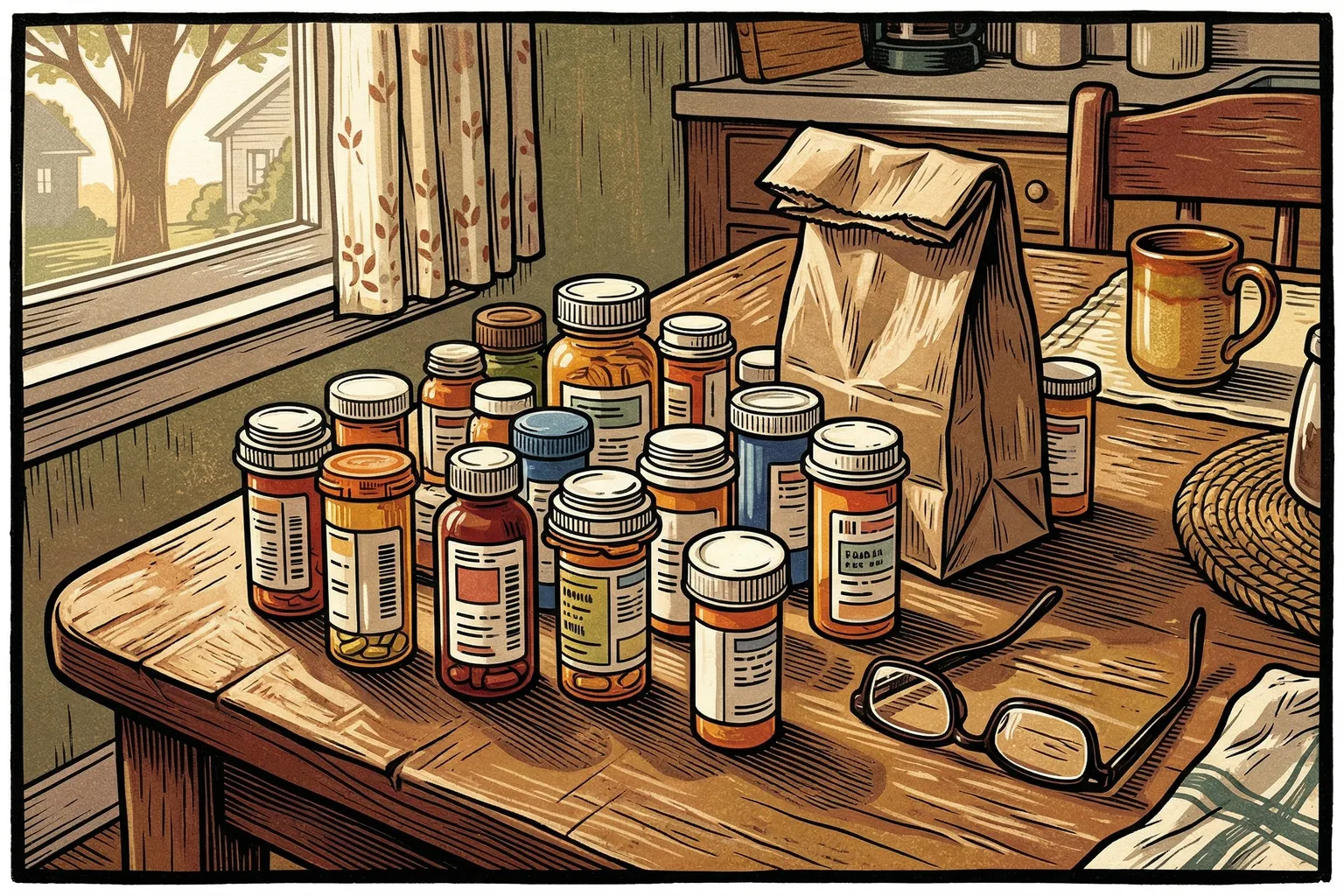
She figured it out herself. She sat at her kitchen table one Saturday morning and lined up every bottle and realized that the insomnia she’d originally mentioned had been caused by the antihistamine she was taking for seasonal allergies, which her allergist had prescribed two years earlier and never revisited. She stopped the antihistamine. She slept fine. She did not need the sleep medication, the antacid, the adjusted beta-blocker, or the antidepressant. She needed someone to look at the whole picture.
Nobody had.
This is the polypharmacy problem, and if you’re over sixty and taking more than a few medications, it is almost certainly relevant to your life.
What the word actually means
Polypharmacy, in clinical terms, means taking five or more medications simultaneously. That’s the threshold most researchers use. But the problem doesn’t begin at five. It begins the moment you’re seeing more than one prescriber and nobody is reconciling what each of them has written.
The numbers are striking. According to data from the Centers for Disease Control and Prevention, roughly 40 percent of adults aged 65 and older take five or more prescription medications. Among those 75 and older, that figure climbs. About 20 percent of Medicare beneficiaries take ten or more. These are not people who are irresponsible about their health. Most of them are doing exactly what their doctors told them to do. The problem is that their doctors told them different things, in different rooms, without comparing notes.
The cascade
There is a term for what happened to the woman with the sleep medication. It’s called a prescribing cascade, and it was first described formally in the medical literature in 1997 by a Canadian research team led by Paula Rochon and Jerry Gurwitz. The concept is simple and, once you see it, hard to unsee: a medication causes a side effect, the side effect is misidentified as a new medical problem, and a new medication is prescribed to treat it. That new medication causes its own side effects, and the cycle continues.
It sounds like something that shouldn’t happen in modern medicine. It happens constantly.
Research published in the Journal of the American Geriatrics Society has found that prescribing cascades are identifiable in a significant percentage of older adults taking multiple medications. The classic examples are well documented. A calcium channel blocker causes ankle swelling, and a diuretic is prescribed for the swelling. A cholinesterase inhibitor prescribed for cognitive decline causes urinary incontinence, and an anticholinergic is prescribed for the incontinence, which then worsens cognition. An NSAID causes elevated blood pressure, and an antihypertensive is added.
Each step in the cascade makes clinical sense in isolation. That’s what makes it so insidious. The cardiologist looks at the swelling and sees a reasonable indication for a diuretic. The urologist looks at the incontinence and sees a reasonable indication for an anticholinergic. Nobody is wrong, exactly. But nobody is looking at the whole patient.
The testing gap
Here is something that doesn’t get discussed enough: the clinical trials that determined the safety and dosing of most medications did not adequately include older adults. The average age of participants in most drug trials skews younger. People with multiple chronic conditions, the very population most likely to be on multiple medications, are routinely excluded from trials because their complexity makes the data harder to analyze.
What this means in practice is that the drug interactions your seventy-year-old body is experiencing may not have been studied in a body anything like yours. Kidney function declines with age, which affects how drugs are metabolized. Liver function changes. Body composition shifts, with more fat and less water, which changes how drugs distribute. A dose that’s appropriate for a sixty-year-old may be excessive for a seventy-five-year-old, and the clinical trial that established that dose may never have enrolled anyone over sixty-eight.
The American Geriatrics Society publishes something called the Beers Criteria, which is a list of medications that are potentially inappropriate for older adults. The list has been updated regularly since it was first published in 1991 by Dr. Mark Beers. The current version identifies dozens of medications and medication classes that carry elevated risks for people over sixty-five: certain sedatives, certain muscle relaxants, certain antihistamines, long-acting sulfonylureas, and others. It is not a banned list. It is a caution list, a tool for clinicians to use when reviewing prescriptions in older patients. But many patients have never heard of it, and not every prescriber consults it routinely.
The specialist problem
The structural issue underneath all of this is specialization itself. Modern medicine is organized around organs and systems. Your cardiologist manages your heart. Your rheumatologist manages your joints. Your endocrinologist manages your thyroid and your blood sugar. Your pulmonologist manages your lungs. Your primary care physician is, in theory, the person who sees all of it. In practice, your primary care physician has seventeen minutes with you and a screen full of notes from four specialists, and the honest truth is that a comprehensive medication review takes longer than seventeen minutes.
I don’t say this to blame your doctor. I say this because it’s real and because you need to understand it. The system wasn’t designed for people managing five chronic conditions across four specialists with a primary care physician who serves as the coordinator. It was designed for simpler problems. When the problems got more complex, the system didn’t redesign itself. It just added more specialists.
The result is that nobody may be looking at the complete medication list with fresh eyes. Each specialist sees their own prescriptions. The primary care physician sees the list but may not have time to interrogate it. The pharmacist fills what’s written. And the patient takes what they’re told to take, because they trust the people who prescribed it, which is reasonable and right and also insufficient.
The brown bag review
There is a practice in geriatric medicine called the brown bag review. The concept is literal: you put every medication you take into a brown paper bag, prescription and over-the-counter, and you bring the bag to your doctor. Not the list from your pharmacy’s printout. The actual bottles. Because the printout may not include the melatonin you started taking, or the ibuprofen you take three times a week for your knee, or the fish oil capsule your neighbor recommended, or the calcium supplement you’ve been on for six years and nobody has reconsidered.
A brown bag review forces a conversation that the normal appointment structure doesn’t accommodate. It puts every substance on the table, literally, and asks: what is each of these for? Is it still necessary? Has anyone checked whether these interact with each other? Has anyone adjusted the dose based on how your body has changed in the last five years?
If you’ve never done this, I’d encourage you to try it at your next appointment. Call ahead and tell the office you want a medication review so they can schedule enough time. Bring everything. Include the supplements, the over-the-counter pain relievers, the sleep aids, the vitamins. Put them all in the bag.
Some pharmacies, particularly those with geriatric pharmacy specialists, also offer medication therapy management reviews. These are pharmacist-led sessions specifically designed to evaluate your entire medication regimen. Medicare Part D plans are required to offer medication therapy management to eligible beneficiaries who meet certain criteria, including those taking multiple medications for multiple conditions. It’s worth asking whether you qualify.
What to actually ask
I don’t believe in vague advice about “being your own advocate.” That phrase has become so overused it’s almost meaningless. What I believe in is specific questions. Here are the ones that matter.
For every medication on your list, ask your doctor: What is this treating? Not the drug class. The specific condition. If the answer is vague, or if nobody can remember why it was started, that’s information.
Ask: What would happen if I stopped taking this? Some medications are essential and lifelong. Some were started for a condition that has resolved, or for a symptom that turned out to be caused by something else. The answer to “what if I stopped” is not always “you’d be fine.” But sometimes it is, and you won’t know unless someone asks the question.
Ask: Have you reviewed the full list of everything I’m taking, including the prescriptions from my other doctors? Don’t assume this has happened. It may not have. Ask it directly, without accusation, the way you’d ask whether anyone has checked the oil in a car with 120,000 miles on it. It’s maintenance. It’s normal. It shouldn’t be embarrassing for either of you.
Ask: Is the dose I’m on still appropriate for my age and kidney function? Doses that were right at sixty-two may not be right at seventy-four. Your body has changed. The prescription may need to change with it.
And ask: Are any of these medications potentially causing the symptoms I’ve been reporting? This is the cascade question. It’s the one that catches the ankle swelling caused by the calcium channel blocker, the fatigue caused by the beta-blocker, the confusion caused by the anticholinergic. It’s the question that might have saved the woman at the beginning of this column eight months of unnecessary prescriptions.
The conversation that matters
None of this is about distrusting your doctors. Carol Gifford did not spend fourteen years inside the medical system to come out the other side telling people their physicians are the enemy. Your doctors are working within a system that fragments care by design, and most of them would welcome a patient who shows up with the full list and says, “Can we look at this together?”
The polypharmacy problem is not a conspiracy. It’s a design flaw. It’s what happens when a system built for acute problems tries to manage chronic complexity, and when no single person in the chain of care is formally responsible for the whole picture.
You are the whole picture. You are the only person who takes every pill, who sits in every waiting room, who knows what you’re actually experiencing. That’s not a burden. It’s a position of knowledge that nobody else in the system has. Use it.
Bring the bag. Ask the questions. And if a doctor adds a new prescription, ask one more thing before you leave: “Could anything I’m already taking be causing the problem we’re trying to solve?”
That question, asked consistently, is how cascades end.