A man I’ll call Thomas was sixty-eight when he had his stroke on a Tuesday morning in February. His wife found him in the kitchen, the coffee cup on the counter, his right arm hanging wrong, trying to say something that wasn’t coming out right. She knew. She had seen a stroke awareness campaign somewhere years before, and the pieces clicked into place the way they’re supposed to. She called 911. The paramedics arrived in seven minutes.
The hospital part unfolded with the brisk efficiency that acute care does well. A neurologist explained to Thomas’s daughter, who had driven four hours to get there, that her father had had an ischemic stroke in the left hemisphere, that they had administered a clot-dissolving medication within the treatment window, and that he was stable. Then the neurologist left, as neurologists do, to the next patient and the next crisis.
His daughter sat with him. She answered nursing staff questions. She called her brother twice. And sometime in the second day, when the immediate terror had shifted into something colder and more specific, she started asking the question nobody had prepared her for: what does recovery actually look like? Not whether he would survive. He was going to survive. What happened after he survived.
That question is the one I want to answer here.
The acute phase: the first seventy-two hours
Ischemic strokes, caused by a clot cutting off blood flow to part of the brain, account for about 87 percent of all strokes. Every minute of untreated blockage destroys an estimated 1.9 million neurons. The treatment that matters most in this window is tPA (tissue plasminogen activator), a clot-dissolving medication that can only be administered within 4.5 hours of when symptoms began. For larger vessel occlusions, mechanical thrombectomy (physically removing the clot with a catheter) can extend that window to twenty-four hours for appropriate candidates, based on imaging criteria established by clinical trials over the past decade.
The phrase “time is brain” isn’t hyperbole. Getting to an emergency room quickly is the single most consequential action available to anyone witnessing a stroke. The FAST acronym (Face drooping, Arm weakness, Speech difficulty, Time to call 911) is worth memorizing. It’s a simple and accurate screening tool, and speed genuinely changes outcomes.
Once acute treatment is underway, the medical team shifts focus to stabilizing the patient, identifying the stroke’s cause, and preventing a second event. What families are often not told is that very little reliable long-term prognosis can be made in the first week. The brain immediately after a stroke has a region called the penumbra, where surrounding tissue is stressed but isn’t yet permanently lost. A deficit that looks severe at forty-eight hours may look meaningfully different at thirty days. This isn’t false hope. It’s biology, and it’s worth knowing when the first week feels like a countdown.
Inpatient rehabilitation: where the work begins
Patients who are medically stable and can tolerate three or more hours of daily therapy are candidates for an inpatient rehabilitation facility. This is distinct from a skilled nursing facility, which provides less intensive care, and the distinction matters clinically. The research on stroke recovery is consistent: more intensive therapy earlier produces better outcomes. If a patient is directed to a skilled nursing facility rather than acute inpatient rehab, the family should ask what criteria drove that decision and whether it can be reviewed.
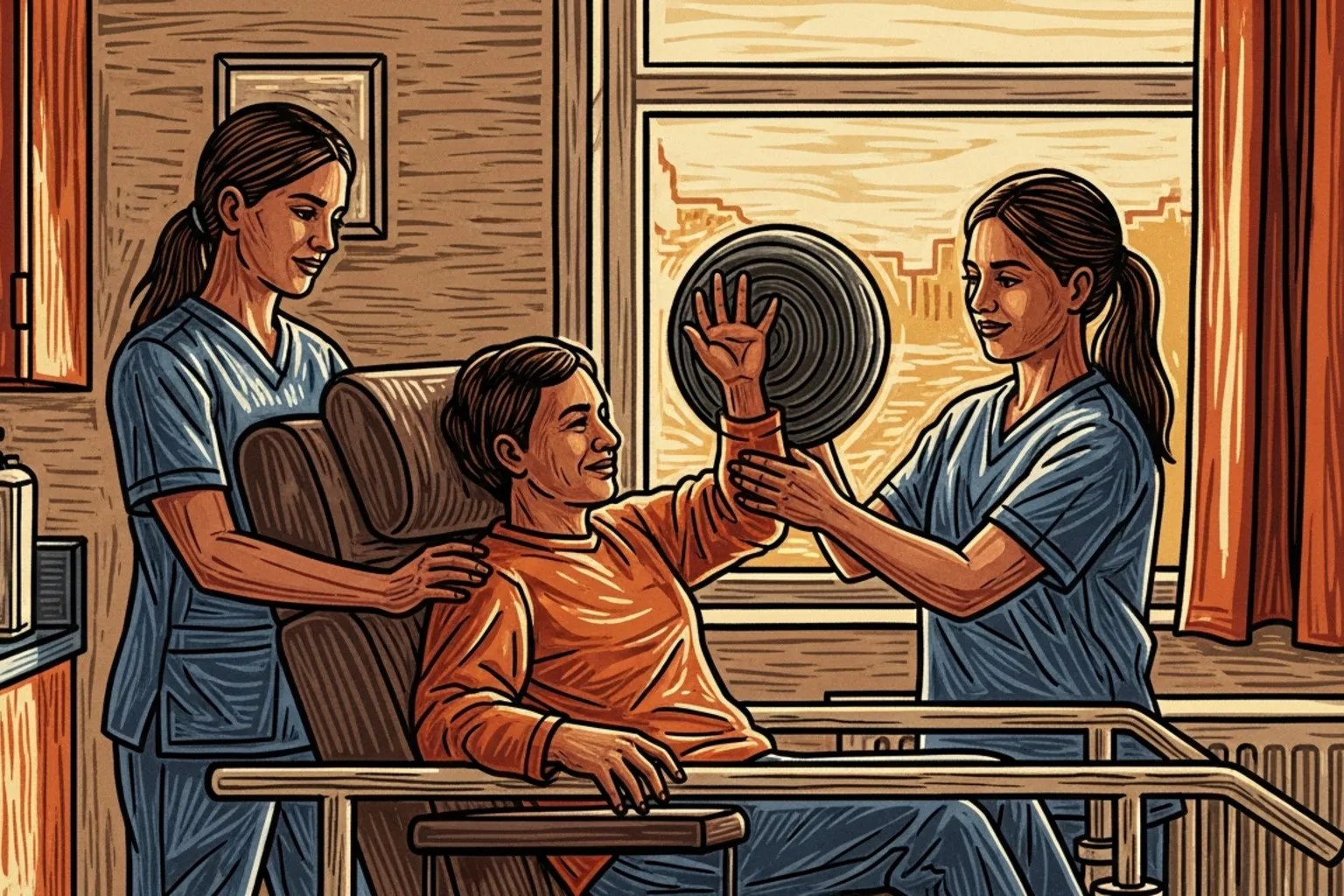
Inpatient rehab typically runs two to three weeks. Physical therapy addresses mobility and strength. Occupational therapy works on activities of daily living: dressing, bathing, functional use of the affected hand. Speech therapy covers not only language and communication but also swallowing, which stroke can disrupt in ways that are dangerous if left unaddressed.
This is also where caregiver education should happen, though it often doesn’t unless someone pushes for it. The therapists working daily with the patient know things that will matter enormously at home: what helps, what doesn’t, what warning signs mean something has changed. Ask them directly. The information exists. It requires being asked.
Outpatient therapy and the long game
After inpatient rehab, most stroke survivors move into outpatient therapy, which continues the recovery work at a pace of several appointments per week. This phase can run for months. It can run longer.
Patients and families often arrive here expecting the worst to be behind them. What they find instead is that the work is harder in some ways than the acute phase, because now the stakes are immediate and visible. The stairs, the shower, the ability to return to work or drive. The cognitive effort required for tasks that were once automatic.
Post-stroke fatigue is pervasive and genuinely under-discussed. It’s different from ordinary tiredness. The brain uses enormous energy in the months after a stroke, doing reconstruction work that doesn’t show up on any scan but shows up in how exhausting it is to make breakfast. This isn’t a sign that something has gone wrong. Sleep quality during this period matters too, and disrupted sleep compounds fatigue in ways that stall recovery. (I’ve written elsewhere about what actually happens to sleep after sixty and why treating disrupted sleep as a clinical concern rather than an inconvenience changes what you do about it.)
Neuroplasticity is the mechanism underlying all of this: the brain’s ability to reorganize itself, grow new connections, and recruit adjacent regions to take over functions of damaged ones. The first three to six months typically show the fastest gains. But the research, including guidelines from the American Heart Association and the American Stroke Association, has substantially revised the older belief that recovery plateaus sharply at six months. Meaningful recovery can and does continue for two years and beyond in patients who maintain active rehabilitation and consistent home practice.
The plateau that isn’t
The word “plateau” follows stroke patients like a threat. There is a real phenomenon it describes: the rate of visible change slows after early recovery. This is expected and doesn’t mean anything has gone wrong. What it isn’t, in most cases, is a permanent ceiling.
Recovery after stroke tends to move in cycles, not in a straight line. Periods of visible progress alternate with apparent stillness, and then more progress, sometimes triggered by a new therapeutic approach, sometimes by consistent home practice that the clinical team doesn’t directly observe. Constraint-induced movement therapy, where the unaffected arm is deliberately restrained to force the brain to recruit the affected one, has solid evidence for improving arm function even years after stroke. The patients who do best are typically the ones who found a way to make daily practice a habit after formal therapy ended.
Having a primary care physician who knows the full post-stroke picture, not just the vascular history but the functional status and the rehabilitation context, matters enormously in this long middle phase. When no one is looking at the whole clinical picture, things fall through.
The emotional dimension neurologists under-explain
Post-stroke depression affects an estimated 30 to 40 percent of survivors in the first year. Some of this has a direct biological cause: stroke can damage the brain structures and neurotransmitter pathways involved in mood regulation, particularly in strokes affecting the left frontal lobe. Some is situational: a person who was fully self-sufficient on Monday is depending on help with basic functions on Wednesday. Both are real. Both are treatable.
The emotional experience of stroke recovery is sometimes described by survivors as a secondary loss: the loss of the self that existed before, and the uncertain grief of not yet knowing who comes after. This is a rational response to a genuinely disorienting experience. What makes it worse is when nobody names it. A neurologist may be exceptional at the vascular mechanics of stroke and less practiced at the psychological aftermath. This isn’t an accusation. It’s a structural gap. If the subject hasn’t come up in the first three months of follow-up, the patient or family needs to raise it. Mood changes, emotional lability, cognitive fog, and difficulty with attention and memory after stroke aren’t soft concerns. They affect rehabilitation outcomes, and they have treatments.
Caregivers carry their own weight in this, and it typically goes unacknowledged. Caregiver burnout is a recognized clinical phenomenon with real health consequences for the caregiver. Support resources, including respite care, social work services through the rehabilitation facility, and caregiver support groups, are rarely offered proactively. They exist. They require asking for. The same insistence that gets you real answers in a short doctor’s appointment applies here, maybe more so, and over a much longer stretch.
Questions worth having ready
The medical system won’t hand these to you. In the hospital: Is my family member a candidate for acute inpatient rehabilitation, and what criteria are being used? What caused the stroke, and what is being done to prevent a second one?
During inpatient rehab: What specific functions are we working on, and what does the team expect at discharge? What needs to be in place at home before we leave? What should family members know how to do?
In the months after: Is what I’m experiencing an expected part of recovery, or something that warrants fresh clinical assessment? Has anyone screened for post-stroke depression? Is the current therapy plan appropriate for where I am now?
Thomas, eighteen months after his stroke, has most of his speech back. His right hand won’t do what it once did. He golfs left-handed now, badly and happily, by his daughter’s account. She emails me occasionally. She’s fine.
That isn’t every stroke survivor’s outcome. But the brain is substantially less fixed than medicine understood even twenty years ago. Recovery is more possible, more durable, and more individual than the first week of fear suggests. The job of everyone around a stroke patient, including the patient, is to not close the question before the brain has had time to answer it.
Carol Gifford is a former registered nurse and health writer. Nothing in this column constitutes medical advice. Consult a qualified healthcare provider about your specific situation.