A retired librarian I spoke with last spring had been told to rest her shoulder for six weeks after reaching for a book on a high shelf and feeling a sharp pull. Walk-in clinic, quick exam, diagnosis of rotator cuff strain, advice to rest and take ibuprofen. No exercises. No referral. No specific guidance on what “better” was supposed to look like or how long it should take.
Six weeks later she couldn’t raise her arm above her waist. The resting hadn’t helped. It had, in ways she couldn’t have known, made things significantly worse.
This isn’t an unusual story. Shoulder pain affects roughly 7 to 26 percent of adults at any given time (Luime et al., Scandinavian Journal of Rheumatology), making it the third most common musculoskeletal complaint in general practice behind back and knee pain. And it’s one of the most commonly mismanaged, not because physicians are negligent, but because the shoulder is structurally complicated, appointments are short, and the instinct to rest something that hurts is intuitive even when it’s wrong.
What You’re Actually Dealing With
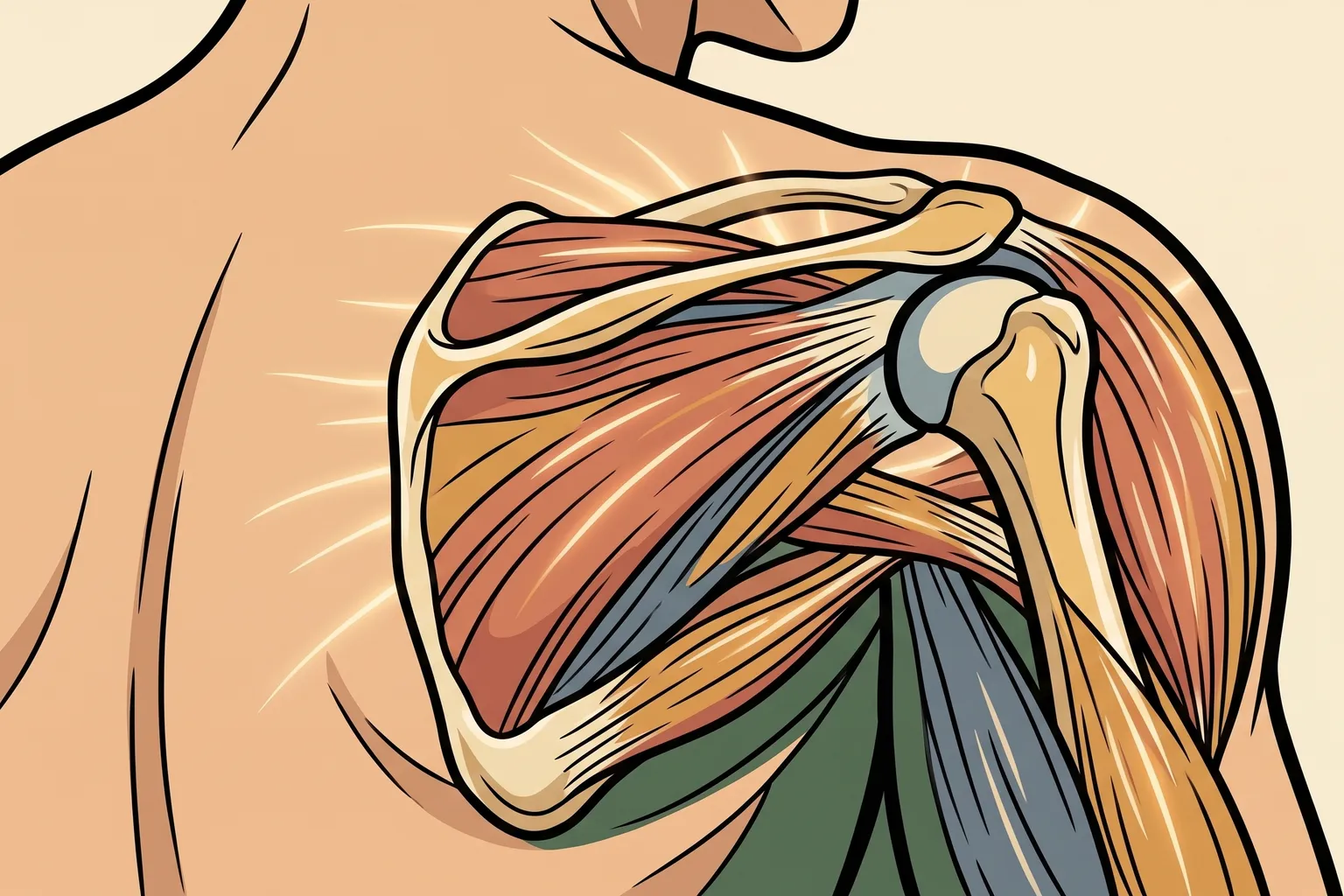
The shoulder is the most mobile joint in the body. It achieves that range of motion by sacrificing stability, which is why it’s also one of the most vulnerable. The joint is essentially a golf ball (the head of the humerus, the upper arm bone) sitting in a shallow tee (the glenoid cavity of the shoulder blade). It stays in place through a combination of muscle, tendon, and bursa, a small fluid-filled sac that cushions the joint. When any of these structures gets injured or inflamed, the whole system slows down.
Four conditions account for most of the shoulder pain people experience.
Rotator cuff problems involve the four muscles and their tendons that wrap around the shoulder and hold the joint together. A rotator cuff strain, tendinopathy (inflammation of the tendon without a full tear), or partial tear typically feels like a dull ache deep in the shoulder, often worse when you lift your arm out to the side or reach behind you. Night pain is common, especially lying on the affected side. Partial tears and tendinopathy are far more common than complete tears and respond well to conservative treatment in most people.
Subacromial bursitis is inflammation of the bursa, the cushioning sac that sits between the rotator cuff tendons and the acromion bone above. It feels similar to rotator cuff tendinopathy, and the two often occur together. The distinguishing feature is usually a painful arc: a specific range of motion, typically between 60 and 120 degrees of shoulder elevation, that hurts noticeably more than the rest of the movement.
Frozen shoulder, or adhesive capsulitis, is a different animal. It begins with pain, usually diffuse and hard to localize, and progresses over weeks to months into a dramatic stiffening of the joint. The capsule surrounding the shoulder becomes inflamed and then scarred, restricting motion in multiple directions. People with frozen shoulder typically describe difficulty reaching to fasten a seatbelt, wash their hair, or reach overhead. The condition moves through three phases: freezing (painful), frozen (stiff), and thawing (gradual recovery). Full recovery takes one to three years without treatment. It’s more common in women, in people with diabetes, and after periods of immobility. Which is why telling someone with early frozen shoulder to simply rest it is counterproductive in a very specific way.
Shoulder osteoarthritis involves cartilage loss in the glenohumeral joint (the main ball-and-socket) or the acromioclavicular joint (the smaller joint where the collarbone meets the shoulder blade). It presents as a deep ache, often worse in the morning and after activity, sometimes with a grinding or clicking sensation. It’s less common in the shoulder than in the hip or knee but becomes more prevalent with age. The pain is usually consistent and progressive, though its rate of progression varies considerably.
The distinction between these conditions matters because the treatment differs. Rest is not neutral advice. For frozen shoulder in the early phase, immobility is close to contraindicated.
What the Evidence Actually Supports
Physical therapy is the strongest answer across nearly all shoulder diagnoses. This is not a hedge. A well-designed randomized controlled trial published in the Journal of Bone and Joint Surgery in 2015 found that supervised physical therapy produced outcomes equivalent to surgical repair for isolated, nontraumatic supraspinatus tears in older patients. The American Academy of Orthopaedic Surgeons’ clinical practice guidelines find that physical therapy and surgery both produce significant improvement for small to medium full-thickness rotator cuff tears, and support physical therapy before surgery for low- and intermediate-grade partial tears.
The key word is supervised. A generic exercise sheet from a website is not physical therapy. What matters is a trained physical therapist who can assess your specific mechanics, identify what’s restricted and why, and progress you through a loaded exercise program appropriately. The research shows consistently that active exercise, specifically strengthening the rotator cuff and the scapular stabilizing muscles around the shoulder blade, outperforms passive treatment like massage or ultrasound for most people over the long term.
Rest with some movement beats total rest. Complete immobilization, particularly for more than a week or two, causes surrounding muscles to weaken and the joint to stiffen, which compounds the original problem. The current evidence supports maintaining gentle range of motion while avoiding the specific movements that provoke sharp pain. Not avoiding all movement entirely.
For short-term pain management, NSAIDs (nonsteroidal anti-inflammatory drugs, such as ibuprofen or naproxen) have reasonable evidence for acute shoulder conditions, particularly bursitis and tendinopathy. They work better used consistently for two to four weeks than taken sporadically, and they’re more effective when paired with active rehabilitation than used as a standalone treatment. If you have kidney concerns, gastrointestinal issues, or heart disease, talk to your doctor before starting any regular NSAID regimen.
Corticosteroid injections deserve a more careful discussion than they usually get. Cochrane systematic reviews and multiple clinical trials show that injections provide small short-term pain relief, typically lasting four to eight weeks, particularly for bursitis and early frozen shoulder. They don’t change the underlying structural problem, and repeated injections may damage tendon tissue over time. One or two injections to reduce pain enough to engage in physical therapy is a defensible use of them. Multiple injections as a long-term management strategy is not.
The Home Interventions With Real Research Behind Them
Pendulum exercises, also called Codman exercises, are the best-supported early intervention for most shoulder conditions. You lean forward, let the affected arm hang freely, and allow gravity to gently distract the joint while making small circles. No active muscle contraction. The research is strongest for frozen shoulder, but they’re appropriate for most shoulder presentations because they promote joint mobility without loading inflamed tissue. Your physical therapist will guide you on range and frequency, but ten minutes twice daily is a reasonable starting point before you get there.
Heat for chronic aching, ice for acute flares. This feels like common sense, but it’s routinely reversed. Heat improves blood flow and muscle flexibility, which is what you want for the chronic stiffness of arthritis or a frozen shoulder in its frozen phase. Ice reduces acute inflammation, which is what you want for bursitis that’s flaring or a fresh strain. Using heat on an acutely inflamed shoulder can increase swelling. Neither replaces physical therapy, but both are reasonable adjuncts once you understand which situation you’re in.
A note on anti-inflammatory supplements: turmeric and fish oil are the two that come up most often, and the evidence for both in joint inflammation is real but modest. I covered this in more detail in Best Supplements for Joint Pain. The short version is that neither replaces the mechanical work of physical therapy, but for people who want to support the process from the inside, the evidence isn’t nothing.
When to Actually See a Doctor
Most shoulder pain doesn’t require an urgent visit. But some does.
Go in quickly if the pain followed a significant fall or injury and you can’t move the arm at all, if you see obvious deformity at the shoulder, or if the pain is severe and accompanied by chest pain, shortness of breath, or numbness and tingling radiating down the arm. That last cluster of symptoms can indicate referred pain from the cervical spine or, rarely, the heart, and it requires a different evaluation entirely.
For pain that came on gradually without a specific injury, a reasonable approach is two to three weeks of conservative management: gentle range-of-motion work, activity modification, short-term NSAIDs if appropriate. If you’re not improving or you’re getting worse, that’s when you need a proper assessment, including a thorough physical exam and possibly imaging to rule out a significant structural problem.
What you shouldn’t do is rest indefinitely and assume the pain will eventually sort itself out. Some shoulder conditions, frozen shoulder being the clearest example, get worse with waiting. The librarian’s frozen shoulder was months further along than it needed to be by the time she finally got to physical therapy. She recovered fully. But it took longer than it had to, and that time mattered.
When you do see a doctor, come prepared. If you want strategies for making the most of a limited appointment, the approach I laid out in Seventeen Minutes applies directly here.
Questions to Ask Your Doctor
What specific condition do you think I have, and what is the typical recovery timeline for that? Should I be seeing a physical therapist, and can you give me a referral? Is imaging indicated right now, or should we try conservative treatment first? Are the activities I’m currently avoiding appropriate to avoid, or am I restricting too much? If I’m not improving in four weeks, what’s the next step?
Shoulder pain is very treatable. The mistake is treating time as the treatment when what you actually need is a plan.
Carol Gifford spent fourteen years as a registered nurse in internal medicine and cardiology before earning a degree in health communication. She writes about what medicine under-explains and what patients deserve to know.