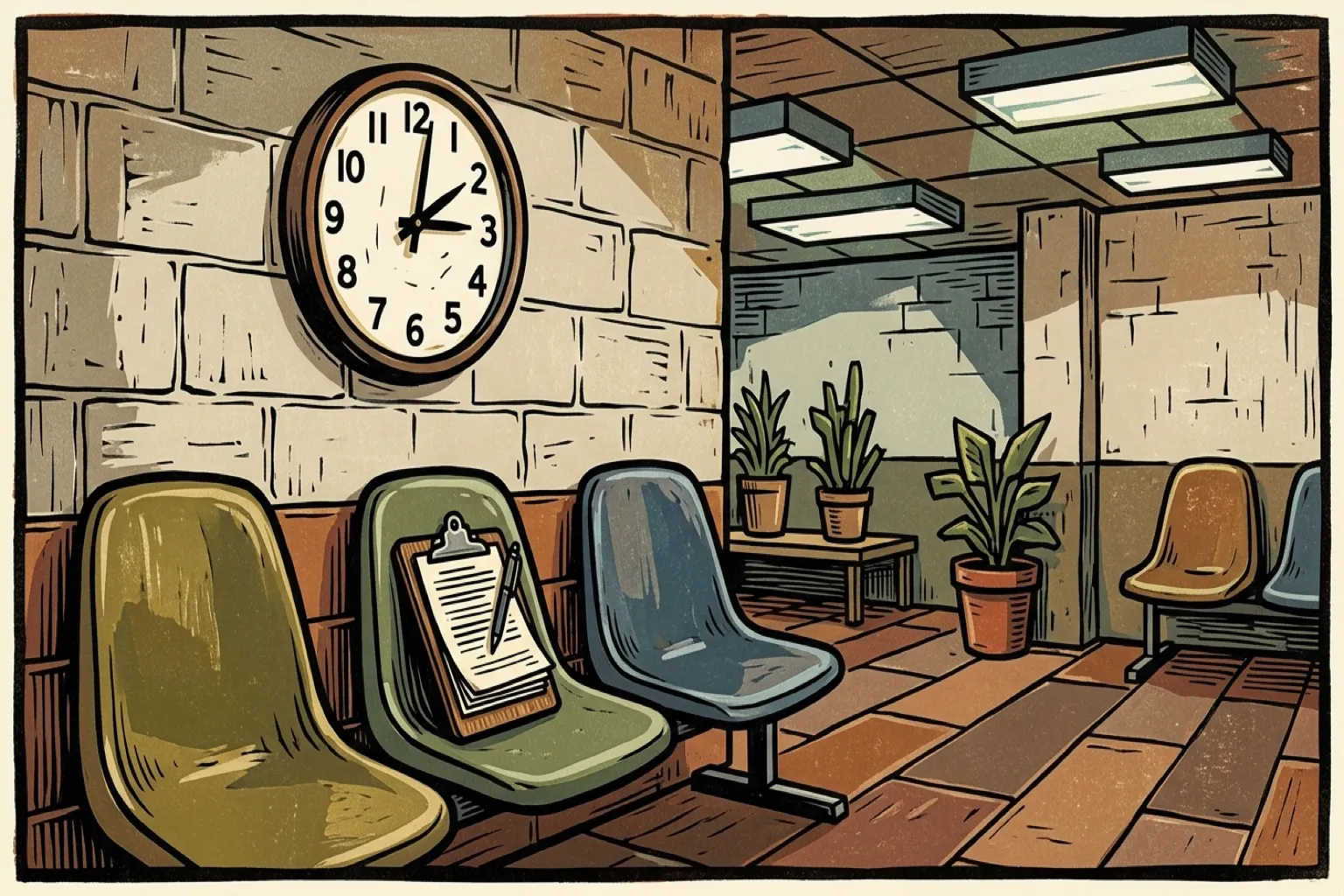
The last time I had a real conversation with my own doctor — not a logistics exchange, not a lab review, but an actual back-and-forth about something that had been bothering me — it ran just over twenty minutes. She apologized at the end. I told her not to. We both knew the system she was operating inside.
The average primary care appointment in the United States runs between fifteen and seventeen minutes. I want to sit with that number for a moment, because I think people hear it and file it under “that’s too bad” without fully reckoning with what it means in practice.
Seventeen minutes. That is the time allotted for your doctor to review what has changed since your last visit, assess any new symptoms, evaluate how your chronic conditions are being managed, reconcile your medications, address whatever you came in worried about, document everything in a way that satisfies the billing requirements of your insurance, and answer your questions. If you are sixty-five or older and you have more than one ongoing health condition — which, statistically, is more likely than not — that seventeen minutes is being asked to do the work of an hour.
This is not a complaint about your doctor. I want to say that clearly, because the natural reaction to learning this number is to feel let down by the person across the desk. That is the wrong reaction. The problem is structural. Primary care physicians in fee-for-service practice are operating under a reimbursement model that financially penalizes them for spending time with patients. They did not design this system. Most of them are quietly furious about it. Some of them are leaving the field because of it.
What this means for you is that you cannot afford to be a passive participant in your own appointments. The system will not compensate for your preparation. You have to bring it yourself.
What actually gets lost in seventeen minutes
I spent six years in hospital case management, which is the job where you sit at the intersection of a patient’s entire healthcare experience and try to understand how the pieces fit together. What I observed, consistently, was that the things most likely to fall out of a short appointment were not the urgent things. The urgent things had already surfaced. What fell out were the slower, quieter concerns — the symptom that had been present for months but didn’t feel dramatic enough to lead with, the medication side effect the patient had assumed was normal, the question the patient had rehearsed on the drive over and then, in the room, decided not to ask because the doctor seemed busy.
In a seventeen-minute appointment, the first problem you mention gets the most attention. Research on this is fairly consistent: physicians ask for the patient’s concerns early in the visit and then redirect toward a clinical agenda within about ninety seconds. If your most important concern is not the first thing out of your mouth, it may not get addressed at all. This is not because your doctor doesn’t care. It is because time is a hard constraint and the brain, when under pressure, prioritizes what it has already been handed.
There is also the issue of medication reconciliation. Patients over sixty take an average of five or more prescription medications. When you add over-the-counter medications, supplements, and vitamins, that number rises considerably. A complete medication review — checking for interactions, assessing whether each drug is still appropriate at your current age and kidney function, looking for what’s called prescribing cascade, where a new drug is added to treat the side effects of an existing one — takes time that a standard appointment does not reliably provide. Drug interactions in older adults are a genuine clinical concern, not a theoretical one. The kidneys and liver process medications more slowly as we age. A dose that was appropriate at fifty may behave differently at seventy. This is the kind of thing that gets caught in a thorough review. It is the kind of thing that slips through a rushed one.
What also gets lost: the thing you didn’t know was worth mentioning. New incontinence. Falling asleep unexpectedly. A low-grade sadness that has been present for longer than you’ve admitted. A change in your handwriting. These things tend to get categorized by patients as “just getting older” and therefore not worth bringing up. Some of them are normal. Some of them are not. The difference matters and your doctor cannot sort it out if the information never reaches them.
How to use the time you have
None of this requires confrontation or extraordinary effort. It requires preparation, and preparation for a medical appointment is not complicated once you understand what it actually involves.
Bring a written list, ordered by priority. This is the single most effective thing you can do. Write down every concern, every symptom, every question you have considered since your last visit. Then rank them. Put the most important thing first, not the most recent thing, not the easiest thing to explain — the most important one. The reason for the ranking is this: if the appointment runs short, and it may, the thing at the top of your list will have received attention. The thing at the bottom may not. You are not being demanding by having a list. You are being useful.
Bring a complete medication list, including everything you take. Every prescription, every over-the-counter medication taken regularly, every supplement and vitamin. Include the dose and how often you take it. Do not assume this information is accurately reflected in your electronic health record. Medication lists in those systems are frequently out of date. A surprising number of patients have been discovered, during careful reconciliation, to be taking two medications that were working against each other for months.
Say the most important thing first, in the first two minutes. Not as background. As the lead. “The main reason I’m here today is X” is a sentence that orients the appointment and reduces the chance that you’ll leave without having addressed what mattered most. If there are secondary concerns, say so: “I also want to ask about Y when we have a chance.” You are giving your doctor a map. That is not overstepping. That is efficient.
Ask about the specific thing you have been avoiding asking about. Most patients, in my experience, have one of these. The thing they found on the internet at midnight and have been carrying since. The symptom they have been watching for three months and deciding is probably nothing. The diagnosis a friend received that sounded too familiar. These are exactly the things that belong in a medical appointment, and they are exactly the things that patient embarrassment and time pressure conspire to keep out.
Questions worth asking in that room
Not abstract questions. Specific ones you can write on the back of your medication list and bring with you.
If you’re starting a new medication: What is this treating, what is the expected effect, and what side effects should make me call you? The third question is the one that most often goes unasked and most urgently needed.
If you have a chronic condition being managed: Is this still the right approach, given my age and other conditions? Treatment targets and medication choices appropriate at sixty are sometimes reconsidered at seventy-five. You have the right to ask whether what you’re doing still makes sense.
If you receive a test result: What does this number mean for me specifically, not just whether it’s in the normal range? A cholesterol panel, a hemoglobin A1c, a bone density score — these numbers tell a story about your individual risk, and “it looks fine” is not the same as an explanation of what you are looking at.
If you have been experiencing something and aren’t sure whether it warrants concern: Is this a normal change I should expect, or is this something worth investigating? That is a direct question. It will get you a direct answer, and a direct answer is worth seventeen minutes of preparation.
One more thing
The system is not going to fix itself between now and your next appointment. The structural problems in primary care — inadequate reimbursement for time, physician shortages, administrative burden — are real and they are not resolved quickly.
What is within your control is how you show up. A prepared patient gets more out of a constrained appointment not because they have hacked the system but because they have reduced the cognitive load on both sides of the desk. Your doctor does not have to spend three minutes figuring out what you came for. You do not have to spend three minutes trying to remember what you wanted to ask. The time goes toward actual medicine.
I have seen the difference this makes. I have watched patients leave appointments with answers they had not gotten in years, not because their doctor suddenly had more time, but because they arrived knowing what they needed and asked for it plainly. The appointment did not change. The preparation did.
Bring the list. Lead with what matters. Ask the thing you have been avoiding asking. That is not a workaround. That is how you use a system as it actually exists rather than as it should be.
Questions to bring to your next appointment:
- Is my medication list up to date, and are there any interactions or doses worth reviewing given my current age?
- Is there anything in my recent labs I should understand better than I currently do?
- [The specific thing you have been avoiding asking about.]
Carol Gifford spent fourteen years as a registered nurse, including six in hospital case management. She writes about health and medicine for people who want accurate information without the alarm or the sales pitch. She lives in Madison, Wisconsin.