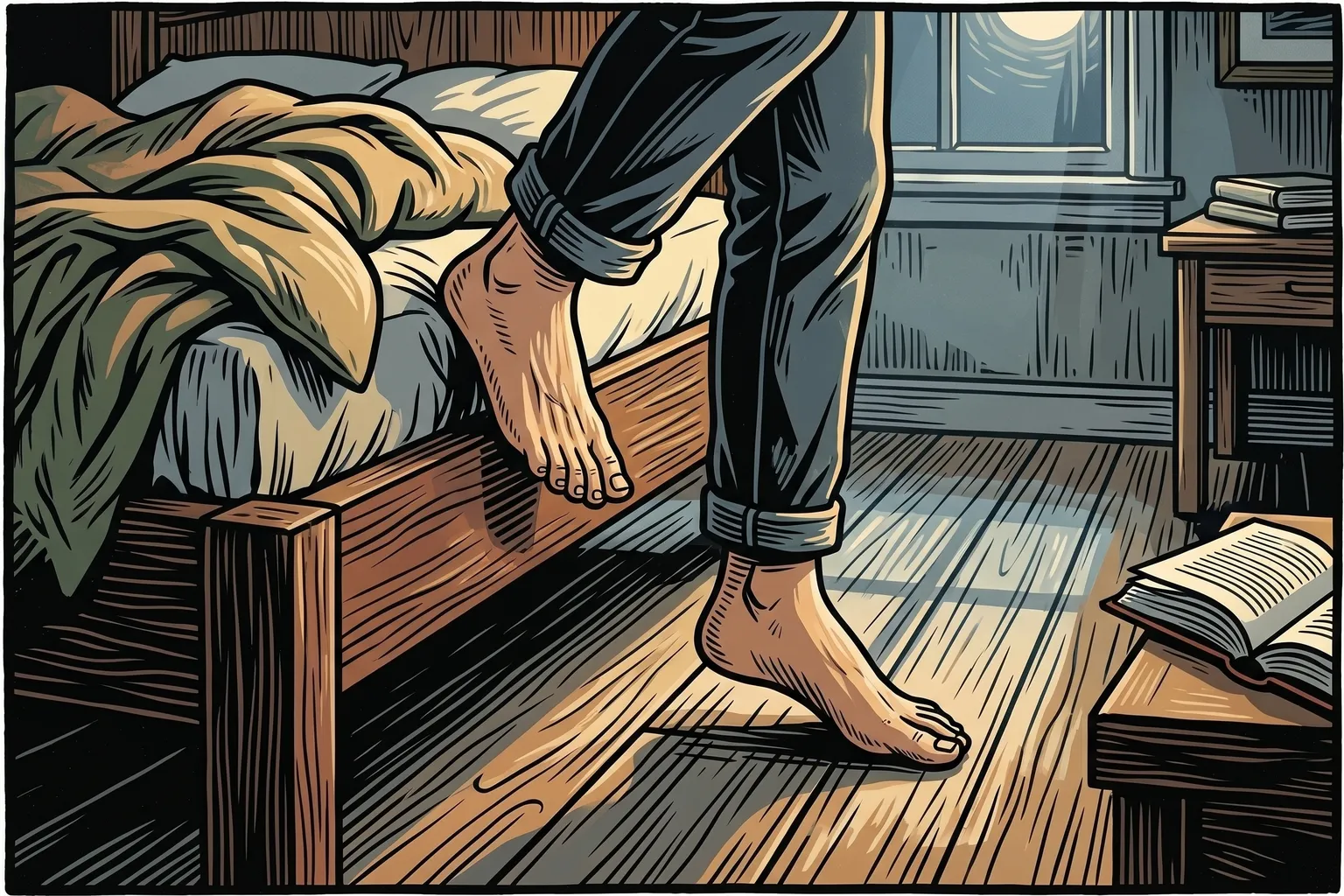
A woman I’ll call Margaret had been pacing her hallway at two in the morning for three years before she found her way to a neurologist. Her primary care doctor had told her it was probably anxiety. Another doctor had suggested a nighttime antihistamine to help her sleep, which she tried for two weeks and which made everything noticeably worse. The sensation she described was consistent: something beneath the surface of her calves, not quite pain, not quite cramping, closer to an urgent electrical current that demanded she move. She’d get up and walk. The feeling would ease. She’d lie back down. It would return. Night after night after night.
She’d named it herself, from a pharmaceutical ad she’d seen years earlier: restless leg syndrome. She’d mentioned this to her doctor. He’d agreed that sounded about right and hadn’t taken the conversation further.
What Margaret needed wasn’t a name. She needed someone to explain what was actually happening.
What RLS actually is
Restless legs syndrome is a neurological sensorimotor disorder, which is a more precise description than the name suggests. The condition involves dysfunction in the brain’s dopamine signaling pathways, not a structural problem with the muscles or the legs themselves. The legs are where the symptoms land. The brain is where the problem originates.
The diagnosis rests on four criteria, established by the International Restless Legs Syndrome Study Group and used broadly in clinical practice. First: an urge to move the legs, typically accompanied by uncomfortable or unpleasant sensations. Second: symptoms worsen at rest. Third: symptoms are worse in the evening or at night. Fourth: movement partially or fully relieves the symptoms, at least temporarily. That temporary relief is characteristic of the condition. It’s part of what makes RLS so exhausting: you move, it eases, you stop, it returns.
The sensations people describe vary. Creeping. Crawling. Pulling. A deep ache. Something vibrating under the skin. The word “uncomfortable” barely covers it. “Irresistible” is more accurate.
RLS affects roughly seven to ten percent of adults in the United States. The prevalence increases meaningfully with age, with a notable uptick after sixty, which makes it far more common in older adults than general population statistics suggest.
Why age matters
Two things happen simultaneously. The dopamine system ages. The dopaminergic pathways that regulate movement and sensation become less efficient over decades, which matters because RLS is, at its core, a disorder of dopamine signaling. The system that should be managing those sensory signals doesn’t manage them as well at sixty-eight as it did at thirty-five.
At the same time, iron status often declines with age, sometimes gradually, sometimes without producing symptoms anyone notices. This second piece matters in ways that most people with RLS have never been told.
The ferritin connection
Iron isn’t only a component of red blood cells. The brain uses iron to synthesize dopamine. When iron levels in the brain are insufficient, the dopamine system can’t function normally, and for people with a genetic predisposition to RLS, that insufficiency can trigger or significantly worsen symptoms.
The number that matters here is ferritin, the protein that stores iron in the body and gives clinicians a way to estimate iron reserves. Most laboratory reference ranges flag ferritin as low only when it falls below 12 to 20 nanograms per milliliter, a threshold designed to identify anemia risk. For RLS specifically, many neurologists and sleep medicine specialists recommend evaluating iron supplementation when ferritin is below 75 ng/mL, a considerably higher threshold than what appears on most lab reports.
A ferritin of 40 ng/mL looks perfectly normal on a standard lab printout. For someone with RLS, it may be contributing substantially to their symptoms.
This matters from a treatment standpoint because oral iron supplementation, when ferritin is genuinely low relative to that RLS-specific threshold, can produce real improvement without the side effects or long-term risks of prescription medication. The usual approach is ferrous sulfate or ferrous bisglycinate (the latter tends to be easier on the stomach), taken with vitamin C to improve absorption. It shouldn’t be taken alongside calcium, coffee, or tea, all of which interfere with how the body absorbs it.
Your primary care doctor can order this blood test. Ask for ferritin specifically. Ask that the result be considered in light of the 75 ng/mL threshold, not just the standard reference range. It’s the most underutilized piece of RLS evaluation, and it’s a blood draw.
Medications: the real picture
For people with moderate to severe RLS that doesn’t respond to iron correction or lifestyle changes, there are FDA-approved medications. The two categories used most often are dopamine agonists and alpha-2-delta ligands.
The dopamine agonists, pramipexole (Mirapex) and ropinirole (Requip), have been first-line treatments for years. They work by mimicking dopamine in the brain, and many patients find significant relief from them, at least initially. The problem is a phenomenon called augmentation, and it’s the part of the dopamine agonist conversation that tends to get left out.
Augmentation happens when the medication that was controlling symptoms begins to worsen them. Symptoms start occurring earlier in the day. They spread from the legs to the arms. The window of relief narrows. The dose that worked six months ago no longer works, and increasing the dose produces only temporary improvement before the cycle repeats. Studies have found augmentation occurring in a substantial portion of patients on dopamine agonists over the long term, with rates cited anywhere from 40 to 70 percent in patients followed for extended periods, depending on the study and the duration of follow-up.
This doesn’t disqualify dopamine agonists. It means they should be used at the lowest effective dose, with consistent monitoring for early signs of augmentation, and with a clear plan for what happens if it develops. That’s a conversation worth having before starting the medication, not after symptoms come back worse than before.
The alpha-2-delta ligands, pregabalin (Lyrica) and gabapentin enacarbil (Horizant), carry a different side effect profile and don’t have the same augmentation problem. They’re increasingly preferred by neurologists for long-term RLS management. They bring their own considerations, dizziness and sedation are common initially, and pregabalin carries some dependence risk with extended use. But for many patients they’re a more sustainable option over years than dopamine agonists.
For cases that don’t respond to either category, low-dose opioid treatment is sometimes used, generally under the supervision of a neurologist or sleep medicine specialist.
What’s quietly making it worse
I’ve written in this column before about how medication lists can work against each other, and RLS is an area where this pattern appears with striking regularity. Several medications that people take routinely for unrelated conditions make RLS substantially worse.
Antihistamines top the list. Diphenhydramine, the antihistamine in most over-the-counter sleep aids including Benadryl, ZzzQuil, and Tylenol PM, blocks dopamine receptors. If you’ve been taking a nighttime antihistamine to help with sleep and your legs are worse, those two facts may not be coincidental. This is exactly what happened to Margaret during her two-week trial. It wasn’t a reaction to the antihistamine in the usual sense. It was the antihistamine’s mechanism working directly against her condition.
Most antidepressants, SSRIs and SNRIs particularly, can exacerbate RLS symptoms. Bupropion is a notable exception and may actually improve symptoms in some people. If you’re managing both depression and RLS at the same time, the specific choice of antidepressant is worth discussing explicitly with whoever prescribes it.
Metoclopramide, used for nausea and gastroparesis, also blocks dopamine receptors. So do most antipsychotic medications.
None of this means these medications are wrong choices for the conditions they treat. It means that if your RLS worsened around the time a new prescription was added, the connection may not be coincidental. It’s worth naming.
Non-drug approaches with real evidence
These approaches won’t be sufficient on their own for moderate to severe RLS. For mild cases, or as complements to medication, several have meaningful evidence behind them.
Temperature is one. Applying something cold to the legs before bed, or a cool shower, provides temporary relief for many people. Others respond better to warmth. The research doesn’t establish a universal answer, which means the practical approach is trying both and using whichever works.
Compression garments providing moderate pressure to the lower legs have shown benefit in clinical research. Compression in the 15 to 20 mmHg range is available over the counter without a prescription. It won’t resolve severe RLS on its own, but for mild to moderate symptoms it’s a reasonable and low-risk trial.
Movement before bed helps, though timing matters. Vigorous exercise in the hour or two before sleep can worsen symptoms in some people. Moderate activity earlier in the evening, walking, stretching, gentle yoga, followed by a genuine wind-down period, aligns better with what the evidence suggests.
Caffeine and alcohol are both worth eliminating deliberately if you haven’t already. Both disrupt sleep architecture in ways that interact badly with RLS, and alcohol tends to worsen symptoms in a majority of people who have the condition. A deliberate two-week elimination trial, rather than a general impression, is the only way to know whether either is a factor.
One practical note: if you’ve been told that relaxation techniques should help and they haven’t, this may explain why. RLS isn’t caused by tension. It’s a neurological condition. No amount of relaxing makes a dysfunctional dopamine signal behave.
When to stay with primary care, when to see a specialist
For mild RLS, starting with a primary care doctor is appropriate. Get the ferritin checked. Review your current medications for RLS triggers. Try the physical approaches above. See if that combination moves things.
If symptoms are disrupting sleep most nights, if they’ve spread to both legs and sometimes the arms, or if you’ve been on a dopamine agonist for more than a year and feel like you’re needing higher doses for the same effect, a referral to neurology or sleep medicine is warranted. Augmentation in particular should be managed by someone experienced with it. The process of transitioning off dopamine agonists involves a period of worsened symptoms that’s real and uncomfortable, and having a physician guide that transition matters considerably.
Worth noting: RLS frequently co-occurs with periodic limb movement disorder, a related but distinct condition involving involuntary limb movements during sleep. If your bed partner tells you that you kick or thrash at night, or if you wake repeatedly without understanding why, a sleep study may be a useful next step in the conversation.
RLS is one of the most underdiagnosed sleep-disruptive conditions there is, in part because the name sounds minor, in part because the standard first-line approaches are often wrong, and in part because the question nobody asks is: what’s actually causing this? That’s the question worth asking.
Questions to ask your doctor
The appointment is short. These questions are specific enough to use.
“Can you order a ferritin level? I’ve read that the relevant threshold for restless leg syndrome is 75 ng/mL, which is higher than the standard lab reference range. Can we interpret the result with that in mind?”
“Are any of my current medications, including any over-the-counter sleep aids, on the list of things that can worsen RLS?”
“If I do need a prescription, what are the long-term augmentation risks with dopamine agonists like pramipexole or ropinirole, and can we talk about the alpha-2-delta options, pregabalin or gabapentin enacarbil, as an alternative?”
“At what point would you refer me to a neurologist or a sleep medicine specialist?”
Margaret, after three years of pacing and two weeks of an antihistamine that made things worse, is now on a low-dose alpha-2-delta medication and sleeping through the night most of the time. Her ferritin, it turned out, was 38. She’d had it checked twice over three years. Nobody had mentioned the RLS threshold.
She didn’t need to suffer through any of that. Neither do most people with this condition.