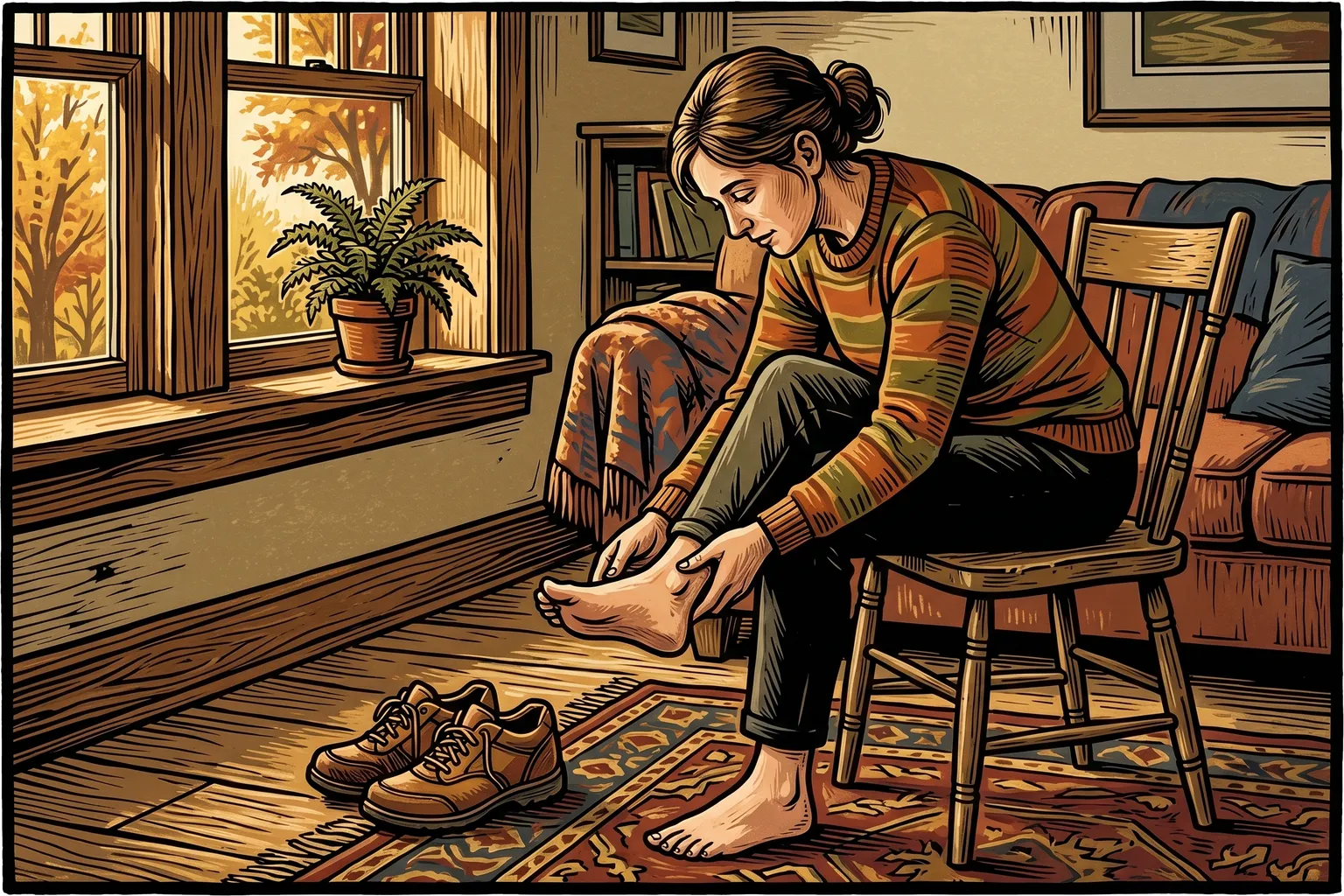
A retired schoolteacher I spoke with last year had been living with heel and arch pain for about eighteen months. She described the progression the way people often do: it started mild, she assumed she’d done something to her foot, it didn’t go away, she bought more cushioned shoes, it got worse. By the time we talked, she was waking up each morning dreading the first steps out of bed.
She had seen her primary care physician twice. Both times she left with advice to rest, ice, and take ibuprofen. No one had asked her to describe the location of the pain precisely, or when exactly during the day it shifted, or what her typical footwear looked like.
When I walked her through it, the picture was clear: sharp pain at the heel, worst in the morning, better after about ten minutes of walking, worse again after sitting for an hour. Pain exactly where the thick band of connective tissue at the bottom of the foot attaches to the heel bone. The extra-cushioned shoes she’d bought were making things worse. The stretching she’d been doing, generic quad and hamstring work from an old pamphlet, wasn’t addressing the involved tissue at all.
She isn’t unusual. Foot pain affects roughly one in five adults, and it’s also one of the most commonly mismanaged conditions in general medicine. Part of the reason is that the foot is structurally complicated: twenty-six bones, thirty-three joints, more than a hundred muscles, tendons, and ligaments. Part of it is limited appointment time for something that doesn’t seem urgent. And part of it is that the most common conditions in the foot look similar on the surface but have different mechanics and need different treatment.
What follows is the kind of explanation that takes about twenty minutes in an exam room but rarely gets that time.
Plantar fasciitis
This is the most common cause of foot pain in adults, and I’ve written specifically about footwear for it, so I’ll focus here on the full treatment picture rather than just shoes.
The plantar fascia is a thick band of connective tissue, not a muscle, that runs along the bottom of your foot from the heel bone to the base of the toes. Its job is structural: it supports the arch, absorbs shock, and acts as a kind of tensioning system for the foot’s architecture when you stand and walk. Plantar fasciitis is what happens when that tissue becomes overstressed and inflamed, particularly where it attaches to the heel bone.
The hallmark symptom is morning pain. When you sleep, your foot relaxes and the fascia shortens. When you take your first steps, you’re stretching an inflamed, shortened tissue under your full body weight. That’s why the first five to ten minutes out of bed are often the worst, and why it returns after you’ve been sitting for any length of time. The fascia tightens again during rest, and standing stretches it back out.
The most evidence-supported foot pain remedies for plantar fasciitis are stretching and footwear changes, and the stretch that matters most is the calf stretch. Not the standard straight-leg wall stretch, which targets the gastrocnemius, the visible calf muscle. The one that matters for plantar fasciitis is the bent-knee calf stretch, which targets the soleus, the deeper muscle that connects to the heel via the Achilles tendon. Stand at a wall with both hands flat against it. Stagger your feet. Bend the back knee deeply while keeping the heel flat on the floor, hold for thirty seconds, and repeat several times throughout the day. The research support for this specific stretch is solid, and most people with plantar fasciitis have never been told the distinction.
Night splints, which hold the foot at a neutral angle during sleep to prevent the fascia from shortening overnight, are also well-supported by clinical trials. They’re not comfortable at first. The evidence for them is real, and they’re particularly useful if morning pain is severe.
Most plantar fasciitis resolves with conservative care over six to twelve months. When it doesn’t, a physical therapist can design an eccentric strengthening protocol, and a podiatrist may discuss corticosteroid injections or other interventions. But the simple measures, the right stretch, the right footwear, the night splint, resolve the majority of cases.
Metatarsalgia
This word is unfamiliar to most people. It means pain in the ball of the foot, specifically at the metatarsal heads, which are the rounded ends of the long bones in your foot that form the front pad of the sole. When you stand or walk, that area absorbs considerable force. When the tissue becomes inflamed there, you get an ache or burning sensation in the front of the foot, sometimes described as feeling like there’s a pebble you can’t locate.
Metatarsalgia tends to worsen with prolonged standing, with high-heeled shoes, and with any footwear that concentrates pressure on the forefoot. The natural fat pad that cushions the metatarsal heads can thin over time, which makes the metatarsals more vulnerable to this kind of repetitive stress loading.
The most effective foot pain remedies here are metatarsal pads and footwear changes. A metatarsal pad is a small, dome-shaped insert placed just behind the ball of the foot that redistributes pressure away from the metatarsal heads. Unlike plantar fasciitis, metatarsalgia doesn’t respond well to stretching because the issue is pressure distribution, not tissue tightness. A shoe with a wider toe box and a rocker-bottom sole (the curved design that rolls you forward through the gait cycle, reducing the bend required at the forefoot) can reduce symptoms substantially.
If the pain is severe and persistent, it’s worth seeing a podiatrist, because metatarsalgia can be complicated by a plantar plate tear. The plantar plate is a small ligament that stabilizes the toe joints and can rupture under repetitive stress. A plantar plate injury requires a different treatment plan entirely.
Bunions
A bunion (the clinical term is hallux valgus) is a bony prominence at the base of the big toe that develops as the toe gradually drifts toward the second toe. It isn’t simply a cosmetic issue, though that’s often how it gets dismissed. When the angle between the first metatarsal and the big toe widens beyond about 15 degrees, it causes pain from friction and pressure at the bunion site, alters how force moves across the forefoot, and can eventually cause deformities in the smaller toes.
Genetics plays a larger role than footwear in whether you develop bunions. Footwear absolutely affects how fast they progress and how much they hurt. Narrow, pointed shoes push the big toe toward the smaller toes and accelerate the process. Wide, roomy footwear doesn’t reverse a bunion, but it reduces the compressive forces that make things worse.
Conservative foot pain remedies include shoes with a wide, rounded toe box, toe spacers or bunion sleeves to maintain some separation between the first and second toes, and padded bunion shields to reduce friction. Night splints designed to hold the toe in better alignment have modest evidence for slowing progression. None of these reverse the underlying bony deformity.
Surgical correction, an osteotomy that realigns the bones of the forefoot, is very effective for severe bunions that cause significant pain and functional limitation. Recovery takes months, and it isn’t a casual decision. But for people who’ve genuinely exhausted conservative options, it works.
Morton’s neuroma
A neuroma, in this context, means a thickening of tissue around one of the small nerves that run between the toes. Morton’s neuroma most commonly affects the nerve between the third and fourth toes. The nerve gets compressed and irritated between the metatarsal heads, and over time the tissue around it thickens, which makes the compression worse.
The symptoms are fairly distinctive: burning or shooting pain in the ball of the foot and toes, numbness or tingling in the affected toes, and often a sensation of standing on something that isn’t there. It tends to hurt more in narrow footwear and during activity, and some people get temporary relief from removing the shoe and massaging the foot.
The first and most important of the foot pain remedies for Morton’s neuroma is footwear. Narrow shoes compress the metatarsal heads together, squeezing the nerve between them. Switching to a shoe with a wide forefoot, even before any other intervention, often reduces symptoms considerably. A metatarsal pad can also help by creating more space around the nerve.
When footwear changes aren’t enough, corticosteroid injections, which reduce inflammation around the nerve, are reasonably effective in the short to medium term. If symptoms persist over several months despite these measures, a procedure called a neurectomy (surgical removal of the thickened nerve segment) is effective. It does leave permanent numbness in the space between the affected toes. Most people find that a reasonable trade for the relief.
Foot arthritis
Osteoarthritis, the gradual breakdown of joint cartilage, doesn’t just affect hips and knees. The foot has thirty-three joints, and several are commonly affected. The most frequent sites are the first metatarsophalangeal joint (the joint at the base of the big toe) and the midfoot joints in the arch, particularly the tarsometatarsal joints.
The symptoms are stiffness (especially in the morning), aching after activity, and tenderness directly over the affected joint. Foot arthritis also often appears alongside knee arthritis. If you’re managing both, the principles I’ve written about for knee support translate: you’re managing load on a joint that’s lost some of its cushioning.
The evidence-based foot pain remedies for arthritis follow the same logic as arthritis management elsewhere. Supportive footwear that reduces stress on the affected joints. Custom orthotics or stiff-soled shoes for midfoot arthritis, because limiting painful range of motion at those joints makes walking significantly more comfortable. Anti-inflammatory medications when inflammation is driving acute flares. Low-impact exercise: walking, swimming, and cycling maintain joint mobility without the repetitive high-impact loading that accelerates cartilage breakdown.
Corticosteroid injections into arthritic foot joints can provide meaningful relief, though the effects are temporary. When arthritis is severe enough to cause real functional limitation and conservative measures have run their course, surgical fusion of the affected joint is effective, particularly at the first metatarsophalangeal joint.
What makes all of it worse
There is a short list of things that consistently aggravate every condition above.
Worn-out shoes are at the top. The midsole of most athletic shoes loses meaningful support after 300 to 500 miles, or roughly 12 to 18 months of regular use. They don’t look worn out. The upper still looks fine. But the support structures have degraded, and your foot is absorbing the consequences.
Going barefoot on hard surfaces is a common aggravator that people don’t connect to their foot pain. At home, on tile or hardwood, there’s nothing between your foot and the floor. If you’re managing active foot pain, a supportive slipper or sandal with built-in arch support worn indoors makes a genuine difference.
Body weight adds cumulative force to every structure in the foot with every step. I mention this not to add to anyone’s burdens, but because the math is real. Even modest reductions translate to measurably less load on inflamed tissue.
Inactivity tends to worsen most foot conditions rather than improve them. The temptation when something hurts is to stop using it entirely. But tendons and ligaments need appropriate mechanical loading to remodel and heal. Complete rest tends to produce stiffness and slow recovery. The goal is appropriate movement in appropriate footwear, not avoidance.
Questions to ask your doctor
If your foot pain has persisted for more than three or four weeks, or if it’s significantly affecting how you move through your day, bring these to an appointment.
“Can you tell me exactly which structure is involved, and can you show me where that is?” Vague reassurance isn’t useful. You need a specific anatomical explanation. If your doctor can’t point to the structure and describe what’s happening there, you need a referral to someone who can.
“What happens if I do nothing?” Understanding the natural trajectory matters. Some foot conditions resolve on their own. Others progress and become harder to treat once they’ve been ignored long enough. You need to know which category yours is in.
“Is there a physical therapist or podiatrist you’d recommend?” Primary care physicians can diagnose common foot conditions, but a podiatrist specializes in them, and a physical therapist can design a specific strengthening and stretching protocol matched to your situation.
“What exercises should I be doing, and what should I avoid?” The right answer is specific to your diagnosis. The stretches that help plantar fasciitis can aggravate metatarsalgia. You need guidance for what you actually have, not a generic handout.
“At what point would imaging change your treatment plan?” Most foot pain doesn’t need imaging initially. But if there’s any concern about a stress fracture, if conservative treatment hasn’t worked after two to three months, or if you’re being considered for a procedure, imaging can change the picture.
The schoolteacher I mentioned at the beginning was pain-free six weeks after she started the proper calf-stretching protocol and switched to shoes with real arch support. Eighteen months of morning dread, resolved by getting a clear explanation of what was actually happening in her foot and what to do about it. That’s not a dramatic story. That’s what happens when the right information finally arrives.