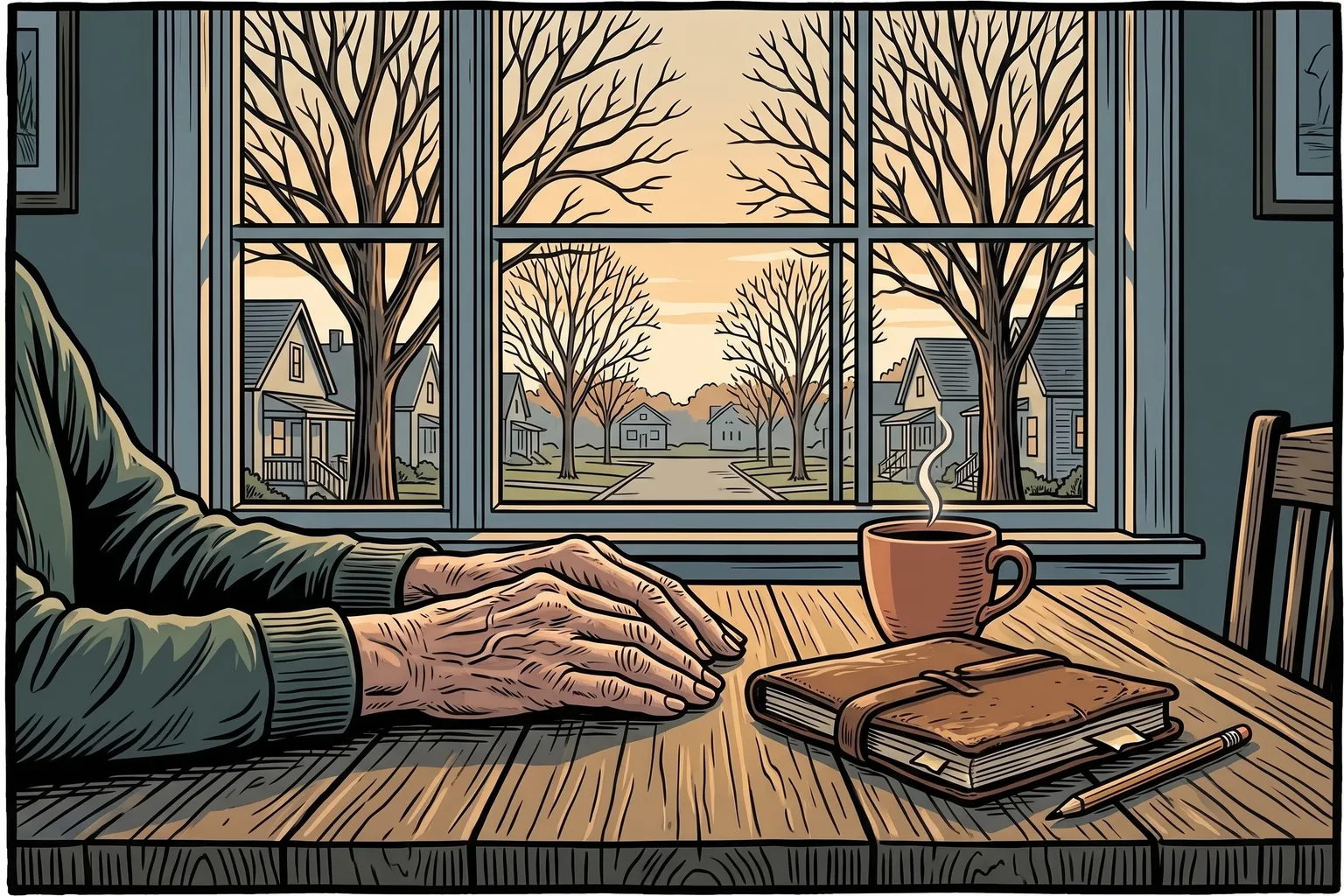
A woman I’ll call Patricia came to see me in 2003. She was sixty-two, recently retired, and she told me she felt fine. Her bloodwork was unremarkable. Her blood pressure was normal. She slept well. She walked three miles a day.
What she wanted to talk about was her hands.
They weren’t hurting. They weren’t swollen. She just noticed, she said, that they looked old. The skin had changed. The tendons were more visible. She held them out and looked at them the way someone might examine a photograph of a person they no longer recognized.
“I thought I was handling aging well,” she said. “But I keep finding new things.”
I think about Patricia when I hear the phrase “aging gracefully.” It gets used constantly now, in magazine headlines and wellness marketing and skincare ads, and it has come to mean essentially one thing: not looking your age. A cream. A routine. A way of appearing to have outrun a biological process that you have not, in fact, outrun.
That’s not what aging well means. I spent thirty years in medicine watching what aging actually looks like in people who do it well, and I’m now sixty-four and doing some of that watching from the inside. The picture is more interesting, and more hopeful, than the cosmetics industry wants you to believe.
The landmark study of successful aging is the MacArthur Study, launched in 1988, which followed more than a thousand Americans over time and tried to answer a genuinely difficult question: what distinguishes people who age well from those who don’t? The research produced a framework that has held up for decades, and its three components are not what most people expect.
Successful aging, the MacArthur researchers concluded, involves three things: avoiding disease and disability, maintaining high cognitive and physical function, and staying actively engaged with life. Notice what’s not on that list. Looking young isn’t on it. Effortlessness isn’t on it. The absence of change isn’t on it.
The framework is useful precisely because it’s honest. Aging is a biological process. Things change. The question isn’t whether they change; the question is how much of that change is modifiable.
The answer, and this is the part that medicine has done a poor job communicating, is: a lot.
Let me tell you what actually happens in your body starting in your sixties, because the gap between what people believe happens and what the research shows is significant.
Muscle loss is real. The process has a name, sarcopenia, which simply means age-related muscle loss, and it starts earlier than people realize, typically in your thirties, and accelerates in the decades after sixty. By seventy, most people have lost twenty to thirty percent of the muscle mass they had at forty if they haven’t done anything to counter it.
That last clause matters. Sarcopenia is one of the most modifiable processes in the aging body. Resistance training, meaning lifting weights or using resistance bands or doing bodyweight exercises that actually challenge your muscles, has been shown in study after study to not only slow muscle loss but to reverse it. A sixty-eight-year-old who starts a resistance training program will gain muscle. This isn’t a minor or theoretical finding. It’s one of the most consistent results in exercise science, and it has profound implications for balance, bone density, metabolic health, and the ability to live independently.
I mention this first because it’s the thing I’d most want my patients to know. The fear about aging is often that it moves in one direction, that the body’s decline is a slope you can only stand on, not redirect. Sarcopenia says otherwise. So does most of the evidence on cardiovascular health, cognitive function, and blood sugar regulation. The body is more plastic than people think, well into the seventies and eighties.
Sleep changes, and changes in specific ways that get mistaken for disorder. Sleep architecture shifts after sixty: you spend less time in deep slow-wave sleep, you wake more easily, you tend to rise earlier than you did at forty. These changes are common and real. They’re also not, in most people, evidence of a sleep disorder. Understanding what’s actually happening makes it easier to adapt rather than fight. (I wrote more about this in What Actually Happens to Sleep After Sixty.)
Cognitive changes get the most attention and generate the most fear. Here the news is genuinely good, though nuanced. Normal aging involves modest changes in processing speed and the kind of rapid recall that feels like your brain’s search function slowing down. It does not, in most people, involve significant declines in wisdom, judgment, vocabulary, or accumulated knowledge. The things that matter most to functioning well in the world are among the most preserved. What erodes them is largely addressable: untreated hypertension, inadequate sleep, social isolation, physical inactivity, and unmanaged depression, which is chronically undertreated in older adults and does considerable cognitive damage over time.
There’s a framing problem in medicine that I’ve spent twenty years noticing and haven’t been able to fix.
When physicians talk to older patients about what’s coming, they tend to frame it as preparation for inevitable decline. Your risk of this goes up. Your metabolism will slow. Your bone density will decrease. You should start thinking about falls. The information is accurate. The framing is catastrophic. What it communicates, even when no one intends it, is: your body is on its way out, and our job is to slow the deterioration.
That’s not wrong, exactly. But it’s incomplete in a way that matters.
The alternative frame, which the evidence supports more strongly, is this: most of the health outcomes that drive aging-related disability are lifestyle-attributable, not inevitable, and the interventions that address them are neither complicated nor expensive. They are boring. They are the things you already know and are probably not doing consistently. Sleep. Resistance training. Social connection. A reason to get up in the morning.
The supplement industry has built a sixty billion dollar business on the gap between what people fear and what science can actually prove. I’ll say this plainly: most supplements sold for “healthy aging” or “anti-aging” have thin evidence, no regulatory scrutiny before they hit the shelf, and no plausible mechanism that would make them more effective than the boring interventions above. Some supplements are genuinely warranted. Vitamin D for people who live in northern climates and have documented low levels. B12 for people on metformin or with absorption issues. Your doctor can tell you whether you’re one of them. The expensive proprietary formulas with the good packaging are, in most cases, expensive urine.
What actually works is less interesting to sell. Eight hours of decent sleep, or as close as you can manage after sixty, is probably the single most powerful intervention available for cognitive health, immune function, and emotional regulation. Resistance training twice a week for thirty minutes is more effective than any supplement sold for muscle health. A real social network, meaning people you see and talk to and who know your life, is associated in the research with cognitive protection, longer life, and lower rates of depression. Having something that feels purposeful, work you still care about or people who need you or something you’re building, is associated with better outcomes across almost every health measure researchers have thought to look at.
None of these things cost forty dollars a bottle.
I want to say something honest about my own experience of this, because I think it’s relevant.
I’m sixty-four. I expected, going into my sixties, certain things. I expected some of what arrived: the sleep changes, the joint noise that wasn’t there at forty-five, the way my body takes longer to recover from anything strenuous. What I didn’t expect was the cognitive piece, specifically the way my brain works differently now, not worse necessarily, but differently. I retrieve information more slowly in some contexts. My attention behaves differently than it did. I notice things I didn’t notice at forty: that rest is not laziness, that certain kinds of effort are unsustainable, that some of what I pushed through in my fifties was not discipline but stubbornness.
I also didn’t expect to care less about some of the things I spent significant energy on earlier. I’m not going to defend this as wisdom. It might just be the editing that comes with time. But it’s real, and it’s not what I was told to expect.
What I was told to expect was decline with occasional exceptions. What I’m experiencing is change, sometimes unwelcome, often interesting, more manageable than I’d been led to believe.
My expectation shaped my experience more than I’d like to admit. I’ve watched this in patients for years and now I see it in myself. The people who came in expecting deterioration tended to interpret every new symptom through that frame. The people who came in expecting a changing body that still had capacity tended to ask better questions and take more useful action. The frame isn’t everything. But it’s not nothing either.
The MacArthur research, and the decades of work that followed it, tells a consistent story. The people who age best aren’t the ones who pretend nothing is changing. They’re the ones who understand accurately what is changing, distinguish it from what isn’t, and respond to the actual situation rather than either the feared version or the wished-for one.
Patricia, the woman with the changed hands, came back six months later. She’d started lifting weights at a community center, which she’d resisted for years because she thought it was for younger people. Her hands looked the same. She’d also, she reported, walked a 5K. She was sleeping better. Her doctor had adjusted a medication that had been making her tired. She hadn’t found a way to stop aging. She’d found a way to engage with it.
She brought her hands out again and looked at them.
“They still look old,” she said. “But they carried me through a 5K, so.”
That’s what aging well looks like. Not the absence of change. The right relationship with it.
Questions worth raising with your doctor: Is my current muscle mass a concern? Should I be doing resistance training, and what does that look like given my specific conditions? Is there anything in my bloodwork that would benefit from lifestyle changes before we consider medication? What cognitive changes are normal for my age and what would you want to know about?