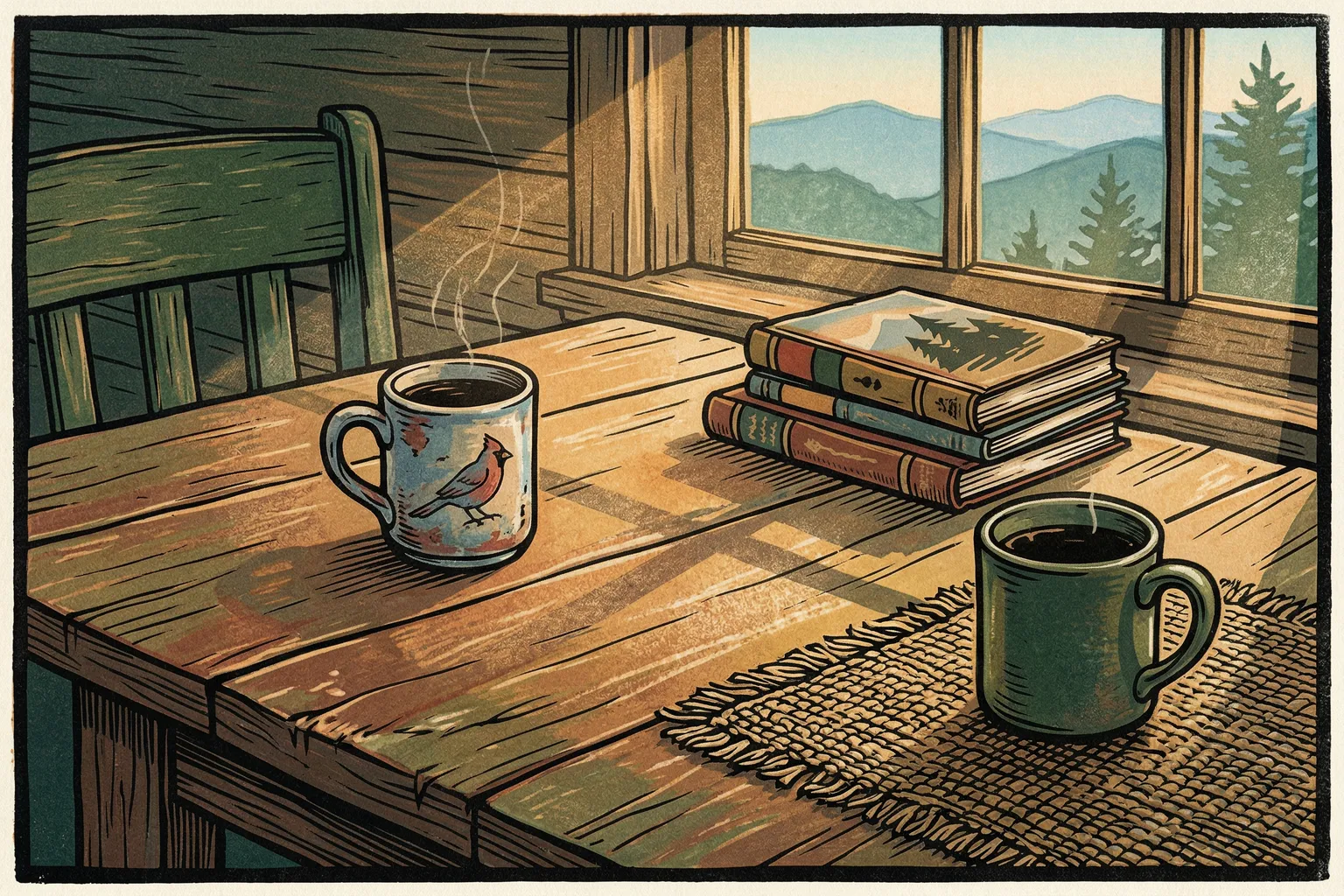
A woman I’ll call Dorothy sat at her kitchen table and poured me coffee in a mug that had a faded cardinal on it. She was seventy-nine. Retired school librarian. Married to the same man for fifty-one years before he died, and she had been alone for three.
She didn’t call me about grief. She said that on the phone. “I’m not calling about Ray.”
I said I understood.
She said: “I need to ask you something and I need you not to give me a church answer.”
I said I’d try.
She looked at the cardinal mug for a while. Then she said: “Did it matter? All of it. The forty years in that school. The kids I read to. The books I shelved. Did any of it add up to something, or was I just busy?”
I have been a pastor for nearly forty years. I have sat in hospital rooms and living rooms and church offices and once, memorably, in the cab of a pickup truck in a Hardee’s parking lot because the man who needed to talk said he could only think straight if he was sitting in his truck. I learned a long time ago not to argue with the conditions people need in order to be honest.
And the question I hear more than any other, in those rooms and those trucks and those kitchen tables, is not about heaven. It’s not about hell. It’s not about what happens next.
It’s about whether it mattered.
Whether the whole thing added up.
I want to be careful here, because I’ve watched too many pastors and too many self-help books turn this question into something it isn’t. They hear “did my life matter” and they rush to the answer. They hand you a Bible verse or a greeting card sentiment or a list of your accomplishments and they say: Of course it mattered. Look at all you did.
That’s not what the question is asking.
The question is asking something harder. It’s asking whether the particular shape of a particular life, with its particular failures and its particular quiet Tuesdays and its particular way of putting the dishes away, amounted to anything that will survive the forgetting.
Dorothy wasn’t asking if she’d been productive. She’d been plenty productive. She was asking if she’d been real. If the life she’d lived had weight, or just motion.
That’s a different question. And it deserves more than a bumper sticker.
I used to think this was a question that arrived only at the end. A deathbed question. Something that showed up in the last weeks when the body was failing and the mind had nothing left to do but take inventory.
I was wrong. It shows up earlier than that. It shows up in your sixties, at the kitchen table, on a Tuesday. It shows up when the schedule clears and the kids don’t call as often and the days take on a quietness that can feel like either peace or accusation, depending on the morning.
It shows up, I think, because we spend the first two thirds of our lives answering it without knowing we’re answering it. We’re too busy to ask. The kids need rides. The job needs doing. The mortgage needs paying. The question is there the whole time, underneath, like groundwater, but we don’t hit it because we’re too busy paving the surface.
Then the surface clears. And there it is.
Wendell Berry has a poem called “The Wild Geese” where he writes about finding rest in the world, about lying down where “the wood drake rests in his beauty on the water.”
That’s not quite right. That’s Mary Oliver. “Wild Geese.” I get them confused because they’re both doing the same work, which is trying to tell you that your life is already connected to something larger than your list of achievements, and you don’t have to earn it.
Oliver writes: “You only have to let the soft animal of your body love what it loves.”
I have read that line to people in their seventies and watched their faces change. Not because it’s religious. Because it’s permission. Permission to trust that the living itself was the point, not just the things they produced while they were doing it.
Linda says I quote too many poets for a Presbyterian. I tell her the Presbyterians could use more poets. She says that’s probably true but it doesn’t change the fact that I just attributed Wendell Berry’s work to Mary Oliver, and did I not just do this in front of the whole congregation last month. I did. I’ll probably do it again.
Here is what I have learned from sitting with people in the last years of their lives.
The ones who are at peace are not the ones who accomplished the most. They’re not the ones with the longest resumes or the biggest houses or the most stamps in their passports. I’ve sat with very successful people who were terrified that none of it had meant anything, and I’ve sat with people who never left their county who knew exactly what their lives had been for.
The difference, as near as I can tell, is attention.
The people who are at peace paid attention. They were present for the ordinary things. They noticed the people in front of them. They didn’t just feed their children, they watched their children eat. They didn’t just go to work, they learned the names of the people who cleaned the building. They didn’t just live, they were aware that they were living, and that awareness made the living mean something.
Dorothy shelved books for forty years. That is not, on its face, a world-historical accomplishment. Nobody is going to name a building after her.
But she also read to first-graders every Tuesday afternoon. She knew which kids needed the reading and which ones needed the lap. She kept a shelf of books for the children whose parents couldn’t afford the book fair, and she never told anyone where the books came from, and she remembered the titles twenty years later when she told me about it.
That’s not busyness. That’s attention. That’s a woman who saw what was in front of her and responded to it with care, and if that isn’t a meaningful life, then I don’t know what the word means.
The Gospel of Matthew has a parable about a landowner who gives money to his servants before leaving on a journey. You know it, probably. Two servants invest the money and double it. One buries his in the ground. The landowner returns and is pleased with the first two and angry with the third.
I preached this parable for years as a story about using your gifts. About productivity and stewardship. And I think that’s partly right.
But the older I get, the more I think the story is about something else. The servant who buried the money did it because he was afraid. He says so. “I was afraid, and I went and hid your talent in the ground.” He was so scared of getting it wrong that he didn’t do anything at all.
And that, I think, is closer to the real fear behind the question Dorothy was asking. Not did I do enough but did I show up at all. Was I present for my own life, or did I bury it in the ground because I was afraid of getting it wrong?
The answer, for Dorothy, was clear. She showed up. She just needed someone to say it back to her.
I should tell you what I said.
I’m not always good at the moment. I’ve been a pastor long enough to know that the wrong sentence at the wrong time can close a door that took someone years to open. So I sat with it. I drank the coffee. I looked at the cardinal mug.
Then I said: “Dorothy, I’ve been doing this for almost forty years. And the people I’ve known who lived the most meaningful lives are the ones who did exactly what you did. They stayed. They paid attention. They loved the people in front of them. Not everyone does that. Not everyone even tries.”
She looked at me like she wasn’t sure she believed it.
I said: “You didn’t just shelve books. You shelved them for someone. That’s the whole thing. That’s what makes it count.”
She cried a little then. Not a lot. The quiet kind, where the tears come before the person has decided to let them. And she said: “I just needed to hear somebody say it.”
I think about this more than I should, probably. About how many people are walking around with that question and no one to ask. About how many Tuesday mornings it takes to carry the weight of was I enough when nobody has said yes.
The church should be saying it. I believe that. I believe the church exists, in part, to be the place where someone can sit down and say “did it matter” and receive an honest answer. Not a greeting card. Not a Bible verse thrown like a bandage. An honest answer from a person who has looked at the evidence of their life and can say: yes.
I have not always been good at this. I have given church answers when people needed human ones. I have rushed to comfort when I should have sat still. I have quoted scripture when what was needed was a pause and a “tell me more.” I am sixty-eight and I’m still learning how to be in the room.
But I’ve learned this much. The answer to “did it matter” is almost always yes. Not because every life is a triumph. Some lives are quiet and small and full of unremarkable Tuesdays. But the quiet ones, the small ones, the unremarkable Tuesday ones, they counted. They counted because someone was paying attention inside them. And the attention itself is the meaning.
Dorothy walked me to the door that afternoon. She was steadier than when I’d arrived, which is about the best you can hope for in pastoral work. I don’t fix things. I never have. I sit in the room and I try to say true things, and sometimes that’s enough and sometimes it isn’t, and I’ve made peace with the ratio.
She said: “Tom, do you ever wonder about yours?”
I said: “Every Tuesday.”
She laughed. First real laugh of the afternoon.
I said: “But I think that’s probably the right question to keep asking. I think the day you stop wondering is the day you stop paying attention.”
She said: “That’s a good church answer.”
I said: “It might also be true.”
She said: “It might.”
If you’re carrying this question, I want you to know something.
The fact that you’re asking it means you cared. It means you were paying attention to your own life closely enough to wonder if it held together. A lot of people never get there. A lot of people keep paving the surface and never hit the groundwater, and they arrive at the end without having asked and I don’t know if that’s better or worse, but I know it’s different.
You asked. That tells me something about the kind of life you’ve been living.
And I know I’m a retired pastor in North Carolina and I don’t know the particular shape of your particular days. I don’t know your Tuesday mornings or your kitchen table or the mug you drink from. But I’ve sat in enough rooms to know this: the lives that mattered were the ones where someone was home. Where someone was present. Where the lights were on and a person was inside, paying attention to the people who came through.
If that was you, then yes. It added up.
Not because I say so. Because the people you loved know it, even if they haven’t told you. Because the first-grader who sat in your lap while you read doesn’t remember the title of the book, but remembers that someone was there. Because the attention you gave to your ordinary days was not ordinary at all. It was the whole thing.
It was always the whole thing.
Tom Whitaker is the Faith & Meaning columnist for the Sunday Evening Review. He is a retired Presbyterian pastor who spent forty years in ministry in Kentucky and North Carolina. He lives in Weaverville, North Carolina, with his wife Linda and a cat named Psalms.