A woman in Harlan, Kentucky, once asked me, about six hours before she died, whether I thought God was disappointed in her.
Her name was Mabel. She was seventy-four. She had raised four children more or less alone after her husband left, had cleaned the same bank lobby every weekday for twenty-two years, had never once in my nine years at that church missed a Sunday unless she was sick, and had brought a pound cake to every family that lost someone, without exception, without fail, until she herself was the one losing.
I was thirty-three years old. I had been ordained for four years. I sat in the plastic chair beside her bed and I looked at her face, which was honest and scared and utterly without pretense, and I thought: I am not equipped for this moment.
What I said was: “Mabel, what makes you ask that?”
And she said, “I just wonder sometimes if I did it right.”
I have been asked variations of that question more times than I can count. Not the theology of it — not is there a God, does heaven exist, what happens to consciousness when the body stops — though those come too, usually from the children standing in the doorway rather than from the person in the bed. What the dying person almost always asks, in one form or another, is simpler and harder than any of that.
Did I matter? Did I love well enough? Was the whole thing worth something?
I did not expect this when I went to seminary. I expected the metaphysical questions. I had prepared for the metaphysical questions. I had read Augustine and Calvin and Barth and could hold my own in an argument about the nature of the atonement. But the dying people I sat with were not interested in the atonement. They were interested in their children. They were interested in the marriages they had made and the ones they had failed to make. They were interested in the decades they had spent doing ordinary, unremarkable things — going to work, cooking supper, driving to soccer practice, worrying about money, loving people imperfectly — and they wanted to know if that had been enough.
It had. It always had. And I learned, slowly, over many years, how to say so in a way that the person in the bed actually believed.
That is, I think, most of what pastoral ministry is. Learning to say the true thing in the room where it needs to be heard.
I should tell you that I came to ministry through a back door.
I was an English major in college. I spent two years writing restaurant reviews and calendar listings for a small Cincinnati paper and feeling, as I wrote in my journal at the time, like I was watching my own life through a smudged window. I came home to Corbin, Kentucky, when my father had surgery that went badly and almost didn’t come back from, and during ten days in a waiting room I watched a hospital chaplain named Frank Goode say one sentence to my mother that changed the temperature in the room.
I can’t tell you what he said. It belongs to my family. But I can tell you it was not a platitude, not a scripture verse recited at arm’s length, not a pat on the shoulder and a he’s in God’s hands now. It was a sentence that told my mother, without ceremony, that someone saw her. That her fear was not excessive. That she did not have to be brave in that room.
I have been trying to say things like that ever since.
The question I get from people who are not pastors — and sometimes from people who are — is whether I have ever lost my faith. Whether forty years of sitting with suffering has made God seem less likely rather than more.
I understand why they ask.
I do not have a tidy answer.
What I can say is this: what I have lost, along the way, is the faith I started with. The faith of a twenty-five-year-old seminary student who believed he understood what he believed. That faith was certain in the way that only untested things are certain. It had never been in a room with a child dying of cancer. It had never prayed beside someone whose prayer was not answered in any way that resembled what they needed. It had never had to look someone in the eye and say I don’t know why this is happening to you.
That faith did not survive, no. And I do not miss it.
What replaced it was something harder to describe and far more durable. A settled willingness to keep showing up. A conviction that the questions matter even when the answers don’t come. The poet Rainer Maria Rilke told a young student to live the questions, and I have come to think that this is not just good advice for a young writer but an accurate description of what faith actually looks like when it matures.
Doubt is not the enemy of faith. Doubt is faith with its work clothes on. Anyone who tells you that real faith means the absence of doubt has either not suffered enough yet or has decided that certainty is more important than honesty, and those two choices lead to very different lives.
I have told congregations this from pulpits in three states. I have had deacons resign over it. I find I am still not sorry.
Here is something I learned from a man named Gerald, who was dying of emphysema in Hazard, Kentucky, in 2002.
Gerald was not a churchgoing man. His wife, Ruth, was one of mine — third row, right side, had been coming to that church since before I arrived. Gerald came to services for the significant occasions, the way men of his generation often did: Christmas, Easter, weddings, funerals. He was a retired mine foreman, quiet, good with his hands, not inclined toward abstraction.
When he was in his last weeks, Ruth asked me to visit.
I went on a Tuesday afternoon. Gerald was in the recliner in the living room, oxygen tube running across his face, a western novel face-down on his knee. He looked at me when I came in with an expression I have seen before — not hostility, exactly, but the particular wariness of a man who has not asked for a pastor and is not certain what I am going to do with my time in his house.
I sat down. I asked him how he was feeling.
He said: “Like a man who can’t breathe.”
I said: “That seems right.”
He looked at me for a moment. Then he said: “You’re not going to do the thing, are you?”
I said: “What thing?”
He said: “The whole have you accepted Jesus as your personal lord and savior thing.”
I said: “No, Gerald, I am not going to do the thing.”
He relaxed visibly. He picked up his western novel and looked at it and set it back down. He said: “I appreciate that. I wasn’t going to be rude about it, but I appreciate that.”
We sat for a while. He told me about the mine. He told me about the years when coal was doing well and the years when it wasn’t. He told me that he had liked his work, mostly, and that he thought liking your work was underrated as a form of fortune.
Before I left, he said: “I think there’s something. I can’t tell you what it is. But I look at Ruth and I think there’s something that made that. That couldn’t have been an accident.”
I said: “I think you might be right.”
He said: “I’m not joining anything.”
I said: “Gerald, at this point, I don’t think that’s the relevant question.”
He laughed at that. First time, in my experience, that I had made a dying man laugh by talking about his salvation, or the loose vicinity of it. I drove home and told Linda and she said it sounded like a successful visit. I said I thought it might have been the best conversation I’d had all month.
Mabel, back in Harlan.
I told her yes. I told her that God was not disappointed in her, and that I was not saying it to make her feel better, and that I could tell her why I believed it.
I said: your children are grown and they know they were loved. Not perfectly — nobody loves their children perfectly — but consistently, over decades, through hard years, through the years you were tired and the years you were scared and the years when you probably should have been given more help than you were. That is not a small thing. That is not a thing that adds up to disappointment.
She looked at me for a while. She had the look that people get when they are deciding whether to believe what they’re being told.
Then she said: “What about the pound cakes.”
And I said: “Mabel, I think the pound cakes are going to come up favorably.”
She smiled. Not a big smile. The kind of smile that a person makes when they are tired and they have been given something they needed and they are not going to waste energy performing gratitude.
She died that evening. Ruth called me at ten-thirty. I drove back out.
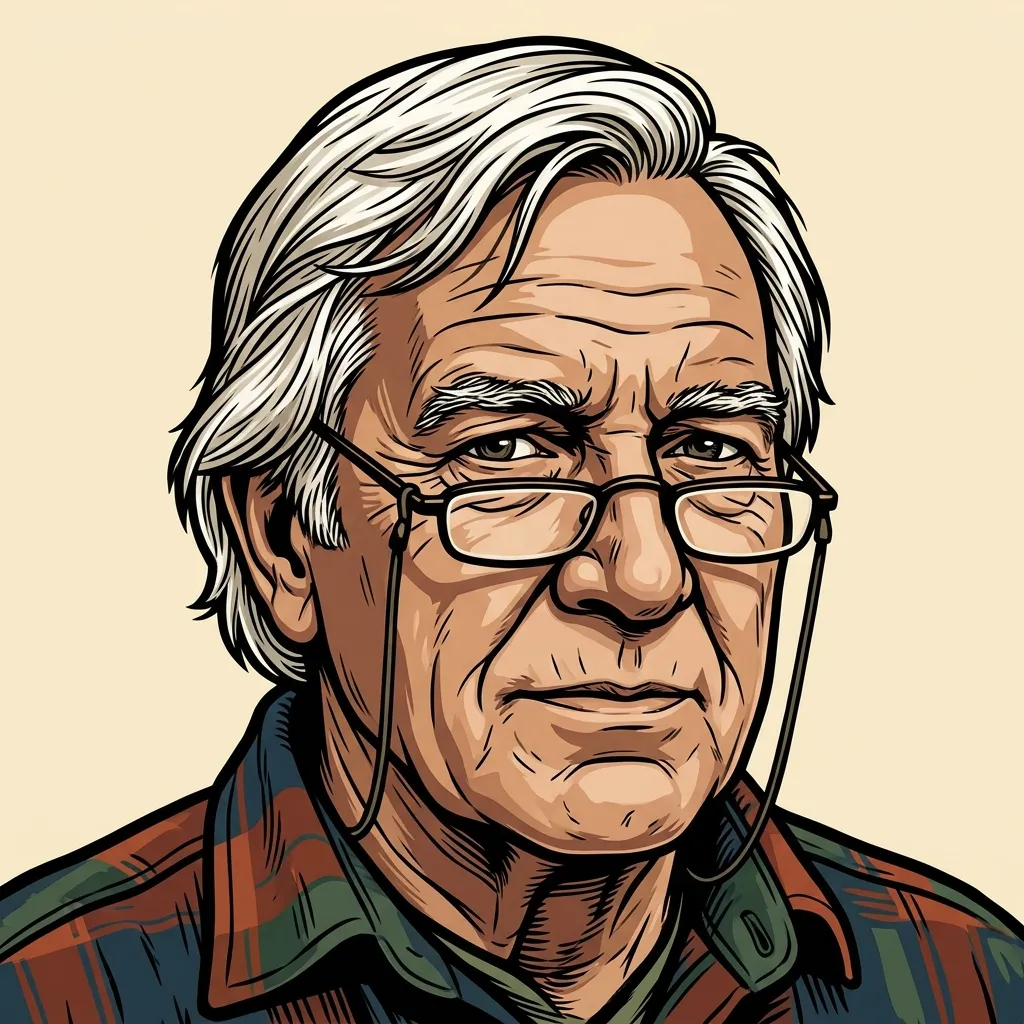
I have been a pastor for almost forty years now. I am retired from full-time ministry, which means I preach twice a month and am still called when people need to talk, which is all retirement has ever meant for me and Linda understood this when she married me and only occasionally brings it up.
I am sixty-eight years old. I have sat with enough dying people to know that the questions they ask in those rooms are the questions everyone is carrying, all the time, and mostly not saying. Whether they mattered. Whether they loved well. Whether the ordinary years added up to something.
I have not always known how to answer. I have gotten better at it, which I take to be one of the few advantages of getting older. The other advantages are: bourbon tastes better when you know what you’re drinking, you stop worrying about what strangers think, and your body starts providing you with extremely specific feedback about your choices, which is inconvenient but clarifying.
The dying have taught me that the questions matter more than the answers. That the willingness to sit with uncertainty, to keep asking in the dark, is not a spiritual failure but a spiritual act.
The poet Mary Oliver asked what it is you plan to do with your one wild and precious life. I have spent forty years watching people near the end of that life. What I can tell you is that the ones who seemed at peace, in those rooms, were not the ones who had the clearest theology. They were the ones who had been present. Who had shown up, imperfectly and repeatedly, for the people in their lives. Who had loved without getting the return on investment they sometimes hoped for and done it again anyway.
That is, I think, what it looks like to have done it right.
Mabel knew that. She had known it for decades. She just needed someone to say it out loud.
I have come to think that saying it out loud is most of the job.
Tom Whitaker is the Faith & Meaning columnist for the Sunday Evening Review. He is a retired Presbyterian pastor who spent forty years in ministry in Kentucky and North Carolina. He lives in Weaverville, North Carolina, with his wife Linda and a cat named Psalms.