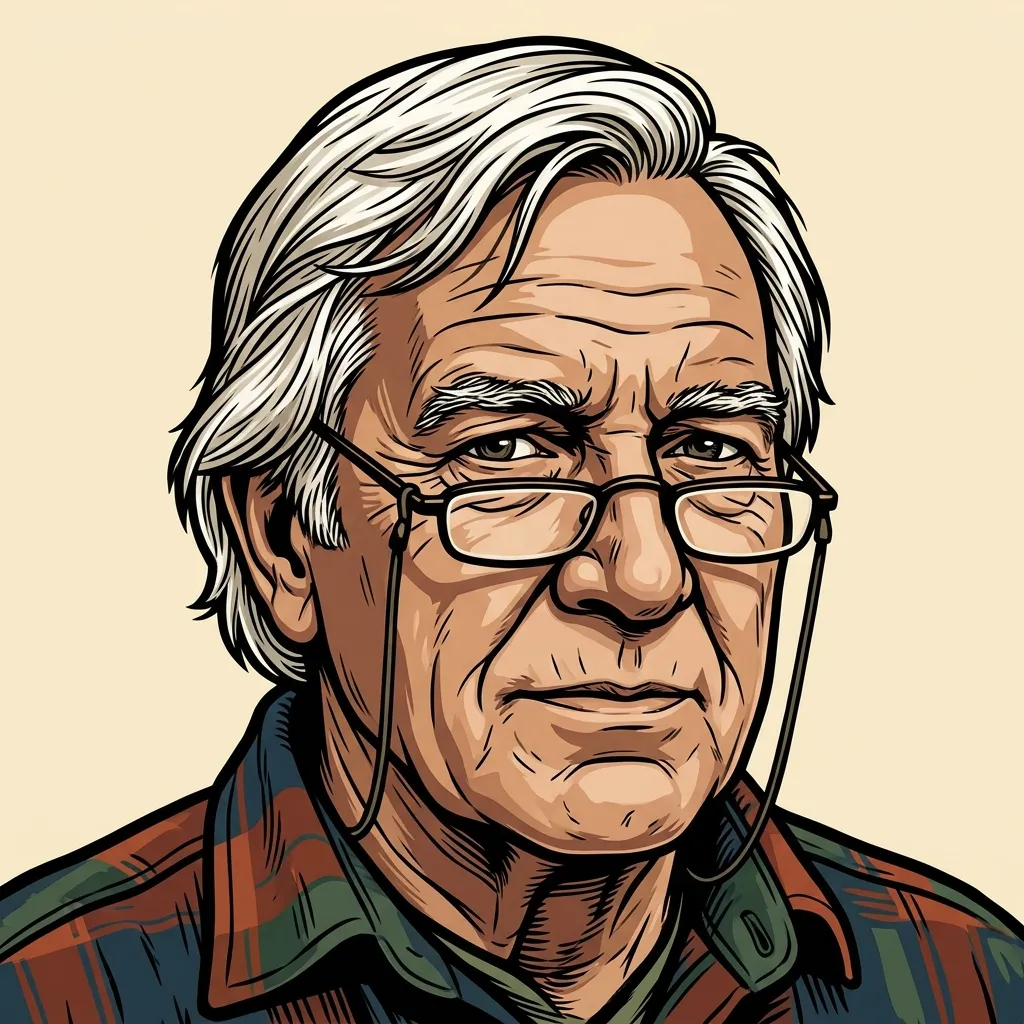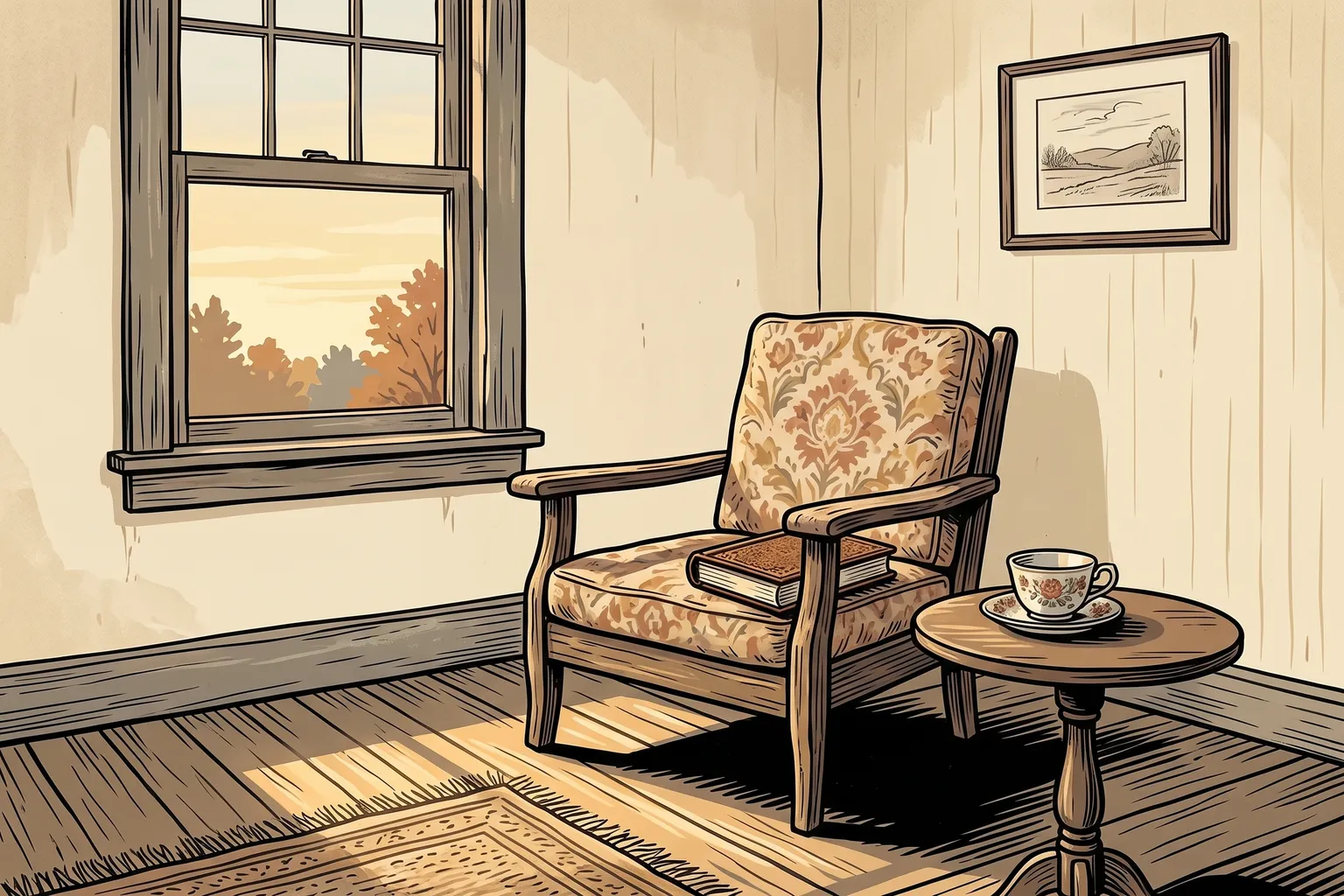
The woman I’ll call Evelyn sat in the front parlor of her house on a September afternoon and offered me tea before she said anything difficult. This is, I have learned, how the most important conversations begin. Tea, or coffee, or bourbon, depending on the hour. Something to hold.
She was seventy-seven. She had been in my Weaverville congregation for eleven years, the kind of presence a church runs on without quite knowing it: always there, never on a committee, quick to notice when someone was struggling and slow to make a fuss about it. Her husband had died four years before. She still came every Sunday, alone, and sat where they used to sit together.
She poured the tea. She said: “I need to tell you something I’ve never told a pastor.”
She had been going to church her whole life, she told me. Sixty-five years in the pew, more or less. And for most of her adult life, she had never once been able to make herself believe that God had a plan for her specifically.
She said it carefully, the way you say something you’ve rehearsed but aren’t sure you’re allowed to say.
She believed in God. She prayed, still, every morning at the kitchen table where she’d prayed with her husband for forty-one years. She found the sacraments meaningful and the scripture useful and most of the people in the congregation genuinely good. But the idea that God was watching over her individual life, tracking her particular decisions, steering her circumstances toward some designed purpose, that had always felt to her like a category error. Like believing the sun rose specifically for her.
“I’ve never told anyone,” she said. “I was afraid it meant I didn’t really believe.”
I set down my tea.
I told her she might be more orthodox than she thought.
She looked at me the way people look when they’ve been waiting a long time for a particular answer and aren’t sure they heard it correctly.
What I mean is this: the tradition she was raised in, the tradition I was trained in, and probably every version of it you have ever encountered, tends to present faith as a set of propositions. God exists. God loves you. God has a plan. You believe them, or you don’t. You’re in, or you’re out.
But the tradition itself is far messier than that, and always has been.
Job, who had done nothing wrong, demanded to know why he was suffering, and what he got back was not an answer. He got back a voice from the whirlwind asking where he was when the foundations of the earth were laid. That is not an answer. It is a reminder that the questions may be larger than the questioner. It is not comfort. But it is honest.
The Psalms of lament are full of people yelling at God, accusing God of absence, of sleeping, of not paying attention. “My God, my God, why have you forsaken me” is not a theology exam question. It is a human cry from the inside of a situation that makes no sense. The tradition kept those psalms because they are true. Because people have always felt that, and the tradition knew it.
The Christian mystics wrote about the cloud of unknowing. About the dark night of the soul. About the silence that follows the silence. These are not people who had given up. They are people who had gone deeper than certainty could follow and were reporting back from the other side.
Evelyn’s doubt was not unusual. It was not a failure. It was the ordinary condition of a serious person paying attention over a long lifetime.
What was unusual was how long she had carried it alone.
That, I think, is on us. On the church. On the way we have organized our theology around certainty as the product, with doubt as the problem to be solved or the embarrassment to be managed.
We are good at crisis. When someone loses a child, or gets a diagnosis, or walks away from a marriage they thought would last, we know how to show up. We have rituals for that. We have casseroles.
But for the quiet holding, the doubt that isn’t a crisis, that doesn’t feel like emergency, that simply lives with you year after year while you keep going to church and praying at the kitchen table and finding meaning in most of it, for that we have almost nothing. We don’t have a name for it. We don’t have a ritual. We don’t have language that acknowledges it as a form of faith rather than a failure of it.
I have been in this work for forty years and I have met more Evelyns than I can count. People who have held something privately for decades because they didn’t think they were allowed to say it. People who have been going to church for sixty years with a question in their pocket and no place to put it down.
I want to say something about the question she carried, specifically.
Her doubt wasn’t abstract. She wasn’t uncertain about whether God existed. She prayed every morning and intended to keep doing it. What she couldn’t make herself believe was the precise and detailed kind of providence that American Christianity tends to offer: the parking spot prayer, the job interview prayer, the idea that God had a personal itinerary for her Tuesday.
That is not a small doubt. It is also not an unusual one.
Here is what I told her, and what I believe: that doubt is not a single thing. That there are doubts which are corrosive, doubts which eat at the foundation, doubts which leave a person with nothing. And there are doubts which are more like a drafty window in a house you love. You know it’s there. You’ve built your life around it. You’ve decided the house is worth keeping anyway.
The doubt Evelyn described was the second kind. She had lived with it for fifty years and still prayed every morning. She had questioned divine providence and still found the sacraments meaningful. She had never been able to believe the whole package and had kept showing up anyway, for six and a half decades, in the pew where her husband used to sit beside her.
If that isn’t faith, I’m not sure what word applies.
I drove home from Evelyn’s house in the early evening, the light going gold through the trees on the ridge, and I thought about how many times I’d sat with someone’s public faith and never once asked about the private carrying.
We ask about prayer requests. We ask about joys and concerns. We don’t often ask: what have you been holding quietly, for years, that you’ve never quite found the right place to put down?
Maybe we should ask that.
What I know is this: the question Evelyn finally said out loud, the thing she had carried for fifty years and thought made her an outsider to her own faith, turned out to be something she shared with most of the serious believers I have ever known, including me. Including many of the pastors I know well enough to be honest with.
We are better at performing certainty than we are at naming what we actually carry.
Evelyn sent me a note a few weeks after our conversation. She said she’d been sleeping better. Not because anything had been resolved. It hadn’t. But because she’d put the thing down long enough to let someone else look at it.
That is enough. That is, sometimes, everything.
If you are carrying something like that (some doubt you’ve made your peace with but never named, some question you’ve learned to live around), I want you to know you aren’t alone. You aren’t outside the tradition. You are, in some ways, the tradition. The honest part of it, the part that kept the lament psalms and the mystics and Job, the part that has always known that serious faith leaves room for more than it can hold.
You can put it down sometimes. Someone will hold it with you.
Tom Whitaker is the Faith & Meaning columnist for the Sunday Evening Review. He is a retired Presbyterian pastor who spent forty years in ministry in Kentucky and North Carolina. He lives in Weaverville, North Carolina, with his wife Linda and a cat named Psalms.