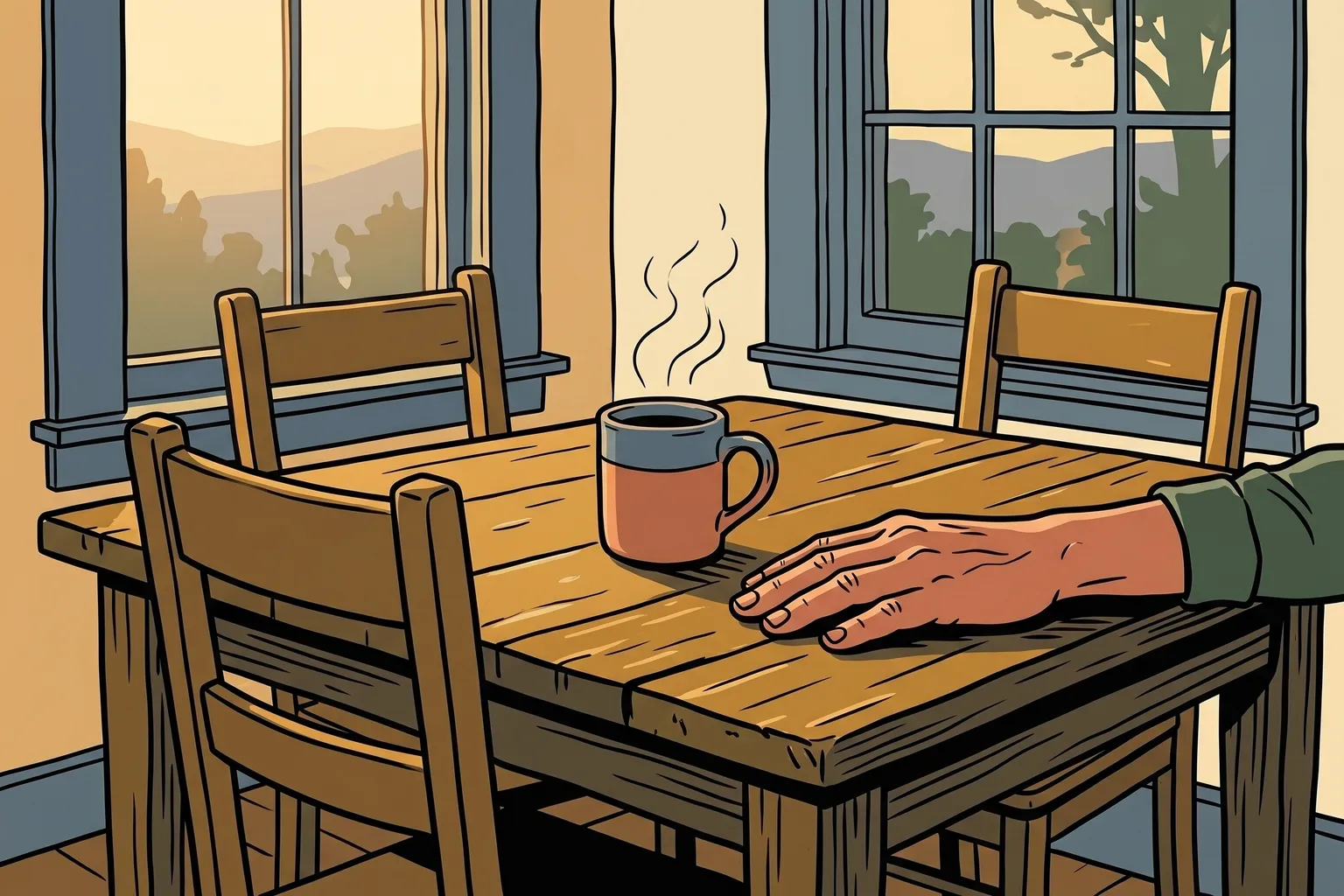
The woman’s name was Doris, and she was in the cafeteria of a regional hospital in southeastern Kentucky, sitting with a cup of coffee she hadn’t touched. Her husband Harold was upstairs in an oncology appointment, and she was working her way through a stack of papers someone on the care team had handed her on the way in.
This was maybe fifteen years ago, when I was still at my second congregation in Hazard. I had stopped in to check on Harold and found Doris instead, which is how pastoral visiting often works. You plan to see the sick person and you end up in the kitchen with the one who isn’t sleeping.
She had a pamphlet open in front of her. After a while she said: “They keep mentioning palliative care. I keep nodding. Harold doesn’t want me to ask because he thinks it means they’re giving up on him. I don’t want to ask because I think he might be right.”
I knew the word. I had been in enough of these rooms to know the word. But when I tried to explain it to her, I realized I was reaching for generalities when what she needed was something solid to hold onto. I told her I would find out and come back.
And I did.
What I came back and told her was this: palliative care is not hospice.
It is not giving up. It is not a sign that the doctors have stepped back from the fight. It is not, clinically or practically, the beginning of the end.
Palliative care is comfort care that happens alongside whatever treatment the patient is already receiving. Harold was doing chemotherapy. He could receive palliative care at the same time. The palliative team’s job is to help with pain, nausea, fatigue, the anxiety that wraps itself around serious illness like a second diagnosis. They work alongside the oncology team. You don’t choose one over the other. That’s the whole point.
Doris hadn’t known that. Harold hadn’t known that. Nobody had explained it in plain language, and so the word had been sitting there between them carrying more weight than it was supposed to.
Hospice is different, and the difference matters.
Hospice is palliative care for people who have a terminal prognosis. Under Medicare, that means two physicians have certified that the patient has six months or less to live if the illness follows its expected course. The patient chooses to stop treatments aimed at curing or slowing the disease and to redirect everything toward comfort. A team comes to the home, or to wherever the patient is living. Nurses visit regularly. There are social workers and chaplains and aides. Pain management becomes the central work.
This is not giving up, and I want to say that twice because I have watched too many families hold off on hospice for months past the point where it would have helped, because they heard the word and heard surrender. It is not surrender. It is a decision to spend whatever time remains as comfortably as possible, with people who are very good at making hard things bearable.
The National Hospice and Palliative Care Organization has documented for decades what people in this field know from direct experience: patients in hospice often have better quality of life in their final weeks than those continuing aggressive treatment. Some research suggests they live as long or longer, though that isn’t the primary argument. The primary argument is simpler. They are more comfortable, more supported, more at peace.
Palliative care, on the other hand, can begin at diagnosis. Any diagnosis. There is no six-month rule. There is no requirement to stop curative treatment. The Center to Advance Palliative Care describes it as appropriate for anyone with a serious illness at any stage, from the first round of chemotherapy to the last conversation with a doctor about what comes next.
A family can receive palliative care for years before the word hospice ever enters the room. Many do. Most don’t know they can.
The families who do best, in my experience, aren’t the ones with the most information. They are the ones who start the conversation before they have to.
I have sat with a daughter who told me she wished she had known about palliative care when her mother was still in active treatment. The nausea from the chemotherapy was so severe her mother barely left the house for the better part of a year. There were medications that could have helped. There were specialists who could have helped. She just hadn’t known to ask, and no one had offered.
I have sat with a husband who resisted hospice because agreeing to it felt like being the one who decided his wife was going to die. He wasn’t choosing hospice; he was choosing to keep fighting, even as she was telling him, in her way, that she was tired. He held on for months. When they finally made the transition, she had about three weeks left. He told me later they were the most peaceful three weeks they had in two years. He said he wished someone had told him that hospice doesn’t take away hope. It just aims it differently.
I have sat with grown children who didn’t know their parents had any strong preferences because the conversation had never come up. The parents assumed the children would figure it out. The children assumed the parents didn’t want to talk about it. Nobody was wrong, exactly. But the absence of the conversation meant the family was making decisions under pressure, with grief already in the room, without the information that could have made those decisions easier.
The practical gift that comes from having this conversation early is time. Time to ask the questions before you’re in crisis. Time to figure out what the patient actually wants, not what everyone assumes they want. Time to find out what your insurance covers, what your local hospice programs offer, what a palliative care consultation would look like at your hospital or clinic.
Glenn Suttner has written plainly about the financial side of long-term care planning over in the Money section, including what Medicare does and doesn’t cover, and it’s worth reading alongside this. The care decisions and the financial decisions belong in the same conversation, even if they feel like they live in different rooms.
The questions worth raising, not just in crisis but at any appointment when serious illness is in the picture:
What is the goal of the current treatment? Is it to cure, to slow progression, or to manage symptoms? If symptoms are the focus, how does that overlap with what palliative care does?
What can be done about the side effects? Most people don’t know that managing the side effects of cancer treatment is a palliative care specialty. They don’t have to be endured as the price of admission.
At what point would hospice become worth discussing? Not as a threat or a deadline. Just as a question that deserves a real answer from someone who knows the case.
What does comfort look like for this person, specifically? This is the question that changes everything, because the answer is almost never the same as the assumptions.
And: who do I call when things get harder? Knowing who to call before you need to call them changes what happens at two in the morning, which is when things sometimes get harder.
Ruth Ann Pemberton has written honestly about what grief support looks like for families after a loss, and the truth is that the families who handle loss with the most grace are often the ones who had good support before the end, not just after. That is part of what palliative care and hospice offer: not only medical support but human support, for the patient and for the people sitting in the hospital cafeteria with cold coffee and a pamphlet they are afraid to read.
Doris and Harold ended up getting a palliative care consultation. Harold was still in active treatment at that point, still fighting in his particular way, and the palliative team worked alongside the oncology team. He did better. Not in the way cancer stories sometimes end, but in the way that matters when cancer is the story: he had more good days. The nausea was more managed. He came to church twice in the spring.
Harold died the following January. Doris told me afterward that the last few months had been better than she expected. Not easy. Nothing about it was easy. But better than she had feared.
“I just wish someone had explained all this before,” she said. “Before we needed it.”
I have thought about that sentence many times since.
This piece is what I would have given Doris to read before she went upstairs. Not because information takes away the hard parts; it doesn’t. But because understanding what is available, and saying out loud what you want, and having this conversation before you have to have it in a waiting room under fluorescent lights with your hands shaking, that’s not nothing.
That is, in fact, quite a lot.
If you are already in the season of preparing for what comes next, the piece I wrote on how to write a eulogy might be useful company. Not because you are there yet, but because thinking about those words while there is still time to mean them is its own kind of gift.