My mother’s Sundays were different from her other days, and I say that knowing it sounds like a sentence that explains nothing. Let me try again.
She cleaned houses three days a week in Corbin, Kentucky. Not the same house. Three different families, three different sets of floors and bathrooms and the particular kind of invisible labor that other people’s houses require of the woman who has been hired to make them look like nobody lives in them. She was good at it. She was efficient in a way that had been built by necessity, and she never complained about the work, though I noticed she never talked about it much either.
On Sundays she didn’t clean anything.
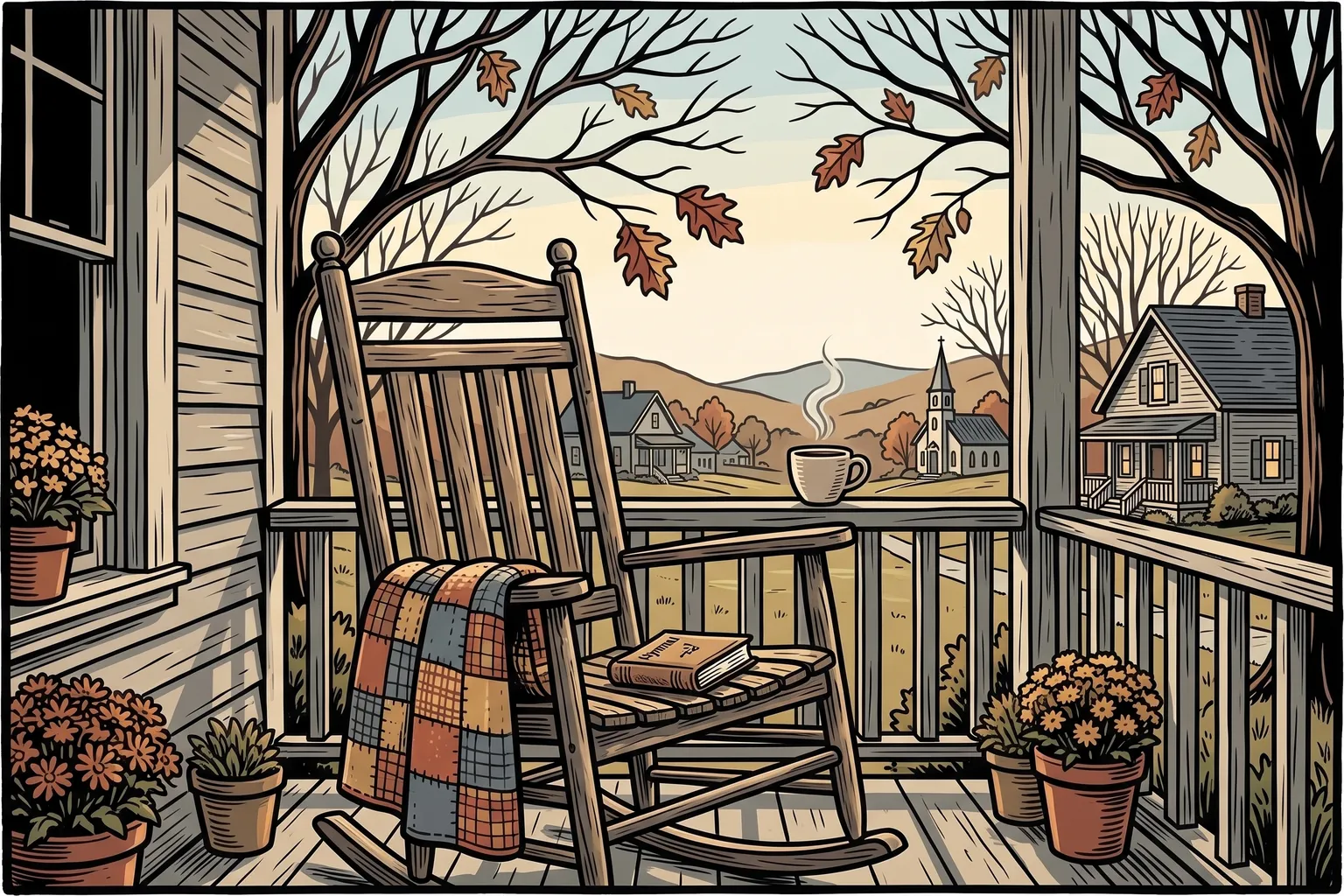
Not just other people’s floors. She didn’t clean our house either. The dishes could wait until Monday. The laundry sat. Our small house in Corbin was, on Sundays, released from the project of maintenance, and my mother moved through it in a different gear. She sang in the choir at First Baptist Church. She read. She sat on the porch in the afternoon with a cup of coffee and what I now recognize was a cultivated stillness. She wasn’t resting, exactly. She was inhabiting a different mode of being entirely.
I was nine or ten before I noticed this. I don’t think she ever explained it to me in so many words. It was just the shape of her week.
I’ve been thinking about my mother’s Sundays lately, since a man I’ll call Harold asked me something I couldn’t answer.
Harold had retired from the plant where he’d worked for thirty-one years. Good benefits, reasonable pension, a party with a sheet cake that said “Happy Trails” in green frosting. He showed me a photo. He wasn’t entirely sure what “Happy Trails” meant as a send-off, but he’d eaten his piece of cake and shaken the hands and driven home on a Tuesday afternoon to a house where there was nothing scheduled.
He came to see me three months later. He was one of those men who don’t visit pastors easily, so I knew it was something.
“I don’t know what to do with Sundays anymore,” he said. “They used to feel different. Now they just feel like Saturday.”
He meant it as a practical problem. He’d stopped going to church twenty years earlier and didn’t think that was what he was missing. He meant something else. He meant that Sundays had lost whatever quality they’d once had of being separate from the rest, and that this loss had become, in retirement, suddenly noticeable in a way it hadn’t been when he was working.
I sat with that for a while. The pastoral instinct is to reach for a fix, but Harold wasn’t asking for a fix. He was asking why it mattered, which is a harder question.
The fourth commandment, the one about the Sabbath, is given twice in the Bible, and the two versions don’t say exactly the same thing.
The Exodus version says: remember the Sabbath because in six days God made the world and rested on the seventh. Rest because creation rested. The Deuteronomy version says something different. “Remember that you were a slave in the land of Egypt,” it says, “and the Lord your God brought you out from there with a mighty hand and an outstretched arm. Therefore the Lord your God commanded you to keep the Sabbath day.” (Deuteronomy 5:15)
I’ve always thought the Deuteronomy version is the one with the real weight in it.
The commandment was given to people who had never been allowed to rest. Not figuratively. Literally. Egyptian bondage wasn’t a metaphor. The prohibition against working on the Sabbath was extraordinary to people who had never once been permitted to decide when they were done for the day. You can’t hear “you shall not work” the same way unless you understand who it was being said to and what it had cost them to get there.
This is the thing that complicates Harold’s situation, and mine, and maybe yours.
The commandment was designed for people who couldn’t stop. What does it mean for people who can’t seem to start?
I’ve watched enough people move through retirement to have some opinions about this. Not all of them useful. But one thing I’ve noticed is that the problem isn’t usually idleness. People stay busy. They golf, they volunteer, they drive grandchildren to school, they find projects. The problem is that busy and purposeful aren’t the same thing, and that when you’ve organized your entire adult life around the structure of work, removing the structure doesn’t automatically replace it with anything.
Harold didn’t need me to tell him to join a club.
He needed permission to stop trying to solve the problem of his own time.
The Sabbath, when I look at it from this angle, isn’t primarily about rest from work. It’s about releasing the posture of indispensability. It’s the practice of letting the world turn without your effort for one day, not because the world doesn’t need you, but because it’s important to remember that it can.
This matters more than people say. The temptation in retirement isn’t sloth. It’s the constant, low-grade anxiety of justifying your own existence without the vocabulary of productivity. When someone asks what you do and the honest answer is that you’re retired, a lot of people immediately start listing everything they’re still doing. I understand this. It’s not vanity. It’s the residue of a lifetime of believing you’re worth what you produce.
The Sabbath is the practice that interrupts that belief. Not once, but weekly, indefinitely.
My mother wasn’t a theologian. I don’t know if she’d worked any of this out in her head. But watching her move through those Sundays in Corbin, I think she understood something that took me twenty years in a pulpit to arrive at: the point of setting one day apart isn’t the day itself. It’s the act of setting.
It’s the deliberate decision to say: this day is different. Not because different things happen in it, but because I’ve chosen to inhabit it differently.
She still sang in the choir. She still cooked dinner. But the quality of her attention was different on those days. The house had a different atmosphere, one I can still recall and can’t fully describe. She wasn’t on duty. Whatever the labor of the other six days was for, Sunday was for something else.
She was doing, I think, exactly what the commandment was pointing at. Not for slaves this time. For a woman in Corbin, Kentucky, who had chosen to make one day in seven into the practice of not being available for her own usefulness.
When I told Harold some version of this, he was quiet for a while. Then he said: “So it doesn’t have to look religious.”
I said it doesn’t have to look religious. Though for some of us it does, because that’s the container we were handed and we’ve found it holds the thing pretty well.
“It just has to look different,” he said.
That’s the whole practice. One day in seven where you lay down the project of yourself. Where you stop justifying your presence and just inhabit it. Where the world is allowed to be what it is without your improvement.
For Harold, that turned out to mean Saturday mornings alone at a reservoir outside town, fishing without a reason to be somewhere else by noon. Not Sunday. The specific day isn’t the commandment. The setting apart is.
For my mother, it was Sunday, her whole life, until she couldn’t anymore. She sang in that choir for forty years and was never once given a solo, and she died having given those Sundays her full attention anyway.
I think she knew something about rest that neither the commandment nor I have ever quite managed to explain. But she lived it, which is better.