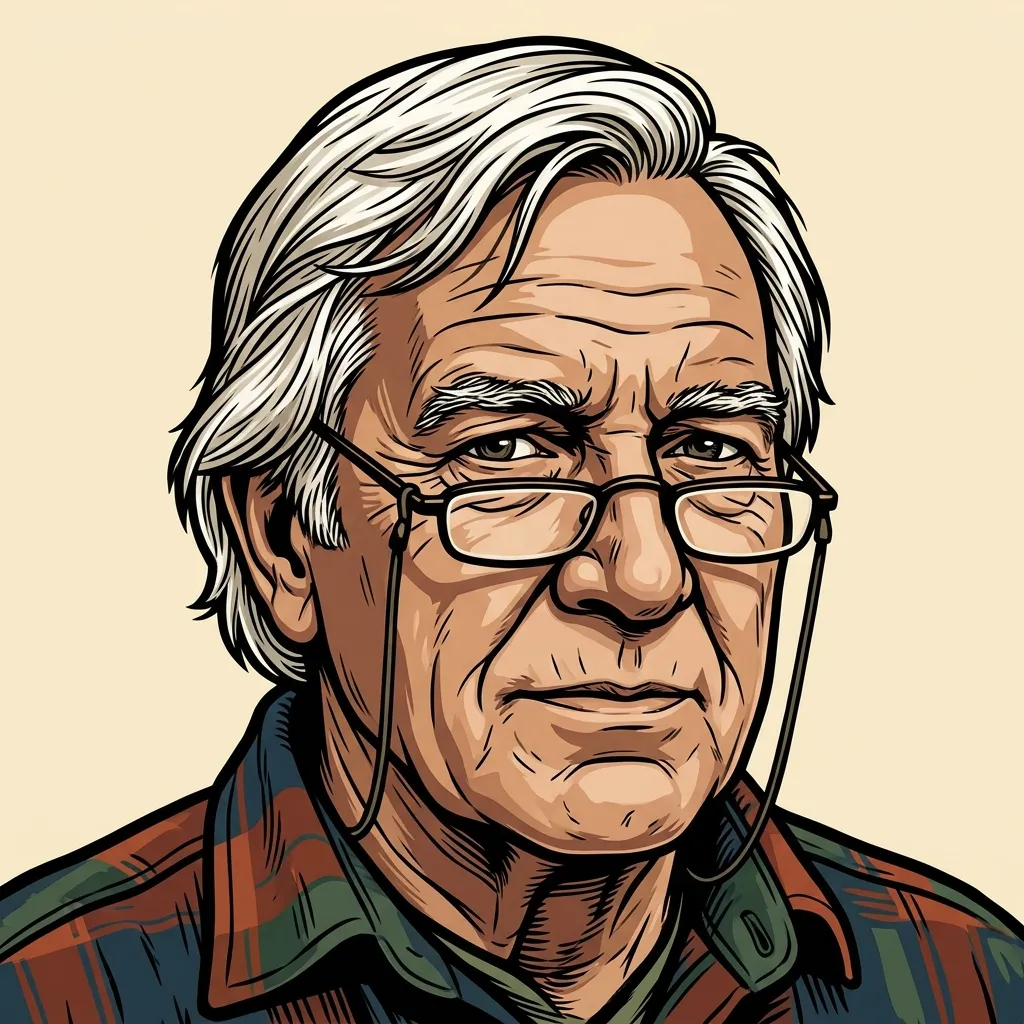
A man I’ll call Walter was sitting up in his hospital bed when I arrived, and his eyes had the particular hardness of someone who has been deciding something for a while and has finally decided.
His wife of forty-one years had died six days earlier. Pancreatic cancer, quick and merciless, eight weeks from diagnosis. They had been in my congregation in Harlan for years, two of the backbone people, the ones you could count on to show up and to stay. She was sixty-one. He was sixty-three.
He looked at me and said: “I want you to tell me what God was doing.”
I didn’t say anything. I had learned, by then, that silence is usually better than the first thing that comes to mind.
“Forty-one years,” he said. “We prayed. We showed up. We did what we were supposed to do. And then this. So I want to know what the plan was. Because I don’t see it.”
I told him I didn’t know.
He said: “Then what good are you?”
That was 1991. Walter is the reason I stopped using certain words in my preaching. Words like plan and purpose when they’re deployed as explanations for why the terrible thing happened. Because Walter was right. If the answer to his question is a plan I can’t show him, in a language he can’t hear, then I’m not offering him anything. I’m just making myself feel useful.
What Walter was in the middle of is what I want to talk about here. Not the grief, though the grief was real. The other thing. The thing that happens to belief when the world stops confirming it.
A crisis of faith isn’t the same thing as losing your faith.
I want to say this plainly, because I’ve watched too many people confuse the two. They hit a wall (Walter’s wall, or one like it) and because the thing they believed no longer feels solid under their feet, they conclude that they’ve stopped believing. They leave the church. Or they stay and go through the motions. Or they spend years in a private guilt that nobody around them knows about, convinced that the shakiness is the end of the story.
It isn’t. The shakiness is the beginning of something harder and more honest.
A crisis of faith is the moment your faith stops being comfortable. The moment the words you’ve been saying stop saying themselves automatically and you have to decide whether you still mean them, and if so, what exactly you mean. That’s not the death of belief. That’s belief becoming real. Becoming yours. Becoming the thing you’ve actually chosen rather than the thing you inherited and never had reason to examine.
I don’t think you can really have faith until you’ve been through this. And I don’t mean that as a compliment to suffering. I mean it as a description of how faith works, the same way I’d describe how a muscle works. The thing that hasn’t been tested hasn’t been built yet. It’s comfort wearing the right clothes. I have said from pulpits in three states that doubt is faith’s work clothes, and I meant it, and I still mean it. But what I want to talk about here is what it looks like when the doubt gets serious. When it’s not a philosophical question anymore but a personal one. When it arrives at your hospital bed at sixty-three and says: then what good are you?
In 1998, I went through a period of about four months in which prayer felt like talking to an empty room.
I’m not going to dress that up. I have preached about doubt, and I’ve written about what it means to ask hard questions in the dark, and the pastoral version of this story is that I sat with those questions until something shifted. But the honest version is that for four months I got up every morning and did the practice and felt nothing on the other side of it. And I kept getting up anyway. Not because I was particularly brave or faithful. Because I didn’t know what else to do.
My wife Linda knew something was wrong. Linda always knows. She didn’t press me, which was the right instinct. She made the coffee. She kept the house. She left me alone in the study where I was wrestling with whatever I was wrestling with, and she trusted that I’d come through it. She was right to trust that. She usually is.
What I know now, looking back from thirty years of distance, is that those four months changed me in ways that ten years of ordinary faith hadn’t. When I came out the other side, and I did come out the other side though not with answers, I was carrying something different than I’d had before. I can’t fully explain what it was. Something like the knowledge that the practice matters even when the feeling is gone. That showing up in the silence is its own kind of faithfulness.
Seamus Heaney wrote about crediting the marvelous, keeping open a space for what resists being explained or systematized, because once you close that space you’ve lost something you can’t recover by argument. I’ve thought about that for thirty years in a pastoral context. The crisis stripped away the part of my faith that needed things to feel a certain way. What remained was the willingness to stay in the room with the mystery. I still don’t know if that’s enough. I think it might be all there is.
Walter came back to see me about a year after his wife died. He was thinner and quieter and had let his hair grow longer than he usually wore it. He sat across from me and looked at his hands.
He said: “I’m still angry.”
I said: “That makes sense.”
He said: “But I’ve been going back. Not because anything got explained. Just because I didn’t have anywhere else to go that helped.”
I thought about that for a long time after he left. Not as a pastoral success story, because it wasn’t one, not the kind that gets written down anywhere. Walter wasn’t healed. He wasn’t restored to the faith he’d had before. What he’d found was something narrower and sturdier: the willingness to keep going into a room that hadn’t given him what he’d asked for, because the alternative was an isolation he liked even less.
That is what a crisis of faith can become, if you let it. Not a resolution. A durability. The faith on the other side of the crisis isn’t the faith you had before, and it shouldn’t be. That earlier faith was a gift you didn’t have to earn. What you have after is what you built in the rubble. It’s smaller and it’s yours and it holds.
I want to be careful here not to make this sound like a program. Like there’s a process: enter crisis, do the work, emerge with sturdier faith. That’s not what I’m describing. Some people enter a crisis of faith and don’t come out the other side, not in any way I can name or point to. I have sat with that. I don’t have an answer for it and I won’t pretend to.
What I can say is what I’ve observed in forty years of being in the room with people who were losing and finding and losing again. The ones who came through were not the ones who found the answer Walter was looking for. They were the ones who decided the question was still worth carrying. That whatever they couldn’t explain about God or prayer or why the terrible thing happened, the love in their lives was real, and the years were real, and they were not done yet.
If you are in it right now, in the silence or the anger or the four-month period where nothing answers, I want to tell you two things.
First: you haven’t lost anything. You’re not on the outside looking in. The crisis is the inside. This is what faith looks like when it’s doing its hardest work.
Second: you don’t have to come out the other side with certainty. You just have to come out the other side. And sometimes what that looks like is Walter, showing back up not because he had an answer but because he didn’t have anywhere else to go that helped, and finding that going back was its own kind of answer. Not the one he asked for. The one he could live with.
You can build something on that. I’ve seen it done. I have done it myself, more than once, in the study with the sagging couch and the two-finger typing and the cat named Psalms who has no theology but excellent instincts about when to sit with someone.
The faith that survives a crisis isn’t a smaller faith. It’s a truer one. It has been in the room with the worst question and decided to stay anyway. That decision is the whole content of it, and it isn’t nothing.
Tom Whitaker is the Faith & Meaning columnist for the Sunday Evening Review. He is a retired Presbyterian pastor who spent forty years in ministry in Kentucky and North Carolina. He lives in Weaverville, North Carolina, with his wife Linda and a cat named Psalms.