Charlotte sat in the chair in my study where people always sit when they’ve come to say something they aren’t sure how to say.
She was sixty-seven. Retired school principal. A woman who had run buildings of four hundred students and twenty-five teachers and knew how to make things work. Her husband, Walter, had died in March. He had been the church person in their marriage, she told me. She had come along, sat in the pew beside him, found the whole enterprise somewhat helpful and somewhat opaque, and had never felt, in forty years of accompanying him, that the book actually belonged to her.
Now she was alone. The Bible was on her nightstand. And she said: “I want to read it. Actually read it. But I don’t know where to start and I don’t want someone to tell me what to think. I just want to know how to find my way in.”
I told her she had just said the most important thing there was to say on the subject.
The most common mistake people make with the Bible is starting at the beginning.
Genesis is a remarkable book, and I’ll come back to it. But if you open to page one and resolve to read through to the end, you’re treating scripture like a novel or an instruction manual, which it isn’t. The Bible is a library. Sixty-six books, written across more than a thousand years, by dozens of different hands, in three languages, for communities facing circumstances that ranged from Egyptian slavery to Babylonian exile to Roman occupation. It’s a library that has been bound together and called a book, and the binding is both a gift and a source of considerable confusion.
You wouldn’t walk into a library and start at aisle one, shelf one, and try to read everything in order. You’d ask: what am I here for?
What Charlotte was here for, she said, was to understand why Walter had found these texts meaningful for fifty years. She wasn’t looking to be converted. She wasn’t testing her skepticism. She was trying to understand something she had lived beside for her entire adult life but never fully entered.
That’s a legitimate starting place. So is anger. So is grief. So is curiosity about the history. So is the nagging sense that something is unfinished in how you’ve been thinking about God, or meaning, or what the point of any of this actually is. The door has multiple entrances. I’ve watched people come in through almost all of them over forty years.
The one entrance I’d steer you away from is obligation. “I should read the Bible.” That “should” has stopped more people before the third chapter of Genesis than any actual difficulty in the text.
Start with what draws you.
If you’re drawn to poetry, start with the Psalms. They’re the most honest document in scripture. One hundred and fifty poems, some of them ecstatic with praise, some of them so raw with grief and anger they’ll surprise you. Psalm 22 begins “My God, my God, why have you forsaken me?” which isn’t a statement of faith. It’s a howl of abandonment. It’s in the canon, taken seriously as scripture by the people who assembled these texts. That should tell you something about what kind of honesty this library is willing to house.
If you’re drawn to story, start with Genesis. The first eleven chapters contain some of the most ancient stories humans have ever told: creation, flood, the scattering of peoples. Then the Abraham narratives begin, and what you’re reading is a family saga: a man and his wife and their complicated descendants wrestling with a God who makes promises and a world that doesn’t cooperate. It’s not allegory and it’s not history in the modern sense. It’s something older than both. A story about what it means to live under a promise you didn’t ask for and can’t fully understand.
If you’re drawn to encounter, start with the Gospels. Mark is the shortest and oldest, written in a style that suggests urgency: someone talking quickly because what he has to say feels like it can’t wait. Matthew and Luke are more measured, more literary, each carrying its own concerns and its own picture of who Jesus was. John is different from all three in tone and intention, almost meditative, the book that most invites you to sit with a mystery rather than solve it.
I told Charlotte to start with the Psalms. She sent me a text at ten o’clock that night, after reading Psalm 22. She said she’d been sitting with it for an hour and couldn’t explain why. I told her that was exactly right.
Now, how to read.
Get a study Bible. I don’t care which tradition it comes from as long as it has footnotes and introductions to each book. Those introductions matter more than most people realize. Before you read a word of Amos, you want to know that he was an eighth-century shepherd from Judah who prophesied in the northern kingdom during a time of economic inequality and political corruption, and that the authorities told him to go home and stop making trouble. That context isn’t background noise. It’s the lens you need. Scripture was written for specific people in specific circumstances. Knowing who and when and why doesn’t diminish the text. It lets you hear what the text is actually saying.
Read with a pen. Mark the things that confuse you. Mark the things that move you. Mark the things that make you angry. The anger is especially worth marking, because scripture that makes you angry is usually scripture that’s demanding something from you, or contradicting something you’d rather keep believing, and that’s precisely where the conversation gets interesting.
Here’s something I’ve been thinking about for a long time, and I want to say it plainly because most beginner’s guides don’t.
There are two kinds of reading, and they’re not the same thing.
There is reading for information: learning what the Bible contains, what it says, what the theological arguments are, what the historical context is. This is valuable. I spent three years in seminary doing it and haven’t stopped since.
And there is reading for formation: reading not to accumulate knowledge but to be changed. To let the text press against your life and see what gives. To ask not just “what does this mean?” but “what does this mean for me, now, in the life I’m actually living?”
These two kinds of reading require different postures. Information reading rewards the mind. Formation reading rewards what I’d call the whole person: mind and memory and loss and longing and the things you carry from your upbringing that you haven’t examined in thirty years. Formation reading is slower. Less efficient. You might spend a week on a single passage. You’ll understand less of the whole Bible and more of yourself.
Most people who come to scripture seriously in their adult years are, eventually, reading for formation, even if they wouldn’t use that word. They’re reading because something in their life has become a question the rest of the culture doesn’t know how to answer, and they’re looking for company in the asking. The Bible is full of people who were asking the same questions. It doesn’t always provide satisfying answers. But the company is real.
Here’s the part people don’t want to hear: you will encounter passages that trouble you. Violence. Commands that look like cruelty. A God who appears to act in ways that are difficult to reconcile with the God described twenty pages later. Passages that have been used to justify things that should never have been justified.
Don’t skip them. Sit with them.
Not because the troubling parts are secretly fine if you look hard enough. Some of them aren’t fine. Some reflect the moral limitations of the people who wrote them in the time they were written. Part of reading scripture as a serious adult is being honest about that, not explaining it away.
But sitting with what troubles you is also how you find out what you actually believe. I’ve written before about the relationship between doubt and faith because I think they’re inseparable, and nowhere is that truer than in the act of reading scripture honestly. The passages that make you argue back are doing something. Let them.
The last thing I’d say to Charlotte, and to you, is this: read with someone else if you can find someone.
I’ve been describing a largely solitary practice, and I should confess that scripture was never meant to be one. These texts were read communally for centuries before the printing press made private reading possible. They were heard together, argued over together, interpreted in the context of communities that were living them out in real time. The tradition of gathering around the text isn’t incidental to the text. It’s part of how the text works.
I don’t mean you need to join a formal study group, though many are worth the time. I mean: find one other person who is willing to read with you and talk about what you’re reading. What surprised you. What confused you. What you think it’s asking. What you’re not willing to accept. Other people see things in a passage that you’ll never see alone. They bring their own experience to the reading, and the text gets larger when more than one life is pressing against it.
Charlotte told me she didn’t know anyone who would do that with her. I said she might be surprised. The people who are asking the questions you’re asking, quietly and in private, are more numerous than Sunday morning suggests.
Three weeks later, she told me her neighbor had agreed to read Psalms with her. Her neighbor had just been through a difficult surgery and was in exactly the kind of reckoning that the Psalms are for.
I wasn’t surprised.
A few practical notes before I stop.
Get a good translation. The New Revised Standard Version is my default because it’s accurate, readable, and not committed to any particular denominational agenda. The Common English Bible is more colloquial and works well for narrative stretches. The King James Version is the most beautiful English ever put on a page and the hardest to understand if you’re coming in cold. Save it for later, once you know what you’re reading.
Don’t read with a goal of finishing. This isn’t a book you finish. It’s a book you live with. I’ve been sitting with these texts for forty years and there are passages I understand differently now than I did at thirty-five, and passages I understand differently now than I did last year. That’s not a failure of comprehension. That’s how living literature works.
Bring your actual questions. Not the ones you think you’re supposed to be asking. Not the ones that will make you sound appropriately reverent. The ones that keep you up. The ones that feel too embarrassing or too angry or too uncertain to say out loud.
Those are the ones scripture is most interested in.
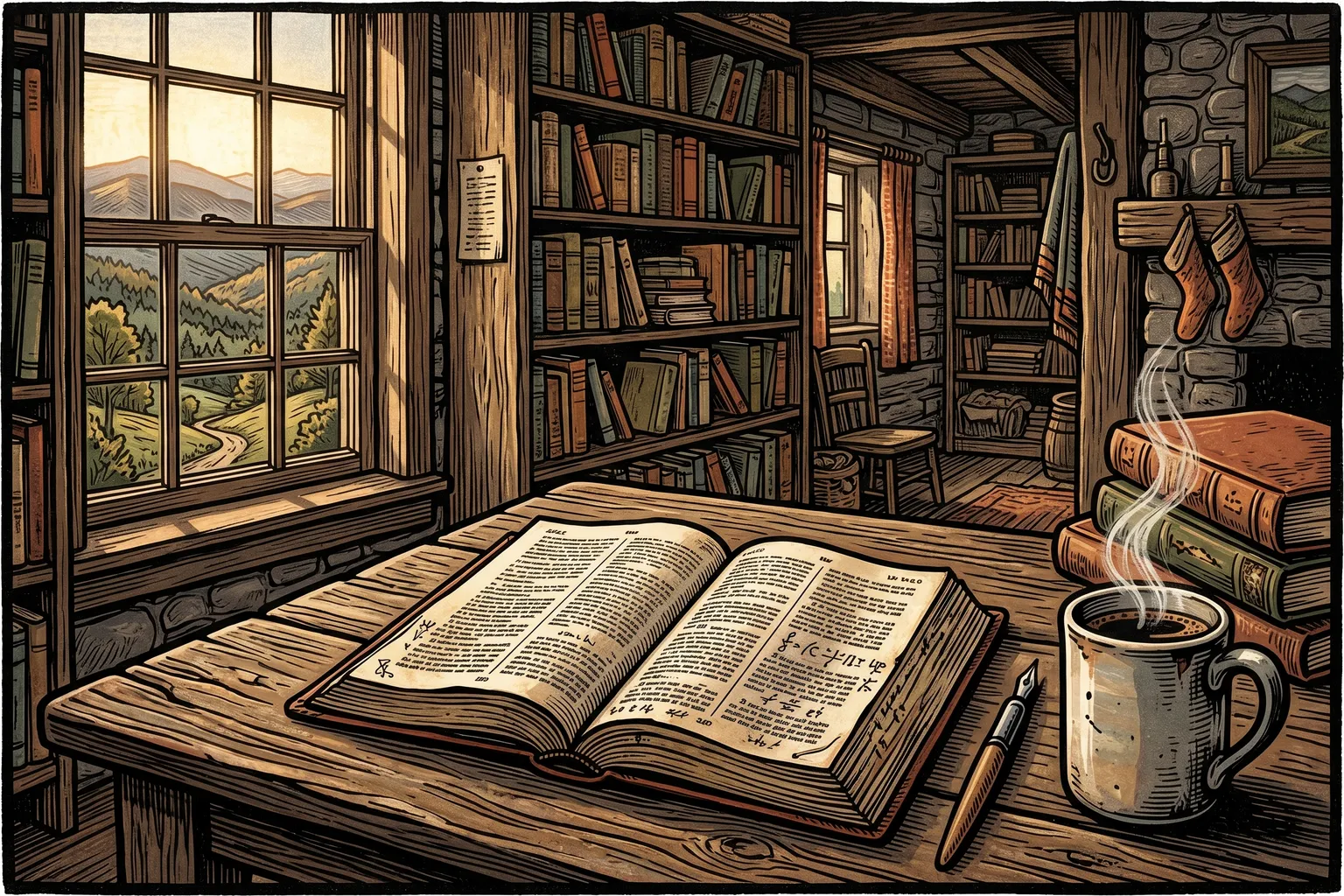
I’ve been reading the Bible since I was a seminary student in my mid-twenties, and I still come to it most mornings with a legal pad and a cup of coffee and the recognition that I don’t have this figured out. The text keeps opening. That’s the only thing I can promise you. Forty years in, it keeps opening.
Charlotte sent me a note two months after our first conversation. She said she’d finished the Psalms and started the Gospel of Mark and hadn’t slept past five o’clock in three weeks because she kept waking up thinking about what she’d read the night before. She said she wasn’t sure she believed in God. But she was starting to understand why Walter had.
That seems to me like exactly the right place to be.